Type “suno vs elevenlabs” into a search bar and you will get the same article a dozen times: a feature tour, a couple of generated clips, and a verdict that amounts to they’re both good, pick the one that sounds nicer to you. That is a fine answer if you’re making music for your own headphones on a Sunday. It is the wrong answer — dangerously wrong — if the track is going to earn money, carry a client’s brand, or land on Spotify under your name. Because the question that actually decides this matchup in 2026 isn’t which sounds better. It’s which output can you legally release, monetize, and keep — and the tool that wins that question is not the tool that wins the listening test.
Here is the short version, and it is the whole reason this page exists. Suno makes the better song: the most expressive English lead vocals in the category, the most finished one-shot results, a mature ecosystem, and a generative DAW that exports stems and MIDI. ElevenLabs Music v2 makes the more releasable song: it is trained only on licensed data, it carries no major-label lawsuit, and its commercial-use grant is built for the exact content most creators are actually making. Suno is the quality leader fighting a war in court. ElevenLabs is the rights leader that just got good enough to take seriously. The order in which you rank them flips the instant your money depends on the answer, and that inversion is the article.
How we approached this. Every spec, price, and licensing line below was re-verified against each vendor’s live product, docs, and terms this session — not older reviews, several of which are already stale on Suno’s post-settlement model lineup and on ElevenLabs’ v2 toolkit. We read the actual terms rather than restating marketing, we separated “the training was licensed” from “your release is covered,” and where a quality claim needs first-party audio measurement we haven’t finished, we say so instead of faking a chart. If you want the deeper single-tool picture, our Suno review and ElevenLabs Music review go further on each; this page is the head-to-head.
Suno to make it; ElevenLabs to clear it. If you want the best-sounding song and you’re a hobbyist, a producer chasing a vocal performance, or someone who finishes in a DAW with stems and MIDI — Suno, and accept the legal overhang. If you’re putting music behind a brand, a client, a YouTube channel, or an ad and you need a clean rights story — ElevenLabs Music v2. The one scenario neither tool cleanly wins is a pure Spotify single under your own name: Suno carries litigation and ownership risk, and ElevenLabs bars its Marketplace tracks from streaming entirely — so read our guide to releasing AI music before you commit either to a distributor.
The Verdict
A near-tie on the scoreboard that hides a decisive split: Suno wins the song, ElevenLabs wins the release. Pick by what your money depends on, not by which clip sounds nicer.
| Axis | Suno | ElevenLabs v2 |
|---|---|---|
| Vocal quality | 9.1 | 7.8 |
| Instrumental & fidelity | 8.6 | 8.4 |
| Control & editing | 8.3 | 7.6 |
| Release confidence | 6.0 | 8.2 |
| Value & pricing | 8.0 | 7.7 |
| Workflow & ecosystem | 8.5 | 7.4 |
| Overall | 8.1 | 7.8 |
Scores are calibrated to one decimal and defended in the sections below. The overall gap is deliberately small — the point is the Release confidence row, where the order inverts. Prices and legal status verified June 18 2026; the moving items (Suno’s July 2026 ruling, both vendors’ pricing) are flagged “verify live” in the text.
The Real Question: Can You Actually Release It?
Start here, because everything else is downstream of it. When you generate a track with an AI tool, there are two completely separate legal questions, and the marketing on both products blurs them on purpose. The first is was the model trained legally — did the company have the right to learn from the music it learned from? The second is is your output covered — can you legally use, distribute, and own the song that came out? A tool can pass the first test and still fail the second, and that gap is exactly where producers get hurt. Our deep dive on AI music licensing walks the full legal backbone; here we apply it to these two tools.
On the first question, the two are night and day. ElevenLabs trained only on licensed data. It built Eleven Music through deals with Merlin — the licensing body representing roughly 30,000 independent labels — plus the publisher Kobalt and SourceAudio’s catalog, and it has stated plainly that it does not use Universal, Warner, or Sony recordings. That is the cleanest training story in mainstream AI music, and it is the reason ElevenLabs faces no major-label copyright suit while its rivals are buried in them. Suno trained on copyrighted music and is arguing in court that doing so was fair use. Warner settled in November 2025 and is now a licensing partner, but Universal and Sony are still suing in federal court in Massachusetts, a summary-judgment hearing on Suno’s fair-use defense is scheduled for July 2026, and in May 2026 the labels moved to add more than 61,000 recordings to the case after audio-fingerprinting their catalogs inside Suno’s training data. None of that is settled, and how it resolves could reshape what AI music costs for everyone.
On the second question — is your output covered — neither tool gives you the clean answer the marketing implies, and the differences are subtle. ElevenLabs says self-serve output is “cleared for commercial use,” which is true for YouTube, podcasts, ads, social, and non-studio gaming. But its Music Marketplace licenses are explicit that distribution to Spotify, Apple Music, and SoundCloud is not permitted under any license, and that film, TV, and streaming VOD/OTT require an Enterprise agreement. Suno’s paid plans grant commercial-use rights, but post-settlement reporting indicates Suno now retains the underlying ownership of generated songs rather than handing it fully to the subscriber — so “you can use it commercially” is not the same promise as “you own the master.” And sitting underneath both is the hard ceiling that catches everyone: a purely AI-generated track may not be copyrightable at all. The U.S. Copyright Office requires meaningful human authorship, and a German court has already held that prompting a generator does not earn you a copyright in the result. You can read the full version of that question in can you copyright AI music, but the one-line takeaway is this: a paid AI license buys you the right to use a track; it does not automatically make the track yours.
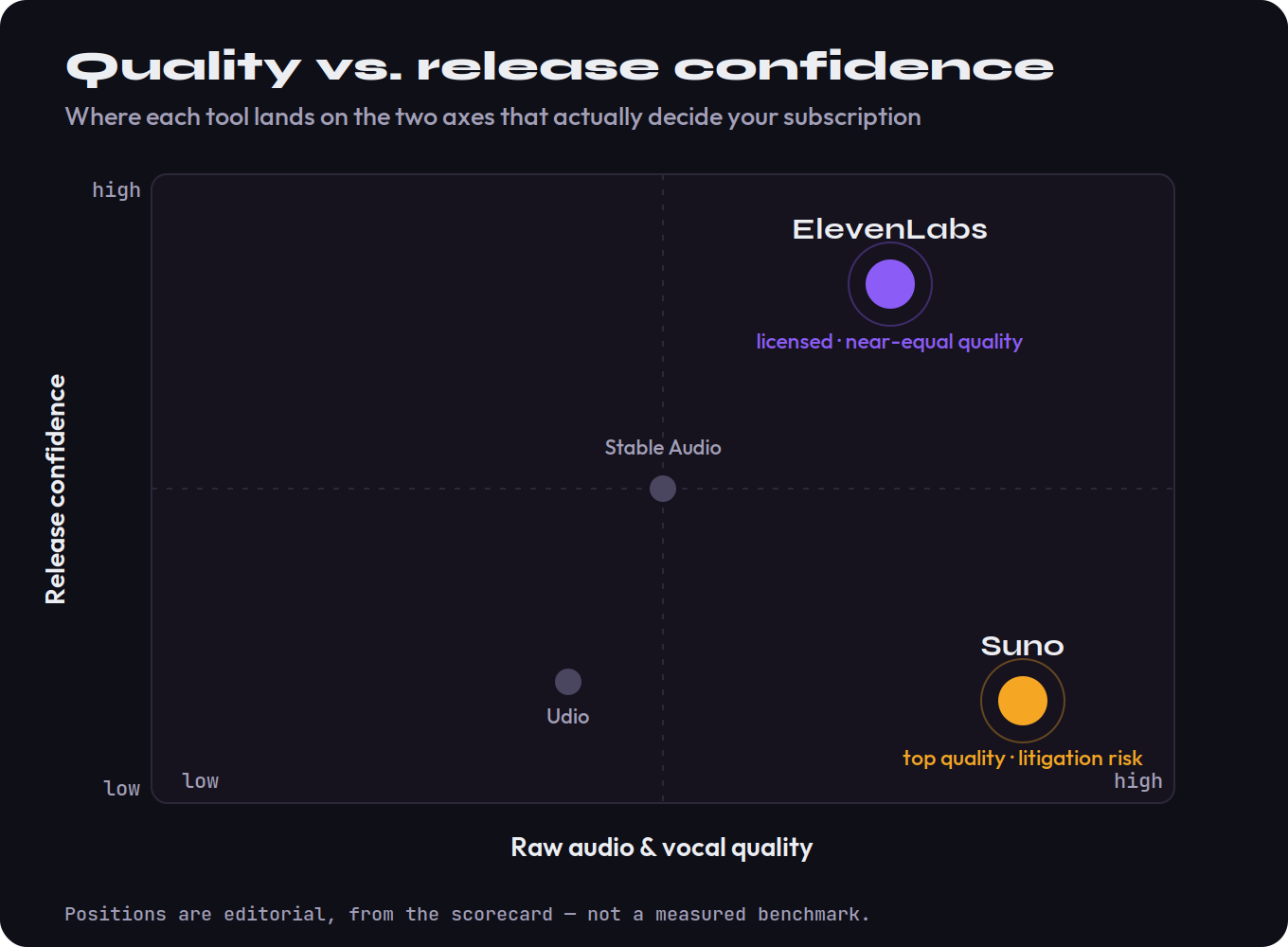
That is the frame for the rest of this comparison. We’ll score sound, control, licensing, and price honestly, but keep the quadrant above in mind: a producer optimizing for the top-left corner (best possible song) and a producer optimizing for the bottom-right (cleanest possible release) are looking at two different tools wearing the same category label.
Sound: Who Actually Sounds Better
Capability and quality aren’t the same thing, so here’s the honest picture from mechanism and consensus rather than a cherry-picked clip. Suno’s advantage is the lead vocal. Across independent listening and the community ELO leaderboards, Suno’s V5 generation produces the most expressive English singing in the category — the breath, the vibrato, the small dynamic shifts that sell a performance — and a single prompt tends to return a song that already sounds finished: arrangement, mix, and master in one shot. That is why Suno scores a 9.1 on vocals here and ElevenLabs a 7.8. If your project lives or dies on a believable hero vocal, Suno is the tool, and our Suno vs Udio comparison digs further into where Suno’s vocal edge holds and where it doesn’t.
ElevenLabs’ counter is twofold and genuinely strong. First, multilingual vocals: because the company spent years building the best text-to-speech in the business, Music v2 holds lyrics and pronunciation across dozens of languages where rivals smear into English-accented mush. For anything outside English, that alone can flip the pick. Second, fidelity is closer than the vocal gap suggests — instrumental quality lands 8.6 (Suno) to 8.4 (ElevenLabs), nearly a wash. Both top out at 44.1kHz, which is CD quality and the standard streaming delivery rate; the resolution ceiling matters mostly to producers who resample and time-stretch aggressively, and even then Udio’s 48kHz is the only mainstream tool that goes higher. The fairest summary, echoed across early v2 reviews, is that ElevenLabs doesn’t win AI music on peak vocal expressiveness; it wins on workflow and rights, and it has closed the musicality gap to the point where, for most uses, you would not bet money on telling the two apart in a blind test.
There is a quieter difference underneath the scores that matters more than either number: what you are actually handed. Suno’s one-shot song arrives pre-mixed and pre-mastered, which is a gift when you want a finished track in ninety seconds and a problem when you want to change one thing — the vocal is already glued to the bus compression and the reverb, so “turn the hi-hats down” isn’t a move you have. ElevenLabs leans the other way: a touch more raw, a touch more neutral, and easier to treat as a starting point you finish yourself. Neither is “better” in the abstract. If your output is the deliverable, Suno’s instant polish wins; if your output is the first draft of something you’ll mix, the flatter, more malleable bounce is the one you want on the timeline.
First-party measurement — in progress, stated honestly
Our edge is running output through the same BS.1770 loudness, true-peak, and spectral analysis we use on commercial masters, and checking whether separated stems actually match the source. That measured comparison isn’t finished, so we’re not going to print a chart — a fabricated graph is worse than none. We’ll swap in the measured data, including a head-to-head on the 44.1kHz question, when the test set is complete. Until then, treat the vocal and fidelity scores above as informed consensus, not a lab result.
One last point the star ratings flatten: what v2 actually changed. ElevenLabs’ upgrade is about coherence and control over length, not a leap in raw timbre. v2 holds a song’s identity across sections, sustains the dense fast vocal lines that tripped v1, and switches feel mid-track — opera to heavy metal and back — without the seams that used to give AI music away. So if you auditioned ElevenLabs last year and bounced off it, the thing most likely to have improved isn’t how a four-bar clip sounds in isolation — it’s whether a full three-minute song stays believable end to end. That’s the gap it just closed on Suno.
Control & the DAW Handoff
For a producer, “does it sound good” is only half the question. The other half is “can I take it apart and finish it in my DAW,” and the two tools answer it differently enough that this section alone decides the matchup for a lot of people. Suno’s editing story is the more complete one for someone who works in Logic or Ableton. On paid tiers it exports up to 12 vocal and instrument stems, and Suno Studio on the top tier is a genuine generative DAW — multitrack editing plus MIDI export, which means you can pull the chord progression or melody out as notes and rebuild it with your own instruments. For the producer who treats AI as a sketching tool and finishes by hand, that MIDI handoff is the single most important feature in this entire comparison, and it lands on Suno’s side. If you’re new to it, how to use Suno covers the workflow.
ElevenLabs answers control from the other direction — not export, but in-place editing. Music v2 ships inpainting (select any section and regenerate just that part — rework the bridge without touching the chorus), section-by-section composition (build a song from labelled parts, each with its own style, length, and lyrics), audio reference (steer with a track instead of adjectives), and Finetunes (bias the model toward a sound trained on your own cleared audio). That is a real toolkit, and it makes the tool behave like something you compose with rather than a slot machine you pull. But the handoff out is where it stops short of Suno: you get finished WAV and MP3 up to 44.1kHz, stems through a separate stem-separation step (which splits a finished track rather than handing you a guaranteed-clean multitrack), and no MIDI export anywhere. That’s the difference. Suno gives you the parts to rebuild; ElevenLabs gives you better control while you’re inside the tool but less to carry out of it. If MIDI is non-negotiable but you also care about rights, note that Mureka exports real MIDI too — a useful third option this two-way framing leaves out.
The handoff gap also changes how each tool behaves inside a revision cycle, which is where client work actually lives. With ElevenLabs you keep iterating in the browser: a client says “make the second verse darker,” you inpaint that section, and the rest of the track is untouched — fast, contained, no re-render of the whole song. With Suno you tend to commit earlier, pull stems and MIDI into your DAW, and from that point your revisions happen in Logic or Ableton rather than back in the generator. One favours staying in the tool and nudging; the other favours getting out fast and owning the arrangement. Match that to how you actually work before you match it to the score: a soloist sketching ideas and a studio turning around client notes on a deadline will not want the same answer here.
Net it out: control & editing scores 8.3 for Suno and 7.6 for ElevenLabs, and the 0.7 gap is entirely the DAW handoff. Inside the browser, ElevenLabs’ inpainting and section composition are arguably the more elegant editing experience. The moment your workflow is “generate raw material, then rebuild it with my own instruments,” Suno’s stems and MIDI win, and it isn’t close.
The Licensing Gap, Tool by Tool
This is the section that earns the page, because it’s where the two products diverge hardest and where the marketing and the contract say different things. We’ll take each tool’s real-world status in turn, then map every common use case to a verdict. None of this is legal advice — it’s general information, and for anything with real money on the line you should talk to a music attorney — but it’s the picture you need before you build a workflow on either tool.
Suno: Warner-settled, Sony-and-UMG-suing, ownership murky. The November 2025 Warner settlement was a real de-risking event — it turned a litigant into a licensing partner and pushed Suno toward models trained on licensed music. But it came with consequences you feel directly as a user: Suno retired its unlicensed models, the free tier lost the ability to download tracks entirely, and paid tiers gained monthly download caps (the exact numbers unpublished as of this writing). More importantly, Universal and Sony did not settle — they expanded. With a fair-use hearing looming in July 2026 and 61,000-plus recordings now in play, Suno’s legal exposure is live, and the post-settlement shift toward Suno retaining underlying ownership means even a paid subscriber’s claim to “their” song is softer than it was a year ago. For a deeper read on the rights side specifically, see can you copyright Suno AI music.
ElevenLabs: licensed, but walled. The training is clean and there’s no major-label suit, which is the headline. The catch is the fence around distribution. On self-serve plans, commercial use covers most online and offline content — but film, TV, and Studio Games are excluded and require Enterprise, and Marketplace tracks are barred from Spotify, Apple Music, and SoundCloud under any license. So ElevenLabs trades Suno’s litigation risk for a distribution ceiling: the rights are clean precisely because the company drew tight lines around where its output can go. That is a better problem to have for most commercial work — a known boundary beats an open lawsuit — but it is not “release anything anywhere,” and anyone who reads the marketing that way is in for a surprise at the distributor.
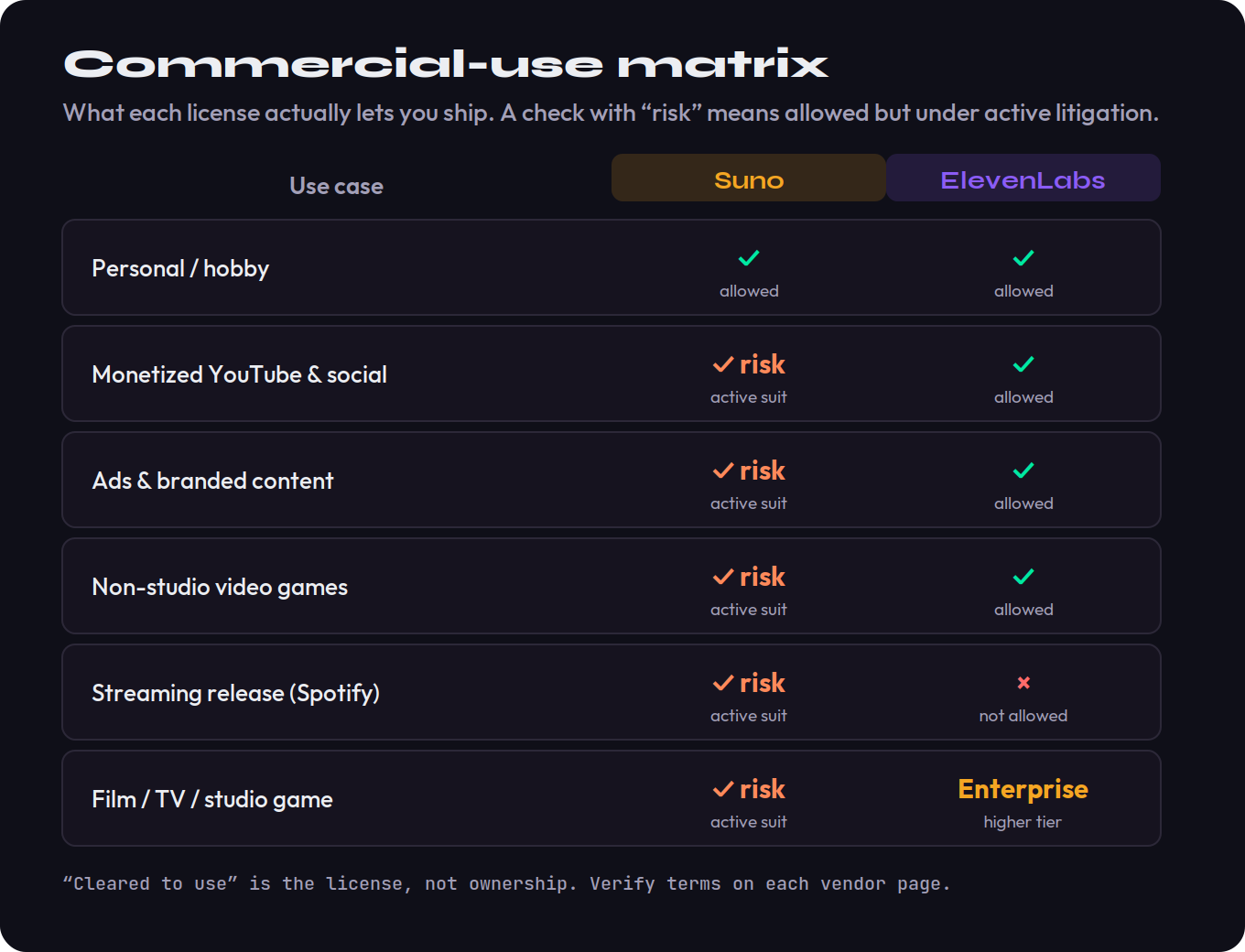
Read the matrix and the pattern is clear. For content — video beds, ad music, podcast intros, social — ElevenLabs is the cleaner choice because its grant is built for exactly those uses and a brand or client won’t inherit a lawsuit. For a streaming release, both tools have a problem: ElevenLabs effectively bars it on Marketplace licenses, and Suno permits it but hands you litigation and ownership uncertainty plus the copyrightability ceiling that affects all AI music. That’s why the next section resolves this by who you are, because the right answer genuinely changes person to person.
Which One for You? A Per-Persona Walkthrough
This is the paragraph the other “vs” pages never write, because it requires committing to an answer. Here are five real producers, and the honest pick for each — with the caveat that comes attached, because every one of these has a catch.
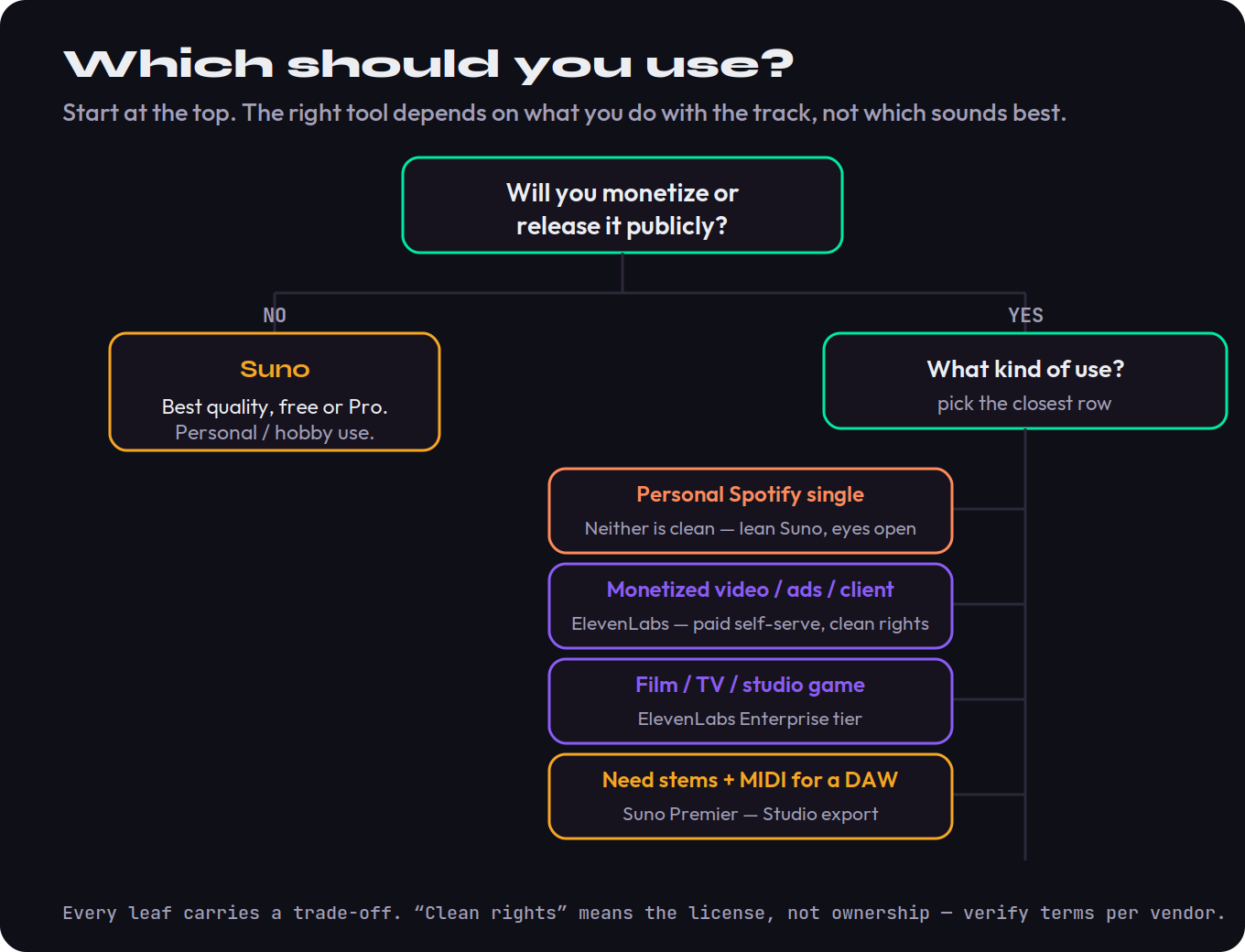
The hobbyist making music for fun. Pick Suno, free tier. You get the best-sounding output in the category at no cost, the V4.5 free model is plenty for personal listening, and the non-commercial restriction and the post-Warner download limits don’t matter if you’re not selling or distributing anything. The caveat: the free tier can no longer download tracks, so if you want a file to keep, that’s the nudge toward Pro. New to all of this? What is Suno AI is the gentle on-ramp.
The monetized YouTuber or podcaster. Pick ElevenLabs, Starter or Creator plan. This is the use case its self-serve license was built for — YouTube, podcasts, social, and ad beds are all explicitly covered, and the licensed-training story means a strike or a rights claim is far less likely than with a tool in active litigation. The caveat: if you also run an ElevenLabs voice subscription, you’re sharing one credit pool, so watch your usage. Suno would sound a touch better, but for monetized content the clean rights are worth more than the marginal vocal edge.
The indie artist releasing a Spotify single under their own name. This is the hard one, and honesty demands we not pretend it’s clean. Neither tool is a clear winner, and our release guide exists precisely for this case. ElevenLabs effectively bars streaming distribution on Marketplace licenses, so it’s out for a true DSP release unless you confirm your exact self-serve plan permits it. Suno permits commercial distribution on paid tiers, which makes it the technically available option — but you’re releasing the output of a tool in active litigation, with softened ownership, and a track that may not be copyrightable and that some distributors (CD Baby blocks fully AI music; see our DistroKid vs CD Baby breakdown) won’t even accept. The honest pick is Suno, with eyes open: verify the current terms, disclose AI use to your distributor, and treat the generation as raw material you finish substantially yourself so there’s a human-authorship story to stand on.
The agency producing a TV spot. Pick ElevenLabs Enterprise — and only Enterprise. Film, TV, and broadcast are carved out of ElevenLabs’ self-serve license and require the Enterprise tier with custom terms, which is exactly the contractual certainty an agency needs to hand a client. Suno is the wrong tool for this deliverable entirely: handing a brand a broadcast spot built on a tool being sued by two major labels is a liability you do not want to own. The caveat: Enterprise means a sales conversation and a custom quote, not a self-serve checkout.
The game studio or app developer needing exportable, editable music. Pick Suno, Premier tier — with one fork. If you need stems and MIDI to integrate adaptive music into a build, Suno’s 12-stem export and Suno Studio’s MIDI are decisive, and non-studio gaming is within commercial bounds. But if it’s a funded studio game (not an indie app), remember ElevenLabs puts Studio Games on Enterprise specifically because those placements are higher-stakes — so a large studio that wants clean rights should weigh ElevenLabs Enterprise against Suno’s exportability and decide which matters more for the title. For most indie developers, Suno’s export wins. For a AAA studio worried about rights, the Enterprise conversation is worth having on both sides.
Pricing: The Real Cost
Both tools price in ways that hide the real number, so here’s how to think about each. Suno is credit-based across three public tiers (verify on the live pricing page). Free gives 50 credits a day (about 10 songs) on the V4.5 model, non-commercial, and — since the Warner deal — no downloads. Pro is about $10/month (roughly $8 billed annually), with 2,500 monthly credits (around 500 songs), commercial-use rights, the V5/V5.5 models, advanced editing, and 12-stem export. Premier is about $30/month (roughly $24 annually) with 10,000 credits (around 2,000 songs) and Suno Studio. The thing to budget for isn’t the subscription — it’s the new download caps on paid tiers and the fact that subscription credits don’t roll over. For most working creators, Pro is the entry point and Premier only pays off at real volume or if you need the DAW.
ElevenLabs prices on its platform-wide subscription plans, and this is where the shared-credit lever changes the math (verify on the live pricing page). The Free tier is non-commercial. Starter (about $5–6/month) is the commercial-license entry point and the cheapest way to unlock music commercial use; Creator is about $22/month; Pro is about $99/month and is where higher-quality PCM/WAV downloads unlock. The key fact: ElevenLabs credits are shared across the whole platform — text-to-speech, voice, and music draw from the same pool. If you already pay ElevenLabs for voice work, music generation is effectively riding on credits you’re already buying, which can make it materially cheaper than its sticker price suggests. At the v2 launch, ElevenLabs also cut music pricing by up to 50% on the API and 40% on self-serve, so the numbers moved recently — confirm the live figures before you subscribe. If you want to model the downstream economics of a release, our guide to how music royalties work and the broader making money with AI music piece are the next reads.
Who Should Pick Which
Strip away the scores and it comes down to a single question: does your money depend on the rights, or on the sound? If it depends on the sound — you want the best vocal, the most finished song, stems and MIDI to finish by hand, and you can live with the legal overhang — Suno is your tool, and it’s the better one at being an AI music generator. If it depends on the rights — you’re putting music behind a brand, a client, or a channel and a clean licensing story is non-negotiable — ElevenLabs Music v2 is your tool, even though it sounds a hair behind, because a known boundary beats an open lawsuit. The 0.3-point overall gap is real but almost beside the point; the Release-Confidence row is the one that should decide it, and it points the opposite direction from the quality rows.
And the honest meta-answer: try both free tiers on the same prompt before you pay either. Generate your actual use case — your genre, your language, your length — in both, listen on real monitors, and then let the licensing reality break the tie. For the full field beyond these two, including Udio, Mureka, and Google’s Lyria, our best AI music generators of 2026 roundup ranks everything by use case, and the complete AI music tools guide maps where each fits a real workflow. The tools will keep leapfrogging each other on quality; the thing that’ll still matter in a year is which output you can actually keep.
Practical Exercises
- Write one detailed prompt for a track you’d actually use — specify genre, tempo, mood, language, and a rough structure (intro / verse / chorus).
- Generate it on Suno’s free tier and on ElevenLabs’ free ElevenMusic app. Keep everything else identical.
- Listen on monitors or decent headphones, not laptop speakers. Note which nails the lead vocal and which holds the arrangement together over the full length.
- Write one sentence on which sounds better for your use — then set it aside, because the next exercises decide whether you can use it.
- Write down exactly where your track will live: personal listening, monetized YouTube, a client ad, a Spotify release, a game build, or a TV spot.
- For ElevenLabs, open the live Music Terms and confirm whether your use is covered on self-serve or requires Enterprise — and whether streaming distribution is barred for your case.
- For Suno, confirm your tier grants commercial rights for songs made while subscribed, and note the download cap and the ownership language.
- If your use is a streaming release, flag it: neither tool is clean here, and you’ll need the human-authorship and disclosure steps from our release guide.
- On Suno (paid), export stems and MIDI for a track and rebuild one section with your own instruments — confirm the MIDI actually lands usefully in your DAW.
- On ElevenLabs, run the stem-separation step on a finished track and check whether the separated stems are clean enough to mix, or whether bleed makes them unusable.
- Document the ownership chain for each: who owns the master, what the license actually permits, and whether the output has enough human authorship to register.
- Decide your default tool by writing the one sentence that resolves it: “For my work, ___ wins because ___, and I accept the trade-off that ___.”