Type “best AI music generator 2026” into a search bar and you get a wall of near-identical lists. They all rank the same way — how good it sounds, what it costs, which genres it nails — and they all crown the same one or two winners. That ranking was fine in 2024. In 2026 it quietly skips the two questions that actually decide whether a producer can use the result: can you legally release what you make, and can you get it out of the platform and into your DAW? A tool can sound incredible and still be useless to you if its best track is trapped behind a walled garden, or if a label’s lawyers can come for it after you press release. So this roundup scores the usual quality and price — and then adds two columns nobody else publishes: Release Confidence and DAW export. That is the difference between a list that tells you what sounds good and one that tells you what you can actually ship.
| Best overall | Suno. The most complete engine, the best vocals, and — the part that decides it — one of the few top-tier tools you can still download and release today. The catch is the live lawsuit over its training data. |
| Best for release-safety | ElevenLabs Music. Built on licensed data (Merlin and Kobalt), cleared for broad commercial use, and the only major name here that was never sued. Thinner toolset, but the cleanest rights story in the category. |
| Best for DAW workflow | Stable Audio. Exports WAV, MP3 and MIDI, trained on a fully licensed dataset with indemnification on the enterprise tier. Leans toward sound design and beds rather than vocal songs. |
| Best for cinematic / score | AIVA. Orchestral and cinematic cues you can export as editable MIDI, with full copyright ownership on its Pro plan. Instrumental only — no vocals. |
| Best for developers / API | Google Lyria 3 Pro. Structure-aware generation across Google’s ecosystem and a real API, watermarked with SynthID. Locked inside that ecosystem and not litigation-free. |
| The honest caveat | Udio arguably has the best raw fidelity in the field — but it is now a walled garden you cannot export from, so it can’t be a “best” pick for anyone who needs to release music today. Best raw sound, worst release story. |
Read this before you pay: none of these tools is “safe” in the bulletproof sense. A platform’s commercial license is step one, not a shield — if an output is later proven substantially similar to a protected recording, you carry that risk, not the vendor. Prices and legal status all move; verify both on each vendor’s live page before you subscribe.
This article may contain affiliate links. If you subscribe through one we may earn a commission at no extra cost to you. It does not change the ranking — the scores below are built the same whether you click or not, and an affiliate relationship never tilts the scorecard.
The 2026 Inflection: “Best” Now Means “Releasable”
For two years the AI music question was an audio question. You compared Suno and Udio on sound, picked one, and moved on. What changed in 2026 is that the music industry stopped fighting AI music and started licensing it — and the moment money and contracts entered the picture, the tools stopped being interchangeable. The same lawsuit the major labels filed against Suno and Udio in mid-2024 has since fractured into settlements, walled gardens, and one company still fighting in open court, and every one of those outcomes lands on you, the person trying to release a track.
The field also widened. It is no longer a two-horse race. Google shipped Lyria 3 Pro in March 2026, bringing structure-aware, three-minute generation to its entire ecosystem and a developer API. ElevenLabs — the voice-AI company — entered music in 2025 with a deliberately licensed model and, by March 2026, a marketplace built on top of it. Stability AI’s Stable Audio matured into a licensed, export-friendly sound-design engine. AIVA kept quietly owning cinematic and orchestral work. The result is six serious tools with genuinely different answers to “can I release this,” not two tools that mostly differ on taste.
Scale is why this matters rather than being a hobbyist footnote. Suno alone reported more than two million paying subscribers and a roughly $300 million annual revenue run rate in early 2026, and in June 2026 it raised $400 million at a $5.4 billion valuation — while two of the three major labels are actively suing it. Distributors and streaming services have noticed: Deezer has reported that a large and growing share of daily uploads are AI-generated, and Spotify has tightened enforcement around AI-driven streaming fraud and undisclosed AI uploads. Whether you can prove your commercial rights is becoming part of the release process, not an afterthought — which is exactly why a roundup that treats licensing as a one-line caveat is doing you a disservice.
It also helps to know how big this has become, because it explains why the legal fights are so fierce. The generative-music market was worth roughly $570 million in 2024 and is projected to pass $2.8 billion by 2030 — the kind of growth that turns a copyright skirmish into an existential negotiation for both sides. For the labels, a licensed AI platform converts an existential threat into a new revenue line and a way to control how their artists’ work trains these models; for the AI companies, a license is the price of certainty. That tension is why two majors took the settlement-and-walled-garden road, one major (Warner) settled but kept things looser with Suno, and Sony alone is still betting on a courtroom precedent. You are choosing a tool in the middle of an industry rewriting its own rules in real time, which is exactly why the “can I release this” question deserves a column of its own rather than a footnote.
How We Ranked: The Two Axes Every Other List Skips
Most lists score three things — sound quality, price, genre range — and stop. We score those too, drawing quality from the consensus of recent hands-on coverage rather than a first-party bench test, and labelling it honestly as such. But the two axes that decide whether the result is usable are the ones the listicles leave out, so we made them first-class, scored columns.
The first is Release Confidence — our composite measure, built from four sub-scores: the clarity of the training-data provenance, what commercial rights the paid tier actually grants you, the live litigation exposure attached to the platform (inverted, so safer scores higher), and whether the output can physically leave the platform for release. No other generator roundup publishes a number like this, because rights is a lens MPW owns and most music blogs treat as a disclaimer. The second is DAW export: stems, MIDI, downloadable files, and whether the platform is open or a walled garden. For anyone finishing a track properly — which is to say, anyone serious — a tool you cannot export from is a tool you cannot use, no matter how good the raw generation sounds.
A worked example makes the composite concrete. Take ElevenLabs, our top scorer at 9.0: licensing clarity is high because the model was trained on data licensed from Merlin and Kobalt before launch; the commercial-rights grant is strong because outputs are cleared for broad commercial use; litigation exposure is near-zero because no major label has sued; and export portability is the one soft spot, because its toolset is MP3-centric rather than stems-and-MIDI. Now contrast Udio at 3.8: its licensing is actually clean — it settled and trained on authorized catalog — and its litigation exposure to the labels it settled with is low, but its export portability collapses to almost nothing because the walled garden prevents you from getting a finished file out. Same four ingredients, opposite results, and a final number you can act on rather than a vibe. That is what a scored rights axis buys you that a one-line caveat never could.
Two ground rules keep this honest. Pricing changes constantly across all six, so every figure here is the current published number with a “verify on the live page” expectation baked in. And legal status is reported, never our verdict — we tell you who is suing whom and what each platform’s terms say, and we leave the prediction to you. The scores below are deliberately spread; honest gaps are more useful than tidy round numbers, and each decimal is defended in prose.
The Map: Quality and Releasability Are Not the Same Thing
Here is the entire argument of this guide in one picture. Plot each tool by Release Confidence on the horizontal axis and raw output quality on the vertical, and the two best-sounding engines in the category — Suno and Udio — do not sit in the safe corner. Udio, in particular, lands high on quality and low on release-ability: the best raw fidelity in the field, trapped behind a wall you can’t export through. The license-clean tools cluster to the right. If you only read the quality axis, you pick Udio or Suno; if you read both axes, the picture changes completely.
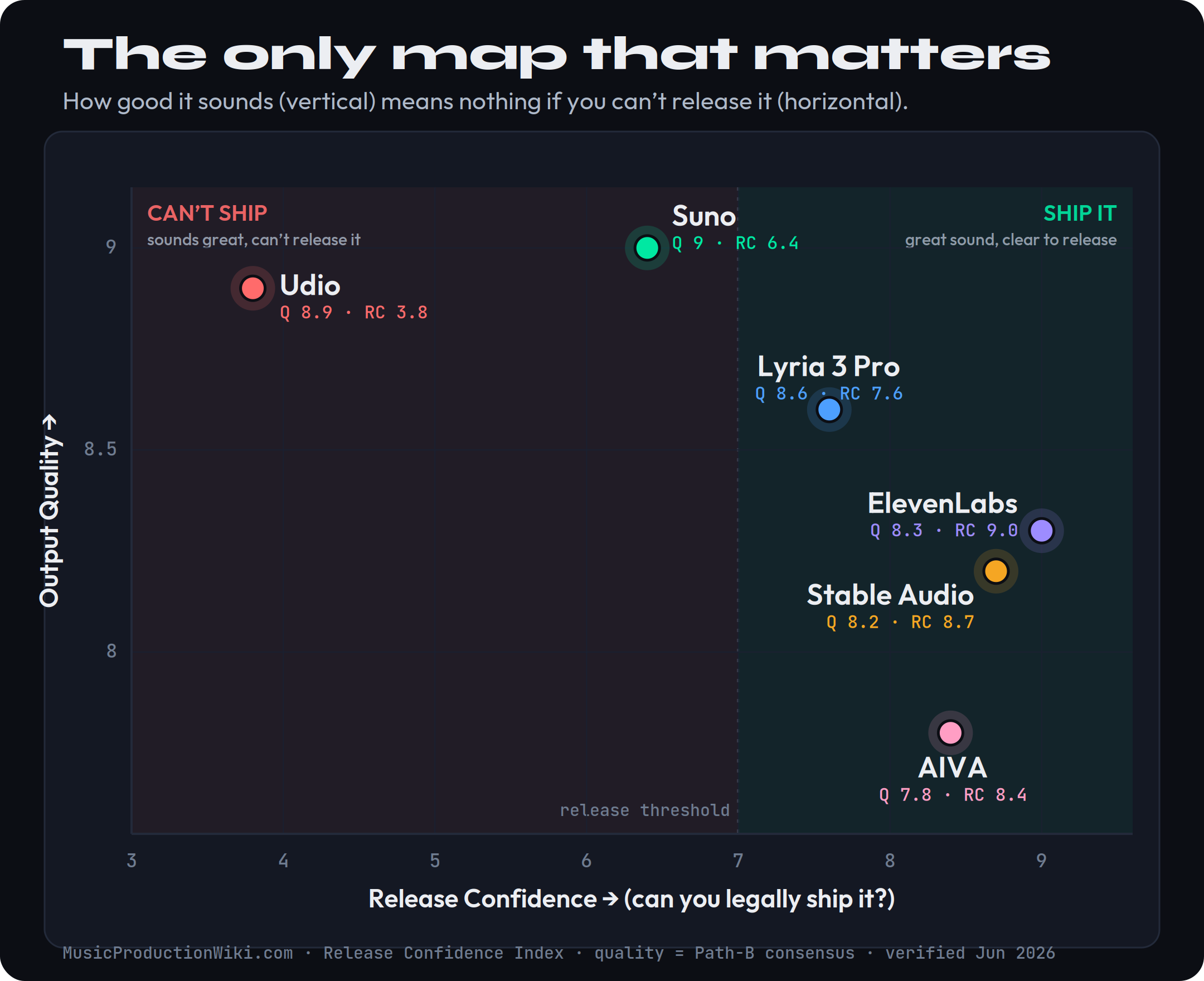
The whole thesis in one image — the best-sounding tools are not the safest to release, and the safest to release cluster on the right. Quality is consensus of mid-2026 coverage; Release Confidence is the MPW composite, defended below.
This is why the rest of the guide is organised around jobs, not a single trophy. Suno is the best overall default because it pairs near-top quality with the ability to actually ship. But if release-safety is your priority, ElevenLabs wins outright despite a lower quality score, and if your workflow is DAW-first, Stable Audio’s export story beats both. The map is the map; the picks are about which corner of it your work lives in.
The Field Scorecard
All six tools, scored on what actually decides the choice in 2026. Quality reflects the consensus of recent hands-on coverage, not a first-party measurement; Release Confidence is our composite; the rest are drawn from each vendor’s current documentation and terms. Decimals are spread on purpose and defended in the sections that follow. The overalls are close at the top, as they should be — but they are not a tie, and the order is not the order a sound-only list would give you.
| Suno | 9.0 | 6.4 | 8.5 | 8.5 | Best vocals and tooling; still downloadable and releasable. Dragged by a live UMG/Sony suit and the “rights only if you paid at generation” trap. |
| ElevenLabs Music | 8.3 | 9.0 | 6.5 | 8.2 | License-clean and cleared for broad commercial use; never sued. Thinner edit toolset, MP3-centric export, commercial-library restriction. |
| Google Lyria 3 Pro | 8.6 | 7.6 | 5.5 | 8.0 | Structure-aware, strong audio, real API. Licensed but contested (a YouTube-training suit), and locked inside Google’s ecosystem. |
| Stable Audio | 8.2 | 8.7 | 9.0 | 7.9 | Fully licensed, WAV/MP3/MIDI export, indemnified on enterprise. Sound-design lean — not a vocal-song machine. |
| AIVA | 7.8 | 8.4 | 8.5 | 7.6 | Cinematic cues with editable MIDI and full copyright on Pro. Instrumental only; no indemnification. |
| Udio | 8.9 | 3.8 | 3.0 | 7.4 | Best raw fidelity, deepest stem and inpainting control — now a walled garden you cannot export from. Cleaner training, unreleasable output. |
The Overall column blends quality, Release Confidence and export, and it deliberately weights releasability — which is why the order isn’t the order a sound-only list would give you. Suno tops it by pairing near-best quality with the ability to actually ship. Udio sits at the bottom despite the best raw fidelity in the field, because an 8.9-quality engine you cannot export from is, for a working musician, worth less than a 7.8 you can release. That inversion is the whole point of scoring release-ability at all.
A note on those Release Confidence numbers, because they carry the argument: Udio scores a 3.8 not because its training is dirty — it settled and is arguably the cleaner of the two originals on provenance — but because you currently cannot get a finished file out of it to release. Suno scores a 6.4 despite an active lawsuit precisely because the opposite is true: you can still export and release, which for a working musician outweighs a legal cloud that may resolve through settlement. ElevenLabs tops the column at 9.0 because it is the rare tool where the rights were cleared before the model shipped. The full composition of each score is in the legal-status section below.
Suno: The Default You Can Still Release
Suno is the platform most people mean when they say “AI music,” and the numbers explain why: over 100 million users, more than two million paying subscribers, and a fresh $400 million round at a $5.4 billion valuation in June 2026. Its current generation — the v5.5-series model — is the first that consistently fools casual listeners on vocals, with phrasing, vibrato and emotional dynamics that read as sung rather than synthesized. You type a description or paste lyrics with structure tags, and under a minute later you have a finished, mixed song. For most people choosing one tool, this is the right default.
What it’s best at: vocal-led songs — pop, country, rock, R&B — plus the most complete end-to-end creator toolkit, including Personas, custom-trained voices, and on its top tier the in-browser Suno Studio for stem-level editing. Release-ability: this is Suno’s real edge over Udio in 2026 — paid users still download finished files and release them commercially. DAW export: stem splitting on the Pro tier; Suno Studio adds multitrack editing, stem regeneration and MIDI export on Premier, though power users describe the current Studio build as ambitious and rough rather than a finished DAW. Price: Free (about 50 credits a day, non-commercial, sometimes an older model); Pro at roughly $8/month on annual billing (about $10 monthly) with around 2,500 credits and commercial rights; Premier at about $24/month annual (about $30 monthly) with around 10,000 credits and Suno Studio. The catch: two of them, actually. The commercial right attaches only if you were a paying subscriber at the moment you generated the track — upgrading after a free song takes off does not grant retroactive rights — and Suno is still being sued by Universal and Sony, who in May 2026 moved to expand the case to more than 61,000 works, with a fair-use hearing set for July 2026. Suno also draws recurring complaints about billing and a post-update vocal regression. Pair it with our Suno Prompt Optimizer to get more out of each generation, and read our full Suno review before you commit a year.
Udio: The Trapped Craftsman
Udio was built by former Google DeepMind researchers and earned its reputation on raw audio fidelity — output listeners routinely describe as hard to tell apart from a real recording — plus production-grade controls: strong stem separation, audio inpainting that regenerates a slice of a track in place, and audio-to-audio remixing. On sound alone, it is arguably the best engine in this roundup. That is exactly what makes its 2026 situation a tragedy for producers.
What it’s best at: instrumental realism, texture, and the granular control a producer wants when chopping samples or finishing in a DAW. Release-ability: this is where it falls apart. After settling with Universal in October 2025 and Warner in November — followed by deals with the indie coalition Merlin and the publisher Kobalt — Udio moved toward a “walled garden.” On its current service, AI outputs cannot be downloaded or posted to external platforms; you can create and listen inside Udio, but you cannot export a finished track to Spotify, YouTube or your DAW. The company offered only brief grace windows for existing files and is building a new licensed, opt-in platform for 2026. DAW export: effectively restricted right now — the stem and inpainting controls that justified its Pro tier are most valuable precisely when you can pull the result out, which is the step Udio has closed. Price: in transition; a free tier plus paid plans historically around $10 and $30/month, but verify the current state on Udio’s help center before paying, because the export terms matter more than the price. The catch: Sony is still litigating against Udio separately, and the entire value proposition now hinges on whether — and when — the new platform restores meaningful export. Until it does, Udio is a remarkable instrument you cannot ship from. Our Udio review tracks the export status as it changes.
ElevenLabs Music: The License-Clean One
ElevenLabs — best known for voice AI — entered music in August 2025 with the opposite strategy to Suno and Udio: it licensed first and litigated never. Eleven Music launched on a model trained on licensed production music, backed by deals with Merlin (representing roughly 30,000 independent labels) and the publisher Kobalt, with a notable 50/50 parity split between compositions and recordings. By March 2026 it had added a Music Marketplace as a commercial layer on top. In a category defined by lawsuits, that consent-first architecture is the whole story.
What it’s best at: license-clean, commercially usable tracks for film, TV, games, ads, podcasts and creator content — the “I need music I can drop into client work without a legal headache” job. Release-ability: the best in this roundup. Outputs are cleared for broad commercial use, with sensible restrictions spelled out in the terms (you can’t use it to build a rival commercial music library, and certain sectors — arms, tobacco, pharma, adult, religious, political — are off-limits). Because the training data was licensed, there is no major-label suit hanging over what you make. DAW export: thinner than the rest — generation, remixing and lyric tools rather than deep stem separation or inpainting, with MP3-centric output and an API billed around $0.50 per minute of generated audio. Price: bundled into ElevenLabs’ plans; the free tier carries no commercial rights and requires attribution, so commercial use starts at the Starter plan (about $5/month); the consumer music experience offers a handful of free songs daily or several hundred a month on Pro. The catch: the toolset is the least producer-deep here, and the platform is still maturing as a music-first product rather than a voice product with music attached. Our standalone Eleven Music review is in the works; until then, treat it as the rights-safe choice with a lighter creative ceiling.
Google Lyria 3 Pro: The Infrastructure Play
Google’s Lyria 3 Pro, launched March 25, 2026, is the first AI music model in this group that genuinely understands song structure — you can prompt for an intro, verse, chorus and bridge and it builds the arc, up to three minutes at 48 kHz. It even auto-generates cover art and watermarks every output with SynthID. But the more important thing about Lyria is where it lives: not a standalone app so much as a capability spread across the Gemini app, Google Vids, ProducerAI, Vertex AI, the Gemini API and AI Studio. Google is treating AI music as infrastructure.
What it’s best at: structure-aware composition, strong and spatially “full” audio quality that some experienced engineers rate above Suno and Udio, and — uniquely here — programmatic generation through a real API for developers building music into their own products. Release-ability: commercial use is allowed for paid subscribers, the training data is partner-licensed plus content Google says it has the right to use, and SynthID provides provenance. But “licensed” is not “uncontested”: a group of independent artists sued Google in early March 2026 over its YouTube training data, so the legal picture is cleaner than Suno’s but not spotless. DAW export: weak for traditional production — there is no stem or MIDI export pipeline into a DAW; you download finished tracks from the Gemini ecosystem. Price: no free tier for the Pro model — it rides on paid Google AI subscriptions (AI Plus, Pro and Ultra, with daily track limits) or enterprise access via Vertex AI and the API. The catch: the experience is best if you already live in Google’s ecosystem or are building on its API; as a standalone creative tool for a producer who wants stems in Ableton, it is the wrong shape.
Stable Audio: The Sound-Design Engine
Stability AI’s Stable Audio took the route the brands and studios wanted: a fully licensed dataset, fast generation, and real export. Stable Audio 2.5 (September 2025) was pitched explicitly as the first enterprise-grade audio model — three-minute tracks generated in seconds, structured intros, developments and outros, plus audio inpainting and audio-to-audio. By mid-2026 Stable Audio 3.0 had arrived with open-weights variants, longer six-minute generation and, crucially, legal indemnification under the enterprise license. For a producer, the headline is that it behaves like a tool, not a toy.
What it’s best at: sound design, brand audio, beds, stingers, ambient and textural material — the functional and instrumental end of the spectrum rather than vocal-forward songs. Release-ability: strong — the dataset is fully licensed, complete commercial licensing is included, and the enterprise tier adds indemnification, the only tool here to do so explicitly. Note the Community License nuance: free commercial use applies under roughly $1 million in annual revenue, with an enterprise license required above that. DAW export: the best in the roundup — 44.1 kHz output downloadable as WAV, MP3 and MIDI, with stem separation and MIDI editing on the premium tier. This is the tool that most respects your DAW. Price: a free tier with limited credits, paid subscriptions for creators, and API or enterprise licensing through Stability and partners like fal, Replicate and ComfyUI. The catch: do not hire it to write a radio single with a believable lead vocal — that is not what it is for. As a licensed, exportable engine for the sounds around the song, though, it is excellent.
AIVA: The Cinematic Composer
AIVA has been doing one thing well for years: emotional, cinematic, orchestral composition. It is the world’s first AI registered as a composer with a rights society (SACEM), and it trained largely on a public-domain-heavy corpus of classical scores — which, almost incidentally, gives it one of the cleaner provenance stories in the field. It is not trying to be Suno. It is trying to be the score under your game, film or documentary, and it gives you that score as something you can actually edit.
What it’s best at: cinematic and orchestral cues, ambient underscore, and composition you can take apart — ideal for film and game composers who want a starting structure to develop in a DAW. Release-ability: high on the right plan. On the Pro tier you own the full copyright of your compositions outright, with no attribution; the Standard tier grants a limited commercial license (monetize on YouTube, Twitch, TikTok and Instagram) but AIVA retains the copyright; the free tier is non-commercial. The public-domain-leaning training means low practical infringement risk. DAW export: strong and producer-friendly — orchestrated MIDI, reduced MIDI and WAV, with MIDI export now on all paid plans as of a mid-2026 update. That MIDI-first workflow is exactly what a composer wants. Price: Free (a few non-commercial downloads a month); Standard around €15/month; Pro around €49/month for full copyright and the highest download limits, with student and education discounts available. The catch: it is instrumental only — no vocals, no lyrics — and like most tools here it offers no indemnification, so the terms put infringement responsibility on you. For its lane, though, nothing else in this group matches it.
The Legal-Status Matrix: Our Moat, Visualized
This is the section the vendor blogs leave out and the one most likely to affect whether you can release your music. The same lawsuit — the major labels suing Suno and Udio in June 2024 for training on copyrighted recordings — has fractured into four very different realities, and a fifth and sixth tool that sidestepped the fight entirely by licensing first. The matrix below is the honest, reported state of play in mid-2026; it is not a prediction.
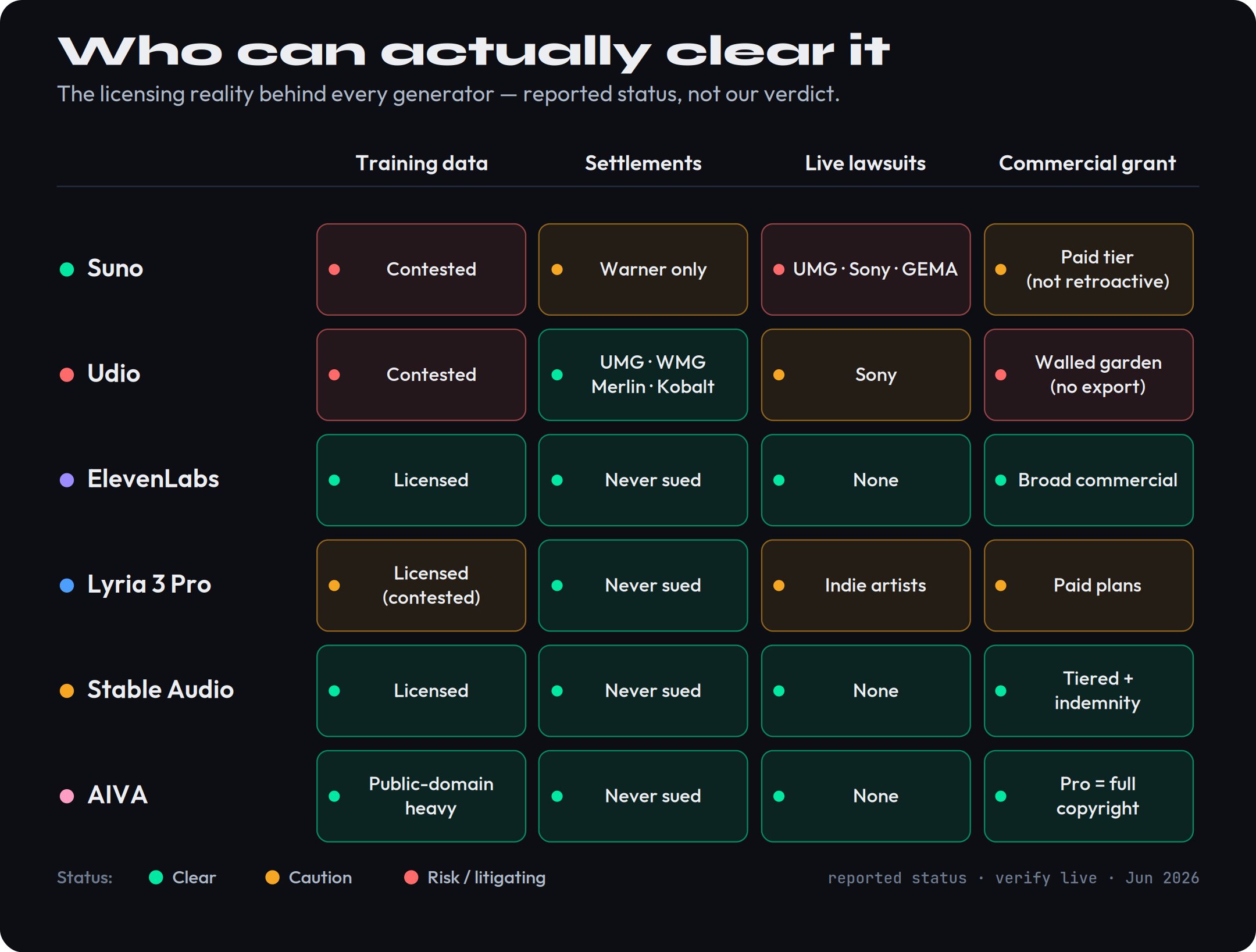
Same starting lawsuit, six different outcomes — reported status as of mid-2026, not our verdict. Verify the live dockets before betting a release on any cell.
A few moving parts are worth watching because they can flip a row. Sony is the last major label still in court against both Suno and Udio, and a fair-use summary-judgment hearing in the Suno case is scheduled for July 2026 — a ruling that could ripple across every generative-AI company, not just music. The labels’ May 2026 move to expand the Suno case to more than 61,000 works dramatically raised the potential damages. A separate case in Germany (GEMA v. Suno) opens a European front, with a ruling expected during 2026. And Google’s “licensed” position is itself being tested by an independent-artist suit over YouTube training data. None of this should scare you off the tools — millions release AI-assisted music every month — but it should make you deliberate about which platform you build a release on.
Underneath the matrix sits the number we publish that nobody else does. Our Release Confidence Index combines four sub-scores — licensing clarity, the commercial-rights grant, litigation exposure (inverted), and export portability — into a single defended decimal. The breakdown below shows how each tool earns its composite, and it makes the central irony legible: the tool with the cleanest training (Udio) scores near the bottom because its output can’t leave, while the tool with a live lawsuit (Suno) scores in the middle because you can still ship.
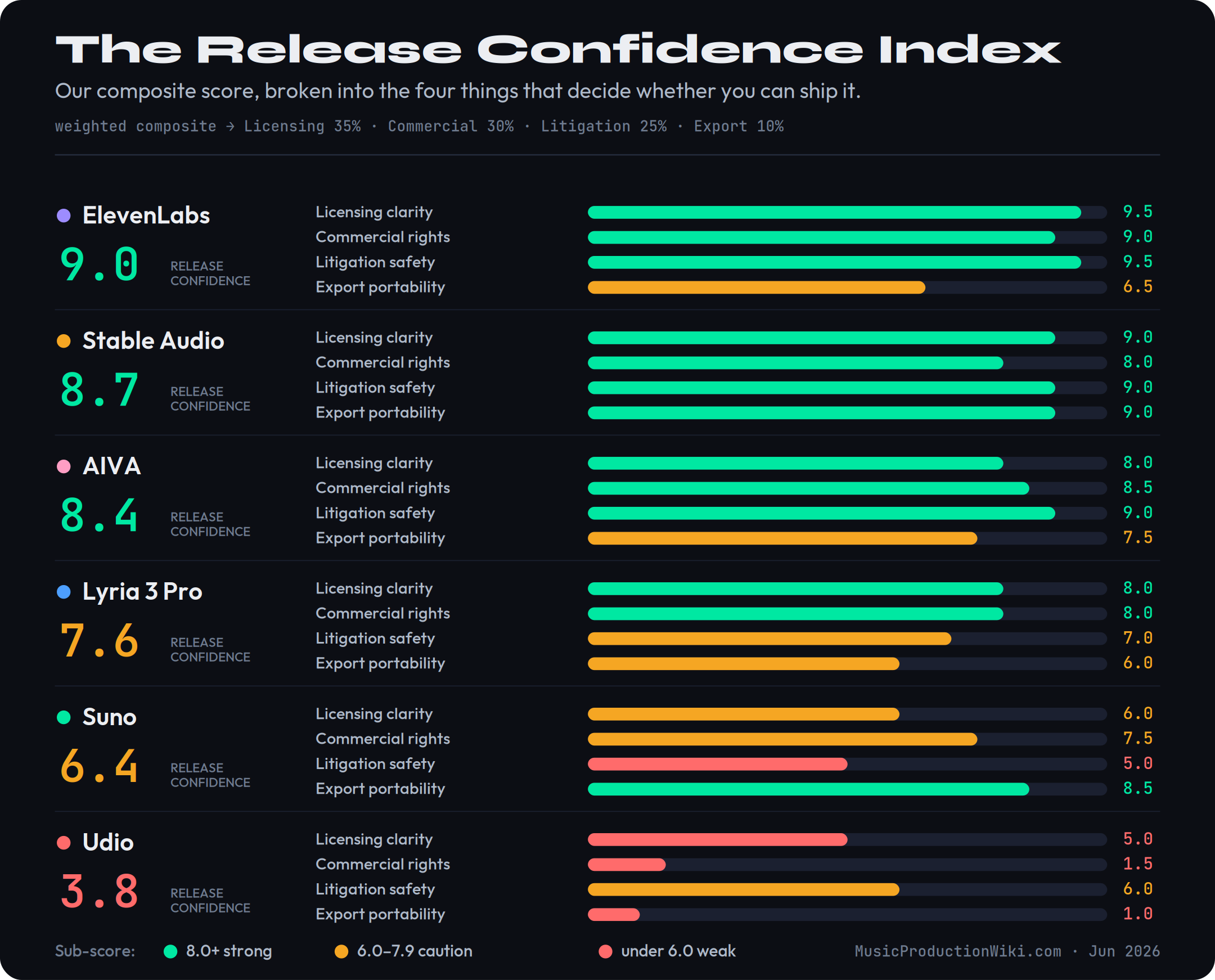
The MPW Release Confidence Index — four sub-scores per tool, combined into the composite used on the map. The cleanest training doesn’t win if the output can’t leave.
If you want to pressure-test a specific track’s exposure rather than a platform’s, our AI Music Rights Navigator walks you through the questions that decide whether a particular release is safe, and our guide to copyrighting AI music covers what the US Copyright Office currently does and doesn’t protect.
It’s worth understanding what a ruling either way would actually mean, because the cases that remain unsettled could reshape these products. If a US court finds that training on copyrighted recordings without a license is not fair use, the pressure on Suno to settle on the labels’ terms — and to wall its own garden the way Udio did — would intensify, and the freedom that makes Suno attractive today could narrow. If the fair-use defence prevails, the balance tilts back toward looser terms and open export across the field. The German GEMA case opens a parallel European front that could diverge from the US outcome entirely. The honest summary in mid-2026 is that the rules are still being written, so the smart move is to keep your options — and your local files — open, prefer paid tiers for the commercial grant, and avoid betting a release on any track that obviously imitates a specific famous record.
The Free-Tier Trap Nobody Warns You About
Here is the single most expensive misunderstanding in AI music, and it is worth its own section because every listicle buries it. On several of these platforms — Suno most prominently — the commercial right attaches only to tracks you generate while paying. It is not retroactive. If you make a song on the free tier, it blows up, and you then upgrade hoping to license it, you are out of luck: the rights had to exist at the moment of generation. The free version is for learning the tool and deciding which platform fits your music, full stop. The instant you make something you might ever release, you should already be on a paid plan.
The trap has cousins across the field. Free tiers are usually non-commercial by default and sometimes serve an older, weaker model, so a free first impression can undersell what the paid version does. AIVA’s free and Standard tiers don’t convey full copyright — only Pro does. ElevenLabs’ free tier requires attribution and grants no commercial rights. And on every platform, credits are spent on every roll, extend, remix and stem operation whether you keep the result or not, and free credits typically expire rather than roll over. The practical rule is simple: pick your platform on free, then generate anything releasable on paid from the first second, and keep your own records of when and how each track was made.
Don’t Be Fooled by the Name
The AI music aisle is full of labels that imply more than they deliver, and a roundup that just repeats vendor framing does you no favours. A few distinctions that separate what these tools are from what they’re called:
“AI music generator” is three different products. Suno, Udio, ElevenLabs and Lyria make full songs from a prompt. AIVA composes instrumental cues — no vocals, despite living in the same lists. And a tier of tools marketed alongside them — Mubert, Boomy, Soundraw — are functional or loop-based libraries for background and royalty-free beds, not artist-track engines. Forcing a beat-bed tool to write your single, or expecting a song generator to behave like a sample library, is the most common mismatch in the category.
“Commercial rights” on a free tier usually means nothing. As above — the words appear in marketing, but the grant frequently requires a paid plan at the time of generation. Read the tier, not the homepage.
“Licensed” doesn’t mean “you own it” or “uncontested.” Google’s licensed training is being challenged in court; Suno’s own terms reportedly say it cannot guarantee copyright vests in your output. A licensed model lowers training risk; it does not hand you a clean, defensible copyright on the result, which in the US still hinges on meaningful human authorship.
“Create music” is not “release music.” This is the big one. A walled-garden platform like Udio’s current service lets you create and listen, but prohibits export to streaming services or your DAW. The verb that matters for a working musician is “release,” and a tool can fully deliver on “create” while failing completely on “release.” That gap is the entire reason this guide scores Release Confidence separately.
The Rest of the Field
Six scored tools don’t exhaust the landscape, and knowing the neighbours keeps you from forcing the wrong fit. Riffusion and Google’s MusicFX offer open or API-flavoured generation for tinkerers and developers. Mureka targets quick royalty-free tracks — we cover it in our Mureka review. Mubert and Boomy specialise in functional, generative background music rather than artist tracks. Soundraw is a hybrid generator-editor for instrumental beds. And several voice-and-audio platforms add music as a feature rather than a focus. For the full map of how generation, mixing, mastering and stems fit together, see our complete guide to AI music production tools; for the assistant-style tools that help you run your DAW rather than generate finished songs, our 2026 AI co-producers roundup.
The realistic 2026 stack for a working artist isn’t one app that does everything. It’s a generation engine chosen for your kind of music, a distributor that accepts disclosed AI uploads, and a finishing step for mastering — because an AI generation usually still benefits from a real mastering pass before release. If your endgame is a polished master, run your best track through a meter before you call it done; our piece on how AI mastering actually works covers what to fix first.
On budget, the honest guidance is to pay only for what your work actually needs. If you make vocal songs to release, the roughly $8–10/month entry tier on Suno is the right starting point — it unlocks commercial rights and the current model without the top-tier price; step up to Premier only if you genuinely need Suno Studio. If you need rights-clean tracks for client work, ElevenLabs’ entry commercial plan is enough to start. If you live in a DAW, Stable Audio’s free-to-under-$1M commercial license is unusually generous, and AIVA’s Pro plan pays for itself the moment you need full copyright on a cue. Across all of them, pay monthly for the first few months rather than committing to annual billing — both the products and the legal picture are moving fast enough that flexibility is worth the small premium, and one productive session can burn a day’s free credits, which is the real reason most serious users end up paying.
Before You Subscribe: Three Checks
Don’t take our word for it — or the vendors’. Run these three checks on free accounts before you pay, and you’ll know within an hour which tool fits your music and your release plan.
- Write one detailed prompt in your core genre — name the mood, tempo feel, instrumentation and (if relevant) the vocal direction.
- Run it on the free tiers of three tools that fit your work: for vocal songs try Suno, ElevenLabs and Udio; for instrumental or cinematic work try Stable Audio, AIVA and Lyria.
- Rank them on two axes only: does it sound right, and could you legally release it? Note which platform won your genre — that’s your shortlist.
- On each shortlisted tool, make a track you’d actually be willing to release.
- Try to get it out — full file, and stems or MIDI if offered. On Suno (paid) and Stable Audio this should be straightforward; on Udio, confirm exactly what the live service currently lets you export.
- Check each platform’s help center for current commercial-use and download terms. If you can’t get a releasable file out, the “better sound” is moot for that use case — cross it off.
- Export your best track from whichever tool let you, and run it through our Mix Fingerprint Analyzer against a commercial reference in the same genre.
- Compare loudness, true-peak and tonal balance — AI masters often sit hot and bright and need a finishing pass.
- Decide whether your real workflow is “generate and ship” or “generate, export, finish in a DAW.” That answer tells you whether you need a releasable, exportable tool (Suno, Stable Audio, AIVA) or whether a walled-garden engine could ever work for you (it can’t, if you need to release).
Frequently Asked Questions
There isn’t one winner — it depends on the job. For most people, Suno is the best overall default: it has the best vocals and the most complete tooling, and you can still download and commercially release what you make, which many rivals now restrict. If your priority is release-safety, ElevenLabs Music is the cleanest choice because it was trained on licensed data and cleared for broad commercial use. For DAW-first sound design, Stable Audio’s WAV/MP3/MIDI export wins; for cinematic scores, AIVA; for developers and API access, Google Lyria 3 Pro. Udio arguably sounds best of all, but its current walled garden means you can’t export and release off-platform, so it can’t be a top pick for shipping music today.
On training-data provenance, ElevenLabs Music, Stable Audio and AIVA are the safest, because each was trained on licensed or public-domain-heavy data and none faces a major-label lawsuit. ElevenLabs is cleared for broad commercial use, Stable Audio includes commercial licensing (with indemnification on its enterprise tier), and AIVA grants full copyright on its Pro plan. That said, “safest” is relative: a platform license is step one, not a shield, and if any specific output is later shown to be substantially similar to a protected recording, you carry that risk. Generate on a paid plan, disclose AI use to your distributor, and avoid prompts that imitate a specific artist or hit.
After Udio settled with Universal in October 2025 and Warner in November, it moved toward a “walled garden” model and restricted downloads on its live service, offering only brief grace windows for existing tracks. The intent is a new licensed, opt-in platform launching in 2026 where AI creations can be made and shared inside the service but not exported to streaming platforms or your DAW. Coverage has fluctuated, so check Udio’s help center for the current status before you subscribe — if exporting finished files matters to you, this is the single most important thing to verify.
Yes, on the right plan and platform. Paid tiers on Suno, AIVA (Pro), ElevenLabs and Stable Audio grant commercial rights, and creators release AI-assisted music to streaming services, sync libraries and content platforms every day. The crucial details: on Suno the commercial right only applies if you were a paid subscriber when you generated the track (it is not retroactive), AIVA grants full copyright only on Pro, and free tiers are generally non-commercial. Disclose AI use to your distributor — most now have an AI field at upload — and remember that a platform’s license doesn’t indemnify you against a copyright claim on a specific output.
Stable Audio is the strongest for DAW export — WAV, MP3 and MIDI, with stem separation and MIDI editing on its premium tier. AIVA exports orchestrated and reduced MIDI plus WAV, with MIDI now on all paid plans, which makes it ideal for composers who want to develop a cue in their DAW. Suno offers stem splitting on Pro and adds multitrack editing and MIDI export through Suno Studio on its Premier tier. Udio historically had excellent stem separation, but its current walled-garden restrictions limit export. Google Lyria 3 Pro and ElevenLabs are weaker here — they deliver finished files rather than a stems-and-MIDI pipeline into a DAW.
No — free tiers are for learning and testing the sound, not for shipping releases. Free generations are usually non-commercial, sometimes serve an older model, and the daily credit caps disappear in a single creative session. On Suno specifically, the commercial right requires that you were a paid subscriber when you generated the track, so a song made for free cannot simply be monetized later. Use the free tier to decide which platform fits your music, then upgrade the one you’ll actually release with — and generate anything releasable on the paid plan from the start.
For most people, Suno — not because it always sounds better, but because you can still download and release what you make, while Udio’s current service restricts export during its walled-garden transition. Suno has the edge on vocals and end-to-end tooling; Udio has the edge on raw instrumental fidelity and granular stem and inpainting control. If you produce vocal-led songs you intend to release, choose Suno. If you chase fidelity and can work entirely inside Udio without needing to export, Udio’s craft is real — but confirm the current download status first. Our dedicated Suno vs Udio comparison goes deeper on the head-to-head.
AIVA is the specialist pick for cinematic and orchestral work. It composes emotional, structured cues, exports editable MIDI on all paid plans, and grants full copyright on its Pro tier, which matters for commercial film and game releases. Its public-domain-heavy training also gives it a clean provenance story. Stable Audio is a strong second for textural beds, ambient and sound design, with excellent export. Google Lyria 3 Pro is worth considering for its structure awareness and audio quality if you work inside Google’s tools or need API generation. Suno and Udio can produce cinematic results too, but they are tuned for songs with vocals rather than score-style underscore.