You finished a track in Suno or Udio, your finger is on the upload button, and then the headlines catch up with you — record labels suing AI companies, “is this even allowed,” songs getting pulled from Spotify. So you stop and ask the obvious question: is AI music actually legal to put out and sell? The honest answer is that “is AI music legal” is not one question. It is three questions that have nothing to do with each other, and almost every page online blurs them into a single anxious blur. Pull them apart and the fog clears immediately: (1) can you legally release and sell it, (2) can you register it and collect the full royalty stack, and (3) can the lawsuits everyone is talking about actually reach you. Different answers, different sources of truth, different things to worry about.
Some links here go to AI generators and tools, a few of which are affiliate links — if you sign up through one we may earn a commission at no cost to you, and it changes nothing about the guidance. This article is general information for producers, not legal advice; for a specific release or contract, consult a qualified music attorney.
Release & sell? Yes — if you generated on a paid tier, because the right comes from the generator’s license, not from copyright. Free-tier output is personal-use only. Register & collect? Only the human-authored parts — pure AI output isn’t copyrightable. Get sued? The lawsuits target the AI companies’ training, not your release; they don’t reach down to your catalog. The real risks are different: rights changing mid-stream, cloning a real artist, and failing to disclose.
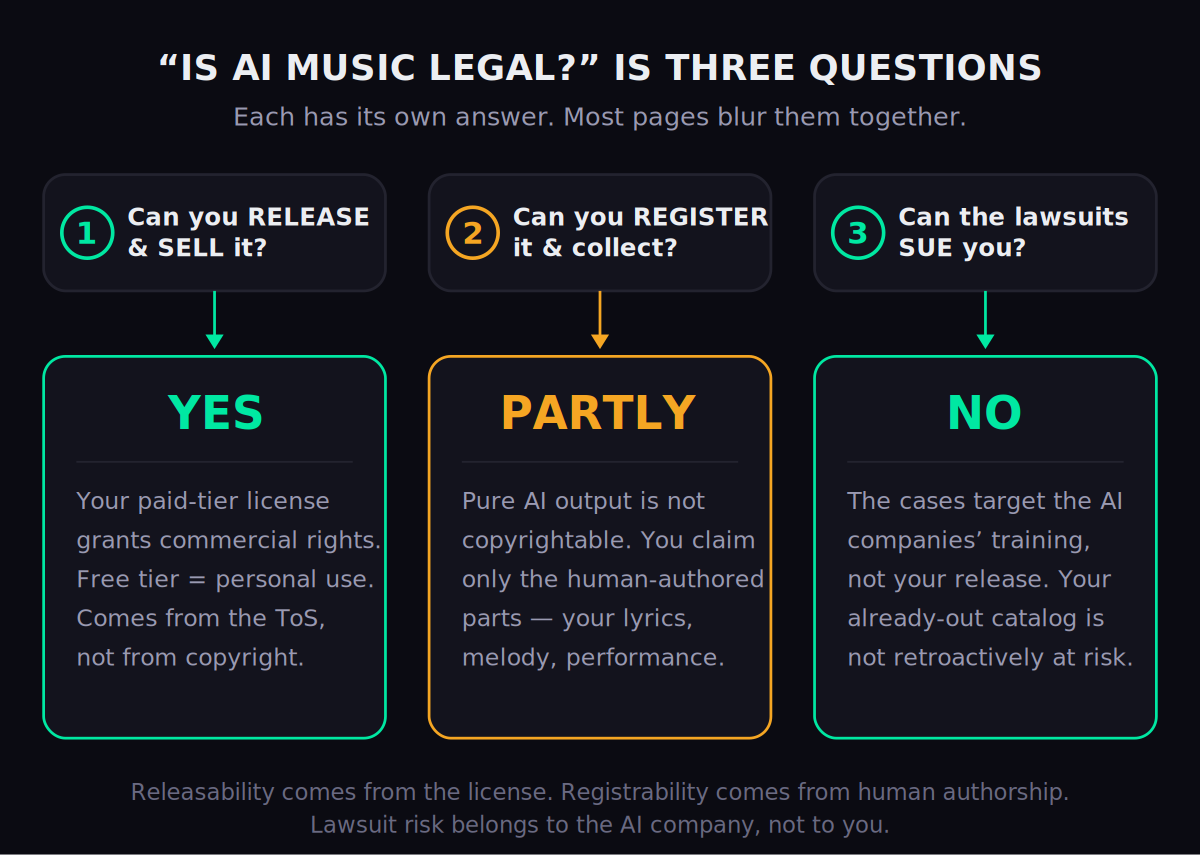
The One Question That Is Really Three
The reason “is AI music legal” feels unanswerable is that the word legal is doing three jobs at once. When a bedroom producer types it into Google, they are usually carrying a single fear — am I safe to put this out and make money from it? — but the internet answers them with copyright-registration theory, then lawsuit headlines, then platform policy, all jumbled together. The trick that unlocks everything is to notice that these are three separate permissions, and you can hold one without the others. You can have a clean right to sell a track that you can never register. You can write a song the Copyright Office will happily protect that a strict distributor still won’t accept. And you can be completely outside the blast radius of a billion-dollar lawsuit that is, on paper, about the exact tool you used.
So this guide answers each question on its own terms. Releasability comes from your license — the contract grant in your generator’s Terms of Service. Registrability comes from human authorship — the US Copyright Office rule that a work needs a human author. And lawsuit exposure comes from what the cases actually claim — which is that the AI companies copied music to train, a fight that lives upstream of you. Get those three straight and you stop guessing. If you want the mechanics of how AI licensing actually works underneath all of this, our AI music licensing explainer is the companion piece; this one sits above it and answers the “am I safe” question that sends people there in the first place. And once you have decided you’re clear, the step-by-step guide to releasing AI music walks the upload itself.
It helps to see the three permissions come apart in a single concrete case. Picture a producer who pays for a Suno subscription, generates an instrumental from a one-line prompt, and uploads it to Spotify. Question 1 — can they release and sell it? — is a clean yes, because the paid-tier license grants commercial use. Question 2 — can they register it and collect the publishing royalties? — is no, because no human authored the expression, so there is nothing the Copyright Office will protect and no composition the PROs will pay out on. Question 3 — can the Sony–Suno lawsuit reach them? — is also no, because that case is about how Suno was trained, not about a producer’s upload. One track, one set of facts, three different answers from three different rulebooks. Almost every “is AI music legal” argument you will read online is really two people answering different questions and assuming they disagree. They usually don’t.
Where the Law Actually Stands — June 2026
Sony is the last major label still fully litigating. A summary-judgment hearing in the Suno case is scheduled for July 2026, with a ruling expected this summer. Nothing below is a verdict — the live cases are allegations plus a scheduled hearing, and the dates move. Verify the current docket before you rely on any of it.
Here is the landscape in plain terms, because the lawsuit is the thing that scares producers most and is the least likely to actually touch them. In June 2024 the major labels, coordinated by the RIAA, sued the two biggest generators — Suno in the District of Massachusetts and Udio in the Southern District of New York — alleging mass copyright infringement in how the models were trained. Since then the wall of plaintiffs has cracked. Warner Music settled with both Suno and Udio in November 2025 (the Suno deal even folded in Warner’s Songkick). Universal settled with Udio in October 2025, establishing the first per-generation licensing template, but is still litigating against Suno. And Sony refused every deal, so it remains in court against both. That leaves the Suno case — Universal and Sony versus Suno — heading into a summary-judgment hearing this summer, the first time a federal judge will rule squarely on whether training a music model on copyrighted recordings is fair use or infringement.
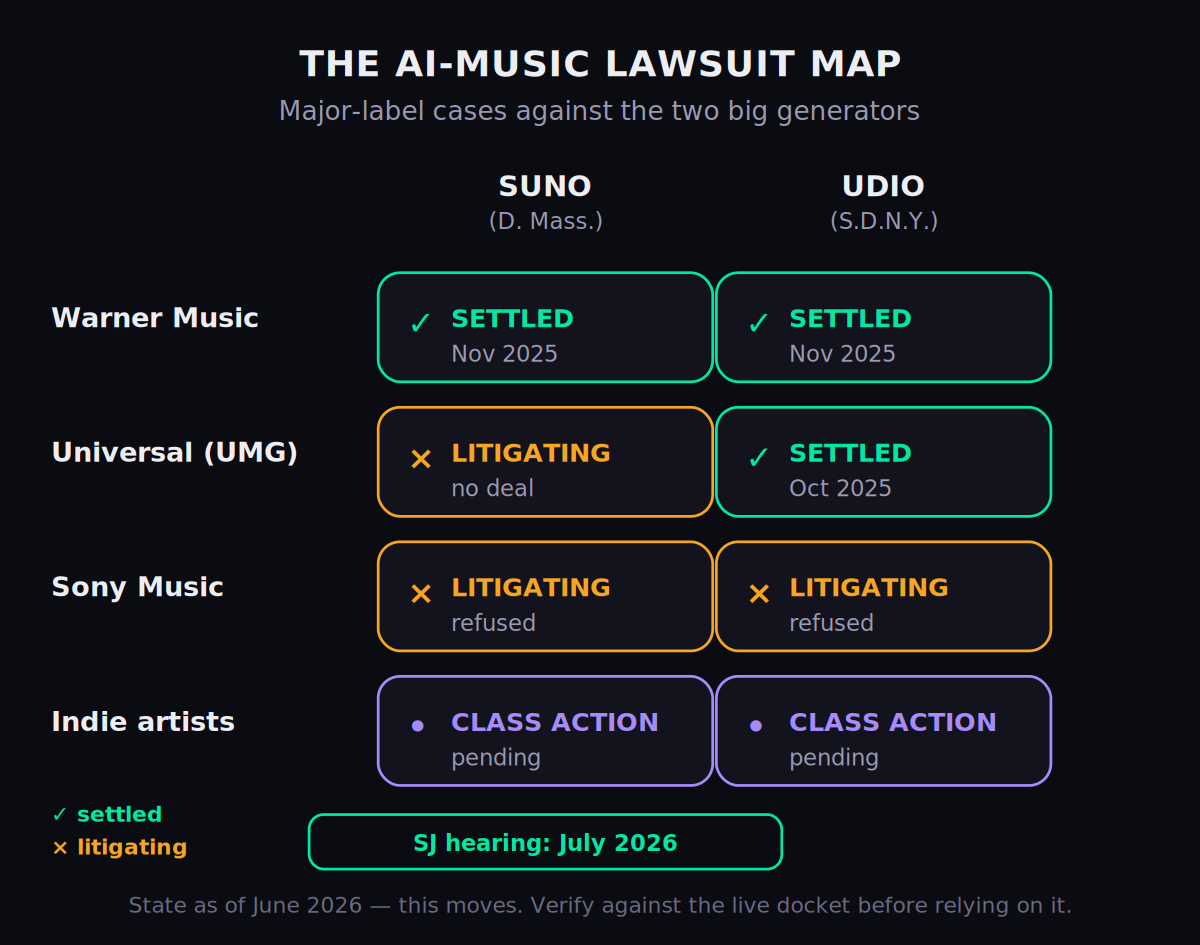
Why this matters to you is narrower than it looks. The fight is over training data, the question at the heart of the fair-use doctrine: was it lawful for the companies to copy millions of recordings to teach their models. A ruling against Suno would force AI music companies to license their training data — reshaping the tools, the prices, and the licenses you get going forward. A ruling for Suno would entrench the current licensed-model market. Either way, the ruling reshapes the tools, not your already-released songs. The cases do not claim that the producer who released a Suno track is an infringer; they claim the company that built Suno is. Separately, independent-artist class actions are pending against both companies, arguing the major-label settlements left smaller rights holders out — another upstream fight about training and compensation, not about your upload. The practical posture is to treat the legal weather as something that changes which tool you should pay for next quarter, not something that retroactively criminalizes what you put out last month.
It is worth understanding what the settlements actually established, because they are quietly redrawing the market you buy your tools in. The Universal–Udio deal reportedly set the first per-generation licensing template — a small royalty (figures in the low fractions of a cent per generation have been reported) flowing back to rights holders, with Udio moving toward a label-licensed, walled-garden product where outputs are created and kept inside the platform rather than freely downloaded. That is the shape the industry seems to be settling into: not “AI music is banned,” but “AI music is licensed,” with the generators paying for training rights and passing the structure down to you as changed terms. Not everyone is happy with that bargain — the American Federation of Musicians has objected that settlements negotiated by the labels can trade away working musicians’ leverage, and the indie class actions make a parallel argument from the rights-holder side. None of these disputes is about your individual release; all of them are about who gets paid upstream when a model is trained. But they tell you where the ground is moving, which is why the single most useful habit is to re-check your generator’s rights page whenever it announces a new model or a new deal.
Question 1 — Can You Legally Release and Sell It?
This is the question that actually unblocks you, and the answer is usually yes — with one condition that does all the work. Your right to release and monetize an AI track comes from your generator’s license, granted in its Terms of Service, and that grant is tied to your subscription tier. On Suno, commercial-use rights attach to songs you make while subscribed to Pro ($10/month) or Premier ($30/month); on Udio, commercial rights come with its paid tiers (the exact tier name is worth checking on Udio’s current terms, since the product is mid-transition to a label-licensed model). The free tiers on both are personal, non-commercial use only — you cannot upload free-tier output to Spotify, monetize it on YouTube, or sell it in any form. If money is anywhere in your plan, pay before you generate.
The trap that catches people is retroactivity. Upgrading to a paid plan after you made a song on the free tier does not, by default, make that earlier song commercial — the right attaches at creation time. So the durable habit is simple: keep your subscription receipts and the creation dates for anything you intend to release, and if a track you love was made for free, regenerate it on a paid plan before you distribute. For the side-by-side on which tool gives you the cleanest grant, our Suno vs Udio comparison, the broader best AI music generators of 2026 roundup, and the ElevenLabs Music review all break down the rights tiers tool by tool; the wider complete guide to AI music tools maps the rest of the stack.
It also pays to read what the commercial grant covers and what it quietly leaves out. A paid-tier license generally lets you distribute the track to streaming services, monetize it on platforms like YouTube, and use it commercially — but it does not hand you the open-ended ownership a recording you made from scratch would carry, and it does not give the rest of the world permission to use your output. It is your license to release; it is not a transfer that lets you, say, stop someone else from generating something similar. And because the generators are mid-transition, the grant can change with the model: when a platform retires an old model and launches a licensed one, the new terms may differ on downloads, stem access, or how outputs can be used. The songs you already created under the old terms keep the commercial status they had, but the safe assumption for anything new is “read the current rights page first.” That is not a reason to avoid AI tools — it is the ordinary discipline of building a release on top of a license you don’t control, the same care you would take with any sample pack or sync library whose terms can be revised.
One more distinction matters enormously and is the one cheap pages skip: a commercial license is not the same as owning the copyright. The generators have moved their language from “you own this” to “you are granted commercial rights,” and at least one major generator states plainly that it cannot warrant that any copyright will vest in your output. So you can have a perfectly clean right to release a fully-AI track and still hold no registrable copyright in it. Treat the ToS grant as your permission slip to release, and treat ownership as a separate question (Question 2). Worth knowing too: standard Suno Pro and Premier plans do not include indemnification — if a release is ever claimed to infringe, the platform won’t cover your costs on those tiers; that protection lives only at the Enterprise level. If you want to pressure-test your exact situation, the AI Music Rights Navigator walks your tier and use case through to a clear release answer, and the monetization mechanics live in how to make money with Suno and the broader making money with AI music guide.
Question 2 — Can You Register It and Collect the Royalties?
Here the answer flips to partly, and the reason is the single most stable fact in this whole area: US copyright requires a human author. The Copyright Office said so in its 2023 registration guidance and reaffirmed it in its 2025 report, and the framework has held steady into 2026. Output generated entirely from a text prompt has no human author and cannot be registered — the prompt is treated as an instruction, not as the expressive authorship of the resulting audio. That is why a fully-AI track can be releasable (Question 1) and unregistrable at the same time: the two questions run on different engines.
But the same guidance opens a real door. AI-assisted work that contains meaningful human authorship can be registered — for the human-authored elements. If you write your own lyrics, compose the topline, arrange the piece, or record a performance, those human contributions are protectable, evaluated case by case, with the AI-generated material disclosed and disclaimed on the application. The more genuine creative control you exercise over the expression, the more of the work becomes yours on paper. Our companion explainers go deeper on the registration mechanics: can you copyright AI music for the general rule, can you copyright Suno AI music for the platform-specific version, and the practical how to copyright your music and how to register your music walkthroughs for the filing itself.
What “meaningful human authorship” looks like in practice is more concrete than it sounds. The Copyright Office’s own position is that simply entering prompts — even long, elaborate, iterated prompts — does not make you the author of the output, because you are not controlling the expressive details the way a writer controls a sentence or a composer controls a melody. What counts is your own creative contribution layered onto or around the AI material: the lyrics you wrote, the melody you composed, the arrangement you built, the vocal you performed, the selection and editing you did to shape raw generations into a finished piece. On the application you register that human contribution and you disclaim the AI-generated portion — you describe what the machine made so the Office can exclude it, and you claim what you made. The result is a registration that protects your verse and topline but not the AI-generated bed underneath them. That is not a loophole; it is the honest shape of a mixed work, and it is exactly why the second-strongest position in the decision table below — human topline and re-recorded vocals over an AI bed — is registrable where a pure-prompt track is not.
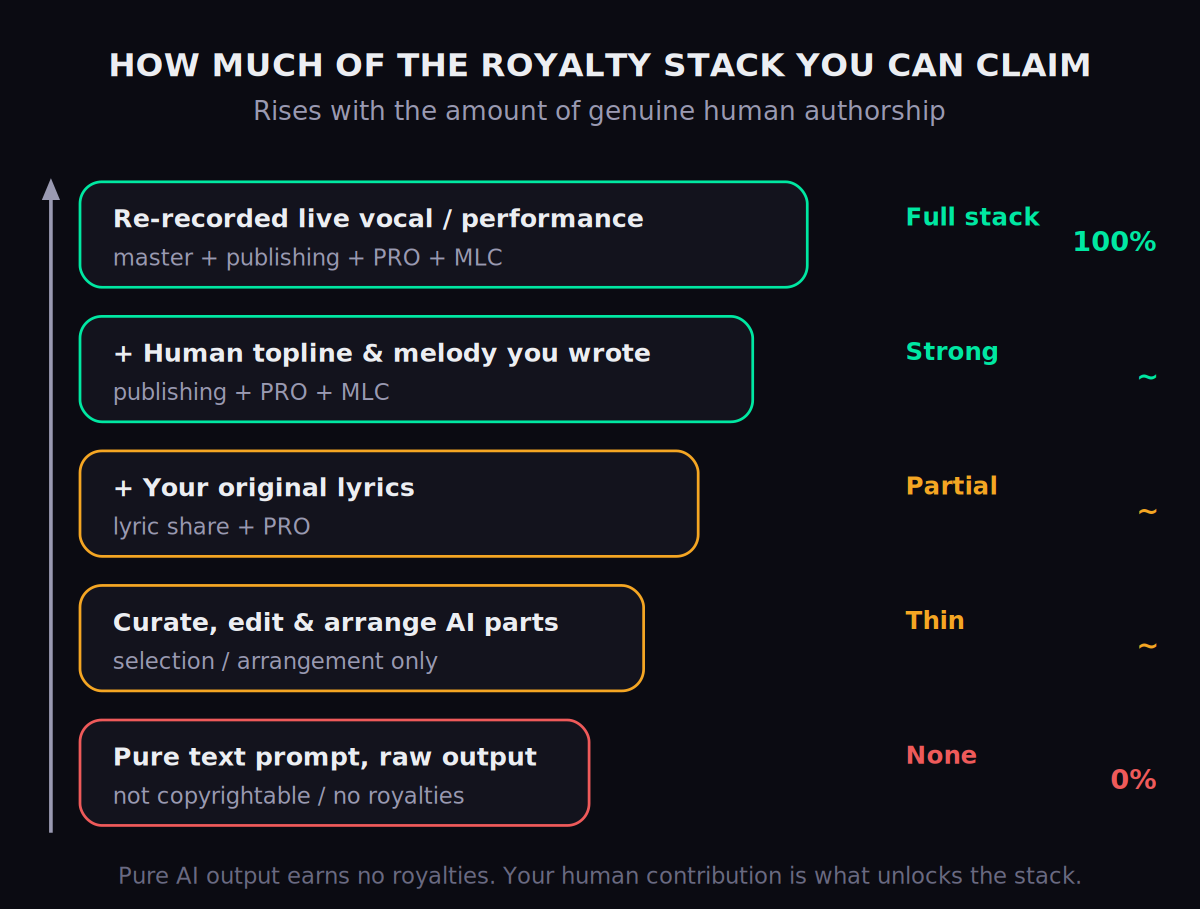
Registration is not just a certificate — it is the gate to the royalty stack. Performing-rights organizations and The MLC generally require human authorship to register a work and collect, so the question “how much can I earn from this” tracks the question “how much of it did a human write.” A pure-prompt track earns its streaming income (that follows distribution, not copyright) but cannot claim the publishing, PRO and mechanical layers, because there is no human-authored composition to register. Add your lyrics and you can claim the lyric share; add the topline and melody and the publishing and PRO layers open; re-record a live vocal and the master itself carries human performance. If the royalty stack itself is unfamiliar, how music royalties work lays out the layers and producer points explained covers the producer’s cut; you can also gut-check how strong your claim is with the AI Copyright Strength tool before you file.
Question 3 — Can You Get Sued, and Does the Ruling Hurt You?
This is where the fear lives, and where the honest answer is the most reassuring — as long as it is stated precisely. The major-label lawsuits target the AI companies’ training, not the individual producer’s release. The claim is that Suno and Udio copied copyrighted recordings to build their models; it is not a claim that you, having paid for a license and pressed upload, are an infringer. When the Sony–Suno ruling lands, it will reshape the tools and their licenses — what the next models are trained on, what your commercial grant looks like, possibly what you pay — but it does not reach back and make a track you already released last year retroactively unlawful. Frame your reassurance there, exactly and no further: the ruling moves the ground under the platforms, not under your catalog.
That said, “the label lawsuit won’t get you” is not the same as “there is no risk.” There are three real producer-level risks, and they are the ones worth managing. First, the generator can change or limit your rights mid-stream. When Warner settled with Suno, Suno announced it would retire its older models and launch licensed ones, with free-tier download access curtailed; songs you already made keep their existing commercial status, but the terms for future models can differ. Read your generator’s rights page when it updates, and keep your provenance records. Second, mimicking a real artist’s voice or style is a different, larger problem. Cloning a named singer’s voice or producing an obvious soundalike triggers right-of-publicity and platform-impersonation rules that have nothing to do with the training lawsuits — the streaming services ban unauthorized voice clones outright and will remove them. This is the one place to simply stop. Third, non-disclosure and fraud get tracks pulled. What platforms actually police is deception: mass-upload spam, bot-driven stream farming, and undisclosed clones. Spotify removed roughly 75 million spam tracks in the year before its 2025 policy update, and Deezer reports that a large majority of streams on detected AI tracks were fraudulent — but both still host honest, disclosed AI music. The pattern is consistent across the industry: they target the fraud, not the tool.
So the risk you can actually control is behavioral. Generate on a paid tier, disclose honestly, don’t impersonate a real artist, and keep your records, and you are releasing in the same lane as the rest of independent music — outside the lawsuit, inside platform policy, with a paper trail if anyone ever asks.
The voice-and-style risk deserves a closer look, because it is the one that is genuinely different in kind. The training lawsuits are a copyright fight; cloning a real singer is a right-of-publicity and impersonation problem, a separate body of law that protects a person’s name, voice, and likeness from unauthorized commercial use. It does not matter whether the underlying generation was “legal” in the licensing sense — making a track that purports to be, or is obviously meant to sound like, a named artist exposes you to a claim that has nothing to do with how the model was trained. The streaming services reinforce this with flat policy: unauthorized voice clones and impersonations are banned outright and removed when detected, regardless of disclosure. A useful line to hold is that style is not protectable but a person is — making “a moody synth-pop track in the general vein of late-2010s pop” is ordinary creative influence, while making “a track that sounds like a specific named singer performing” crosses into their identity. When in doubt on this one, the honest move is not to disclose more carefully; it is not to release it at all.
The Disclosure Layer: What the Platforms Require
Sitting across all three questions is a fourth, smaller obligation that is easy to handle once you see it: disclosure. The streaming services have aligned on a DDEX-based AI-disclosure standard that travels inside your release metadata, so the work is done at upload, by your distributor, not by you directly. Spotify adopted the standard in its September 2025 policy and began rolling out consumer-facing AI Credits in 2026 (the beta went live in April, with DistroKid first to add an AI checkbox and the tag appearing in the song’s credits). Apple Music introduced self-declared transparency tags in March 2026 across artwork, audio, composition and video. The fields are usually a simple scale — from no AI, through minor assistance, up to entirely AI-generated — set per element and sent to the platforms automatically.
The thing to internalize is that honest disclosure does not hurt you. Platforms have been explicit that disclosed, AI-assisted music is not down-ranked for being AI — what gets removed or de-monetized is fraud, impersonation and stream-farming. The risk runs the other way: an omitted disclosure can read as concealment, and detection systems analyze the audio’s own fingerprint regardless of what your metadata says, so “washing” tools that claim to strip an AI signature are both unreliable and a policy violation. Disclose, and the rest takes care of itself. The release workflow guide covers where each distributor’s AI field lives, and the AI Music DDEX Disclosure Checker lets you confirm the disclosure is actually carried in the metadata the platforms read before you hit publish.
In practice the mechanic is genuinely light. Because the standard rides in DDEX metadata, you are not filing anything with Spotify or Apple yourself — you tick a box or pick a level inside your distributor’s upload flow (DistroKid, CD Baby, TuneCore and the rest are wiring these fields in), and the distributor delivers the declaration to every store. The granularity is per-element rather than a single yes/no, which matters for AI-assisted work: you can declare that the vocal is human while the instrumental was AI-generated, or that AI was used only for mastering or a minor assist, so the disclosure reflects the truth of a mixed track instead of flattening it. The industry is also visibly serious about the fraud side this is meant to separate you from — Deezer has reported that a large share of streams on its detected fully-AI uploads were fraudulent, and Spotify’s mass removal of spam tracks runs in parallel with its support for legitimately labeled AI music. The signal is consistent: the platforms are building tools to distinguish honest AI music from deceptive uploads, and the entire point of disclosure is to put you on the right side of that line automatically.
The Decision: Are You Safe to Release Today?
Theory is fine, but you came here to make a call about a specific track. Here is the worked decision — four common situations, each run through all three questions. Find the row that matches what you actually made, and you have your answer.
| Your situation | Release & sell? | Register / collect? | What to watch |
|---|---|---|---|
| Suno Pro track, straight to Spotify, no human edits | ✔ Yes — paid-tier license grants it | ✖ No registrable copyright (no human authorship) | Disclose the AI use; keep your subscription receipt and creation date. Earns streaming income, not the publishing stack. |
| You wrote the topline & re-recorded vocals over an AI bed | ✔ Yes | ✔ Yes — on your human elements (lyrics, melody, performance) | Register the human parts with the USCO and your PRO. This is the strongest position. |
| You cloned a named artist’s voice or made an obvious soundalike | ✖ Stop | ✖ No | Right-of-publicity + platform impersonation ban. Different, larger risk — don’t release it. |
| A free-tier export you want to put out | ✖ No — personal use only | ✖ No | Regenerate on a paid tier first. Upgrading later does not make the old free file commercial. |
The pattern is the spine of the whole piece: the paid-tier license decides whether you can release; human authorship decides whether you can register and collect; and the only hard “stop” is impersonating a real artist. Everything else is a disclosure step and a saved folder of records.
Read down the rows and a strategy falls out of them. The first row — a paid-tier track straight to streaming — is completely fine to release and earn streaming income from; you are simply leaving the publishing royalties on the table because there is no human-authored composition to register. The second row is the position to aim for if music is your livelihood: a small amount of genuine human work, a written topline and a re-recorded vocal, converts an unregistrable generation into a release you can both sell and protect, which means you can collect the full royalty stack instead of streaming alone. The third row is the one to memorize as a hard line, because no amount of licensing or disclosure rescues it — an obvious clone of a named artist is a different legal problem and the answer is simply don’t. And the fourth row is the cheapest mistake to avoid: a free-tier export is not licensed, full stop, so the two-minute fix is to regenerate it on a paid plan before it ever reaches a distributor. Almost every real release you will make is row one or row two; the value of the table is that it tells you, in advance, exactly which royalties you are entitled to and which records to keep.
The EU, and What Changes Next
Two things on the horizon are worth keeping in view, framed proportionally. The first is the EU AI Act, whose transparency obligations begin to apply on 2 August 2026, with some content-labeling specifics phasing in later in the year. Those rules require providers of generative AI systems to mark synthetic output and deployers to disclose it — they are transparency duties, not a ban on AI music, and the heavy obligations fall on the AI companies and large-scale deployers rather than on an individual releasing a disclosed track. If you distribute into the EU it is worth knowing the labeling exists; it is not worth panicking over. As with everything regulatory and fast-moving, treat the exact dates and scope as something to verify against the current rules.
The second is the Sony–Suno ruling itself. When it lands this summer it will move the licensing market — possibly changing which generators offer the cleanest rights, what they cost, and what your commercial grant says — which is exactly why the smart move is to keep your decision-making at the level of “which tool should I pay for,” not “is my catalog suddenly illegal.” We refresh this page and its lawsuit map when the ruling and the EU dates move; bookmark it, and re-check the dated callouts before you make a high-stakes release. For the ongoing tool picture, the best AI music generators roundup and the licensing explainer are kept current alongside it.
A note on what this is: this is general information for producers, not legal advice, and it describes a fast-moving area. The lawsuits are reported allegations plus a scheduled hearing, never a verdict; every claim above is sourced to vendor terms, US Copyright Office guidance, platform policy or the public docket, and the volatile facts — ruling status, ToS terms, EU dates — should be verified on the live source before you rely on them. For a specific release, contract, or registration, consult a qualified music attorney.
Before You Release: 3 Checks
- Open the track and answer Question 1: was it generated on a paid tier? If yes, you have a commercial license. If it was free-tier, stop and regenerate on a paid plan before going further.
- Answer Question 2: did a human write the lyrics, melody, or perform on it? If yes, note which elements — those are what you can register. If it’s pure prompt-to-output, accept that you can release but not register it.
- Answer Question 3: does it imitate a real, named artist’s voice or style? If yes, do not release it. If no, you’re clear of the one hard stop.
- Create one folder per release containing: the prompts, the generation date, your subscription tier (with a receipt or screenshot), and a note on any human edits or co-writing.
- If the track is AI-assisted, list exactly which elements are human-authored (lyrics, melody, arrangement, vocal) so registration and PRO filings are straightforward.
- Save it before you upload. If a rights holder or platform ever questions the track, this folder is your defense — and it takes two minutes now versus hours later.
- Run your tier and use case through the AI Music Rights Navigator to confirm the release is licensed, then gut-check registrability with the AI Copyright Strength tool.
- Set your distributor’s AI-disclosure fields and confirm they’re carried in the delivery metadata with the DDEX Disclosure Checker.
- Register any human-authored composition elements with the USCO and your PRO, then file the release. Now you’re in the legitimate lane — licensed, disclosed, documented, and earning what you’re entitled to.
Frequently Asked Questions
Generally yes, if you generated the track on a paid tier. Your right to release commercially comes from the generator’s Terms of Service, not from a copyright registration. Suno grants commercial-use rights on Pro and Premier; Udio grants them on its paid tiers. Free-tier output on both is personal, non-commercial use only and must not be released — and upgrading later does not retroactively commercialize a free-tier song. The license is what unblocks the release, so the tier you generated on is the fact that matters. See how AI music licensing works.
Pure AI output is not registrable, because US copyright requires human authorship — the Copyright Office’s 2023 guidance and 2025 report are consistent on this. AI-assisted work where a human contributes meaningful authorship (your own lyrics, melody, arrangement, or a recorded performance) can be registered for those human-authored elements, case by case, with the AI material disclosed and disclaimed. The more genuine human input, the more you can protect. Detail in can you copyright AI music.
No — the major-label cases target the AI companies’ training, not your released track. A ruling reshapes the tools and their licenses going forward; it does not retroactively make your already-released catalog infringing. Your realistic risks are different: the generator changing your rights mid-stream, outputs that mimic a real artist (a separate right-of-publicity problem), and platform removal for non-disclosure or fraud.
Split. On the Suno case (District of Massachusetts), Warner settled in November 2025 while Universal and Sony are still litigating, with a summary-judgment hearing scheduled for July 2026. On the Udio case (Southern District of New York), both Universal (October 2025) and Warner (November 2025) settled, leaving Sony alone. Independent-artist class actions are pending separately against both companies. This is a live docket — verify the current status before relying on it.
On a paid tier you keep your streaming royalties on a released track, because that revenue follows distribution, not copyright status. Performance royalties from a PRO and mechanicals from The MLC are different: those bodies generally require human authorship, so they attach to your human-written elements (lyrics, melody), not to a composition with no human author. Register the human parts; see how music royalties work.
No, and conflating them is the most common mistake. A generator’s commercial license is permission to use and monetize the output; it is not a transfer of copyright ownership, and at least one major generator states it cannot warrant that any copyright will vest in your output. You can have a clean right to release a fully-AI track and still hold no registrable copyright in it. The ToS grant is your release permission; human authorship is the separate thing that creates ownership.
Increasingly, yes. The major services adopted a DDEX-based AI-disclosure standard carried in your release metadata; Spotify’s AI Credits began rolling out in 2026 and Apple added self-declared transparency tags. Your distributor sets and sends those fields, so honest disclosure at upload is the whole task. Disclosure doesn’t down-rank honest AI-assisted music — what platforms remove is voice clones, impersonation and stream-farming. An omitted disclosure can read as concealment, and detection runs on the audio regardless of metadata.
No. The EU AI Act’s transparency obligations begin to apply on 2 August 2026 (with some content-labeling specifics phasing in later in 2026) and require providers to mark synthetic output and deployers to disclose it — transparency duties, not a ban. The heaviest obligations fall on the AI companies and large deployers, not on an individual releasing a disclosed track. Treat the exact dates and scope as something to verify against the current rules.