Buy reFX Nexus 5 (around $199) if your goal is finished music, fast, in modern electronic genres: it is the preset-velocity machine with the quickest path from a patch to a mix-ready idea, and it costs a fraction of its rival. Buy Omnisphere 3 ($499, or $199 to upgrade from v1/v2) if your goal is sonic depth and breadth across every genre — scoring, ambient, hybrid, sound design — where its 18 libraries, Quadzone engine and 26,000+ patches have no real rival. The lazy “ROMpler vs powerhouse” framing every old comparison repeats is dead in 2026: Nexus 5 became a full synth in late 2024. The real fork is philosophy — speed versus depth. They solve different problems, and the honest long-term answer is “both” — but below we tell the budget-limited reader exactly which ONE to buy first, and why.
Omnisphere 3 is sold through Spectrasonics directly and authorized resellers such as Sweetwater; some links here may be affiliate links that earn us a commission at no cost to you. reFX sells Nexus 5 direct-only and runs no affiliate programme — we earn nothing if you buy it, and we recommend it anyway where it is the right tool. Every call here is based on source-checked assessment, not on what pays.
| Axis | Nexus 5 | Omnisphere 3 |
|---|---|---|
| Sound & genre breadth | 8.4 | 9.4 |
| Sound-design depth (build from scratch) | 7.9 | 9.5 |
| Speed-to-idea | 9.6 | 8.2 |
| Preset library | 8.8 | 9.3 |
| CPU & stability | 9.1 | 7.8 |
| Value | 8.6 | 8.5 |
| Overall | 8.7 | 8.9 |
Scores are MPW editorial judgement, defended section by section below — a decision framework, not a first-party measurement. Specs and prices verified June 23, 2026 against each vendor’s current product page and 2024–26 reviews. Nexus 5 pricing is quoted regionally by reFX and moves with frequent sales; confirm your region’s figure at the reFX store before buying.
Updated June 2026 — reFX Nexus 5 vs Omnisphere 3
The overall scores sit a tenth of a point apart on purpose, because an honest reading of these two instruments does not produce a winner — it produces a fork. Nexus 5 owns the axes that get a track finished: a category-leading speed-to-idea (9.6) and a notably lighter CPU and stability (9.1). Omnisphere 3 owns the axes that produce sounds nobody else has: sound-design depth (9.5) and sheer genre breadth (9.4). The two synths are nearly tied only on value (8.6 vs 8.5), and for a revealing reason we unpack below. Ignore the overall number; read the axis that matches your goal. That axis is the entire comparison, and every decimal above is defended in the sections that follow.
Why “ROMpler vs Synth” Is Dead in 2026
Search “Nexus vs Omnisphere” today and you will land on forum threads from 2015 to 2022 and one or two thin listicles, every one of them repeating the same shorthand: Nexus is “a big rompler,” “a one-trick pony,” the preset box; Omnisphere is the real synth, the powerhouse. That shorthand was roughly fair a decade ago. It is simply wrong now, and the reason matters more than any single feature.
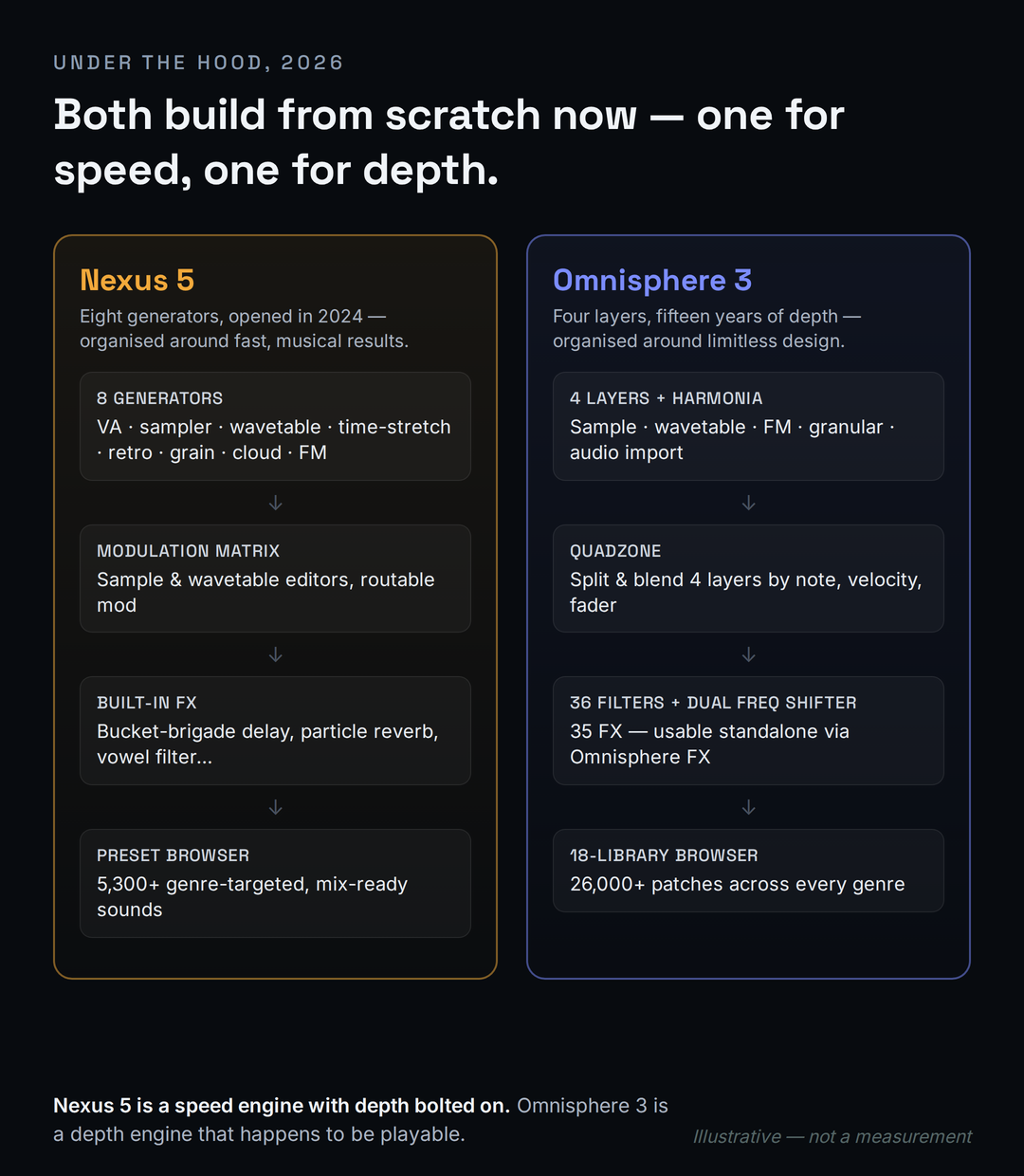
On Black Friday 2024, reFX shipped Nexus 5 and quietly detonated its own identity. For the first time in the product’s twenty-year history, the engine is fully open. You are no longer limited to tweaking presets that partner sound designers built behind a locked door — you can design patches from scratch, load your own samples, edit wavetables, route a full modulation matrix, and even build and sell your own expansions. Under the hood sit eight synthesis generators: virtual analog, a sampler, wavetable, a time-stretcher, a retro sampler that crushes bit and sample rate for an ’80s character, granular (“Grain”), a “Cloud” texture engine, and four-operator FM. That is not a ROMpler. That is a multi-engine synthesizer that happens to also ship with 5,300 ready-to-go presets.
So the old dichotomy collapses. Both instruments now do wavetable, sampling, granular and FM synthesis; both let you build a sound from a blank patch. Calling Nexus 5 “just a ROMpler” in 2026 is like calling a modern phone “just a camera.” Once you stop comparing type, the actual difference comes into focus, and it is not on the spec sheet at all — it is in what each instrument is for. One is built to get you to a finished idea at maximum speed. The other is built to take you as deep into sound as you are willing to go. That is the fork this entire guide is about, and the diagram below is the honest map of it.
It helps to be concrete about what “open engine” actually unlocked, because reFX buried the lede in a Black Friday launch. For two decades the deal with Nexus was simple and limiting: you bought the instrument, you bought expansion packs, and you tweaked what the factory and third-party designers had made — the synthesis layer itself was sealed. Version 5 broke that seal. You now reach the oscillators, the modulation routing, the sample and wavetable editors and the effects directly, and you can save the results as your own patches or package them as your own expansions. reFX even kept a one-click “N2” retro skin that restores the old Nexus 2 look, which is a quiet admission that the company knows it changed what the product fundamentally is. The takeaway for a buyer is that any review, forum post or video predating December 2024 is describing a different instrument, and the “rompler” verdict it reaches no longer applies.
This is not a pedantic point about dates — it is the single most expensive misconception a buyer can carry into this decision. People still talk themselves out of Nexus because “it’s just presets,” and talk themselves into Omnisphere expecting it to be as fast to use as Nexus, and both mistakes lead to buyer’s remorse. Decide on the basis of what these instruments are in 2026, not what they were when the internet’s top results were written, and you will buy the right one. The rest of this guide is built to make that decision on current facts: what each one sounds like, how each one feels to use, what each one truly costs over a few years, and which one belongs in your studio first.
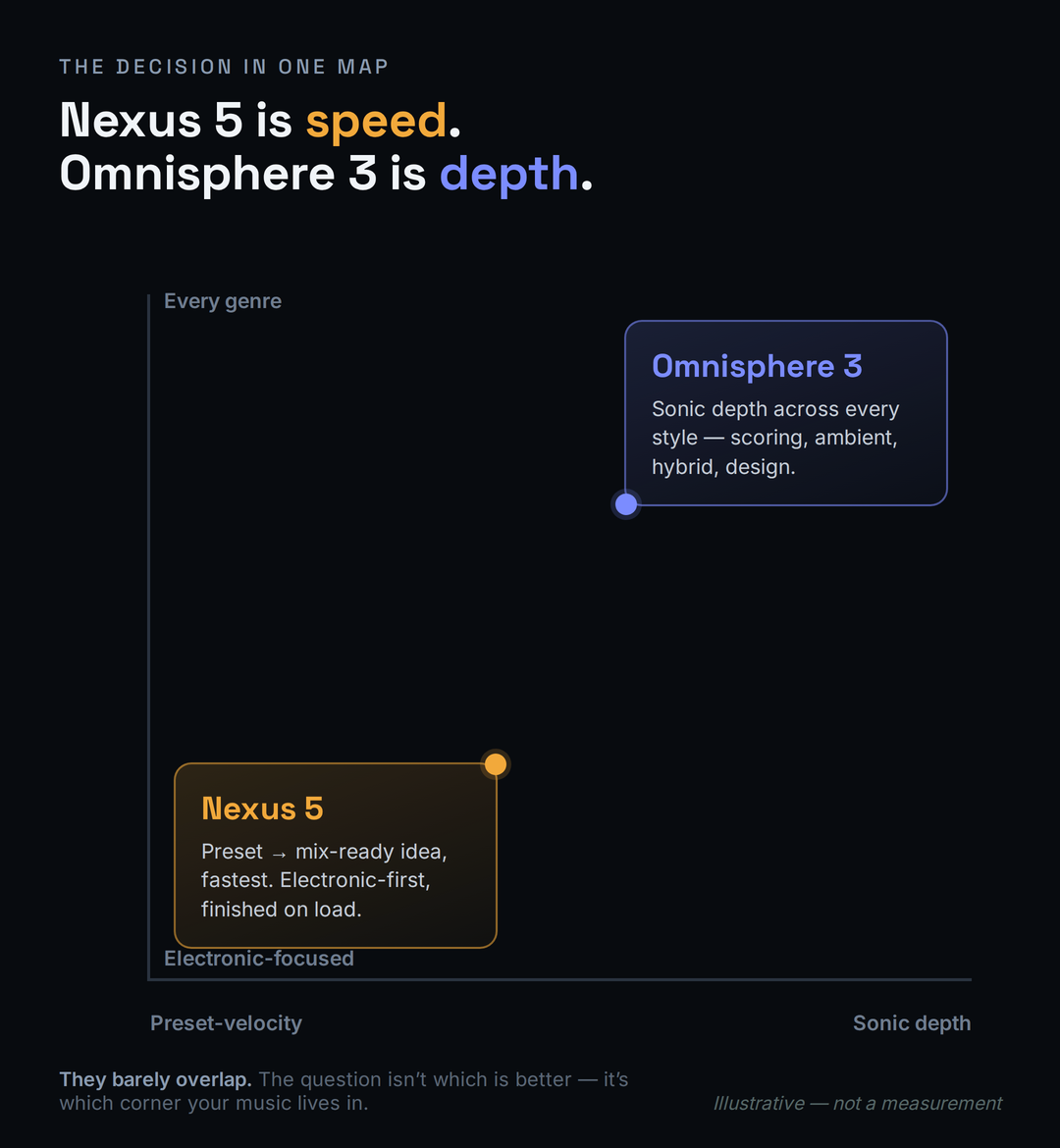
Two Philosophies: Preset-Velocity vs Sonic Depth
Nexus 5 is optimised for one thing above all others: turning a preset into a finished, mix-ready idea in the shortest possible time. Its presets are not raw starting points — they are voiced, layered, effected and arpeggiated to sit in a modern dance track the moment you load them. Browse to a lead, play four bars, and you frequently have something you would keep. The new from-scratch engine is a genuine addition, but it sits underneath a workflow whose entire personality is speed. This is why Nexus has been a fixture of commercial EDM, future bass, trance and pop for years: it removes the distance between inspiration and a usable sound.
Omnisphere 3 optimises the opposite quantity: depth and breadth of sound, and the ability to design timbres that did not exist before you made them, the quality that puts it near the top of our best synth plugins guide. Its factory collection spans 18 libraries — retro analog, classic digital, ambient, cinematic, club, organic — and the engine behind them is enormous. Quadzone lets you split four layers across the keyboard, by velocity, or blend between them with a fader or polyphonic aftertouch. There are 36 new filter types in seven sonic colours, circuit-modeled saturation, oscillator drift for analog instability, a dual frequency shifter, and deep-sampled organic sources (Spectrasonics famously sampled a blown ostrich egg and percussive snow for v3). This is an instrument you grow into over a decade, not one you exhaust in a weekend.
Hold those two descriptions side by side and the consumer question almost answers itself. If your bottleneck is finishing — you start tracks and stall, you lose momentum hunting for the right sound — preset-velocity is the cure, and Nexus 5 is the strongest preset-velocity instrument money can buy (our full Nexus 5 review breaks the reopened engine down). If your bottleneck is originality — your tracks sound like everyone else’s because they use the same presets everyone else uses — depth is the cure, and Omnisphere 3 is the deepest single instrument on the market (the Omnisphere 3 review tours all of it). Neither “better” nor “worse” enters into it.
Watch the two philosophies play out in a real session and the difference stops being abstract. With Nexus, the loop is browse, audition, commit: you scroll a category, hear finished sounds one after another, and the moment one fits you are already writing the part — the instrument is engineered to disappear. With Omnisphere, the loop is browse, audition, shape: you find something close, then you sculpt it with the layers, filters and modulation until it is exactly yours, and that sculpting is where the hours and the magic both live. One workflow protects momentum; the other rewards patience with originality. Neither is a compromise of the other — they are two coherent answers to the question “what should a synthesizer feel like to use,” and the right answer for you depends entirely on whether your scarcest resource is time or distinctiveness.
Sound & Genre Fit: Electronic-First vs Everything
Nexus 5’s sound is unapologetically modern and electronic. The factory library leans into EDM, melodic techno, house, trance, hip hop, lo-fi, retrowave, cyberpunk and drum & bass — its own marketing names the genres, and the presets deliver them with a polished, slightly larger-than-life character. The supersaws are huge, the plucks are crisp, the basses are club-ready. That focus is a strength when you work in those styles and a limitation when you don’t: Nexus does not pretend to be a convincing orchestral, folk, or experimental-texture machine, and you would not reach for it to score a film.
Omnisphere’s sound is defined by range. It will do the same electronic territory (a fight we referee in Omnisphere 3 vs Serum 2) — the new v3 collection even adds a dedicated EDM wavetable set and 600+ morphing wavetables — but its centre of gravity is everywhere at once — broad in the way an Arturia Pigments is, taken further: lush evolving pads, cinematic beds, gritty hybrid textures, vintage analog emulations, acoustic-adjacent oddities, and the kind of ambient soundscape that underpins a trailer or a game cue. If your week moves from a pop topline to a horror cue to an ambient EP, one instrument covers all of it. That versatility is the reason Omnisphere is on so many professional film, TV and game scoring rigs.
There is an honest caveat in Nexus’s favour, though, and most reviews miss it. For its home genres, Nexus often sounds more finished, faster than Omnisphere does, because its presets are pre-mixed for those styles. An Omnisphere patch frequently wants designing — layering, filtering, effecting — before it sits in an EDM drop the way a Nexus preset already does. Breadth is Omnisphere’s; speed-within-a-lane is Nexus’s. If your lane is electronic, Nexus’s narrowness is a feature, not a bug.
The new content in each instrument tells the same story from the other direction. Omnisphere 3 leans hard into texture and organics: alongside the EDM wavetable collection, version 3 ships deep-sampled organic sources that Spectrasonics is famous for chasing — the company has historically recorded everything from blown bottles to struck metal to build soundsources no one else owns — plus cinematic, hybrid and experimental libraries that exist to give scoring composers a palette nobody can copy. Nexus, by contrast, grows through genre-targeted expansion packs: trap, future bass, festival, synthwave, lo-fi and dozens more, each a tightly curated set of sounds aimed at a specific style and built to drop straight into that genre’s productions. That is the breadth-versus-focus split in a sentence: Omnisphere widens outward into every sonic world, while Nexus deepens inward into the electronic genres it already serves, and a buyer should pick the instrument whose growth path matches where their music is actually heading.
It is worth being specific about what Nexus actually sounds like, because that character is the product. Its signature is big, bright and immediate — wide supersaw leads (a lineage that runs back through classics like the one in our Massive review), glassy plucks, punchy gated pads and subs that already sit in a club system — a sound lineage that has appeared on a long run of commercial trance, big-room and festival records — the territory mapped in our best plugins for EDM guide precisely because it reads as “finished” the moment it plays. That polish is partly the presets and partly the built-in effects chains and arpeggiation baked into each sound. For a producer chasing that modern, larger-than-life electronic gloss, Nexus gets there in one click; reaching the same gloss in Omnisphere is entirely possible, the way it is in any deep wavetable synth such as the one in our Serum 2 review but is a sound-design task, not a preset choice. If that specific character is the sound in your head, the “narrower” synth is the faster route to it.
Designing From Scratch: Nexus’s New Engine vs Omnisphere’s Depth
This is the section where Nexus’s 2024 reinvention gets tested honestly, and where the scorecard gap is widest. Yes, Nexus 5 can now design sound from scratch — eight generators, a real mod matrix, sample and wavetable editors, custom expansions. For a producer who has only ever used Nexus as a preset box, this is liberating, and it is enough to build genuinely original patches. But it is a young, two-year-old open engine, and it is not trying to be a sound-designer’s deep playground. The architecture is still organised around fast, musical results, not around limitless experimentation.
Omnisphere’s depth is in a different league, because it has had a decade and a half to accumulate it. Four sound layers, each able to add four more oscillators via Harmonia; Quadzone for splitting and blending those layers by note, velocity and fader; 36 filter types; a polyphonic dual frequency shifter routable in series or parallel; granular synthesis; audio import so any file becomes a soundsource; and Patch Mutation, which spawns useful variations of any patch with a click. The new Adaptive Global Controls even analyse a patch and expose its most meaningful parameters — Tone, Ambience, Filter, Envelope, Vibrato, Unison — so deep design stays approachable. For build-from-nothing sound design, scoring and experimental work, nothing here is close, and it anchors our best plugins for sound design shortlist.
The practical translation: if “design a sound nobody has heard” is a regular part of your work, Omnisphere is the instrument and Nexus is a capable-but-secondary tool. If “design from scratch” is something you do occasionally and you mostly live in presets, Nexus’s new engine is more than enough, and you are paying a heavy premium for Omnisphere depth you will rarely touch. The diagram below lays the two engines side by side so you can see what each one actually hands you.
A few Omnisphere capabilities have no equivalent in Nexus at all, and they are worth naming because they define the ceiling. Audio import turns any file on your drive into a playable soundsource, so a field recording or a vocal scrap becomes the raw material of a patch. Harmonia stacks up to four additional oscillators per layer for huge additive and unison textures. The 35 new effects are now usable entirely outside the synth through the standalone Omnisphere FX plugin, so the reverbs, delays and distortions you designed inside Omnisphere can be dropped on a vocal or a drum bus in your DAW. Oscillator drift models the gentle tuning instability of vintage analog hardware, and the dual frequency shifter, routable in series or parallel, produces inharmonic movement that is hard to get anywhere else. Nexus’s open engine is a real and welcome thing, but it is a fast-results engine with a useful depth layer, not a research instrument — and for the producer whose work depends on never running out of sonic road, that gap is the whole reason Omnisphere costs what it does.
Workflow & Speed-to-Idea
If you put a stopwatch on “launch the plugin, reach a sound you would actually keep,” Nexus 5 wins decisively, and it is not only the presets. Preset loading is genuinely fast, the browser is built for quick auditioning, and because the factory sounds are pre-effected and pre-arped, the gap between “I like this” and “this is in my track” is often seconds. For producers who work in flow and hate losing momentum to menu-diving, this is the single most valuable property a synth can have, and it is the core of why Nexus earns a 9.6 on speed-to-idea.
Omnisphere is not slow — the v3 browser was redesigned and the Adaptive Global Controls make tweaking quicker than ever — but it asks more of you. Its 26,000+ patches are a vast ocean, and finding the exact right one, then shaping it to fit, is a longer journey by design. That is the trade you accept for depth: the same engine that lets you build anything also means there is more to navigate. For a sound designer this exploration is the joy; for a producer racing a deadline in a familiar genre, it is friction.
The honest workflow verdict is that these tools reward opposite temperaments. Nexus suits the producer who wants the instrument to get out of the way so they can write. Omnisphere suits the producer who wants to disappear into the instrument and emerge with something singular. Neither workflow is superior — but they are genuinely different, and pretending otherwise is how the old comparisons led people to buy the wrong one.
Spectrasonics clearly heard the “Omnisphere is slow to navigate” criticism, and version 3 answers it with the Adaptive Global Controls: load any patch and the instrument surfaces its six most musically meaningful parameters — Tone, Ambience, Filter, Envelope, Vibrato and Unison — so you can transform a sound without diving into the engine. Patch Mutation goes further, spawning useful variations of the current patch with a single click when you want a starting point rather than a blank page. These features genuinely narrow the workflow gap, and a producer who lives mostly at the patch level will find Omnisphere 3 noticeably faster than its predecessor. They do not erase the difference, though: Nexus still wins the raw stopwatch because its factory sounds arrive pre-mixed and pre-arranged for their genres, while even a fast Omnisphere patch usually wants a little shaping to sit in a track. The gap is now “seconds versus a minute” rather than “seconds versus several minutes,” but in a writing session that runs on momentum, even that smaller gap is real.
CPU, Stability, Activation & Ownership
On system load, Nexus has a real and consistent edge. reFX built version 5 for fast preset loading and light CPU, and in practice it is friendly to a busy session and an older laptop. Omnisphere has always been the heavier instrument — it is a 64 GB library running a deep multi-layer engine — and while Spectrasonics optimised v3 further (and kept the disk footprint identical to v2 through lossless compression), some of the richest new patches still ask for real CPU. If you run large templates on modest hardware, that difference is felt, and it is why Nexus scores 9.1 here against Omnisphere’s 7.8.
Activation and ownership differ in character rather than friendliness. Nexus 5 uses reFX’s online activation — a few seconds, no dongle, then offline use — and it remains fully compatible with every previous Nexus project and library, so upgrading does not strand old work. Omnisphere uses Spectrasonics’ challenge/response authorisation, ships boxed on a USB drive or as a direct download, supports license transfers under its policy, and is fully backward-compatible: all your old patches are remastered and the originals stay available in the Legacy Libraries. Both are perpetual licences with lifetime-style updates within a version; neither is a subscription.
One ownership point deserves emphasis because it shapes the long-run cost. Omnisphere is a closed, one-price world: you buy it once and the enormous library is simply there. Nexus is an open, expandable world: the base instrument is cheap, but the company’s business is selling expansions, and the temptation to keep buying them is real. That is not a flaw — it is a different model — but it is the hinge of the price question, which almost every comparison gets wrong.
Two ownership details are easy to miss and both matter over years rather than days. First, Spectrasonics rebuilt version 3’s library with lossless optimisation, so despite 18 new collections the install footprint is the same roughly 64 GB as version 2 — a real consideration for laptop producers watching their SSD. Second, Omnisphere’s reach extends past the screen: full MPE support means expressive controllers like the Osmose or a Seaboard can address per-note pitch, pressure and timbre, and the 300-plus hardware profiles let a long list of physical synths act as hands-on controllers for the software. Nexus offers none of that, by design — it is a focused, self-contained software instrument and is happy to be one. If your studio is purely in-the-box and electronic, Nexus’s simplicity is a virtue; if your rig includes expressive controllers or hardware synths you want to integrate, Omnisphere’s breadth quietly becomes part of the value.
Stability in a loaded project follows directly from that CPU profile. Because Nexus 5 loads presets quickly and stays light, you can run several instances across a busy arrangement on modest hardware without the session becoming fragile. Omnisphere’s richest multi-layer patches are gorgeous but hungry, and on an older laptop a template stacked with them can push you toward freezing tracks or bouncing to audio earlier than you would like. Neither behaviour is a defect — it is the honest cost of depth — but it shapes daily life with each instrument. If you produce on a capable desktop the difference rarely bites; if you write on a four-year-old laptop in cafes, Nexus’s lightness is a genuine quality-of-life advantage you will feel every session.
The Price Fork Nobody Computes Honestly
On the sticker, this looks lopsided. Omnisphere 3 is a flat $499 download (or boxed), $199 to upgrade from v1 or v2, and $249 from the old Atmosphere — and that price barely moves, because Spectrasonics does not chase Black Friday or seasonal sales. Nexus 5’s standard edition, by contrast, typically lands around $199 on sale (reFX prices by region and discounts often), roughly a fifth of Omnisphere’s cost. If you stopped there, Nexus wins on value in a walk. But stopping there is exactly the mistake.
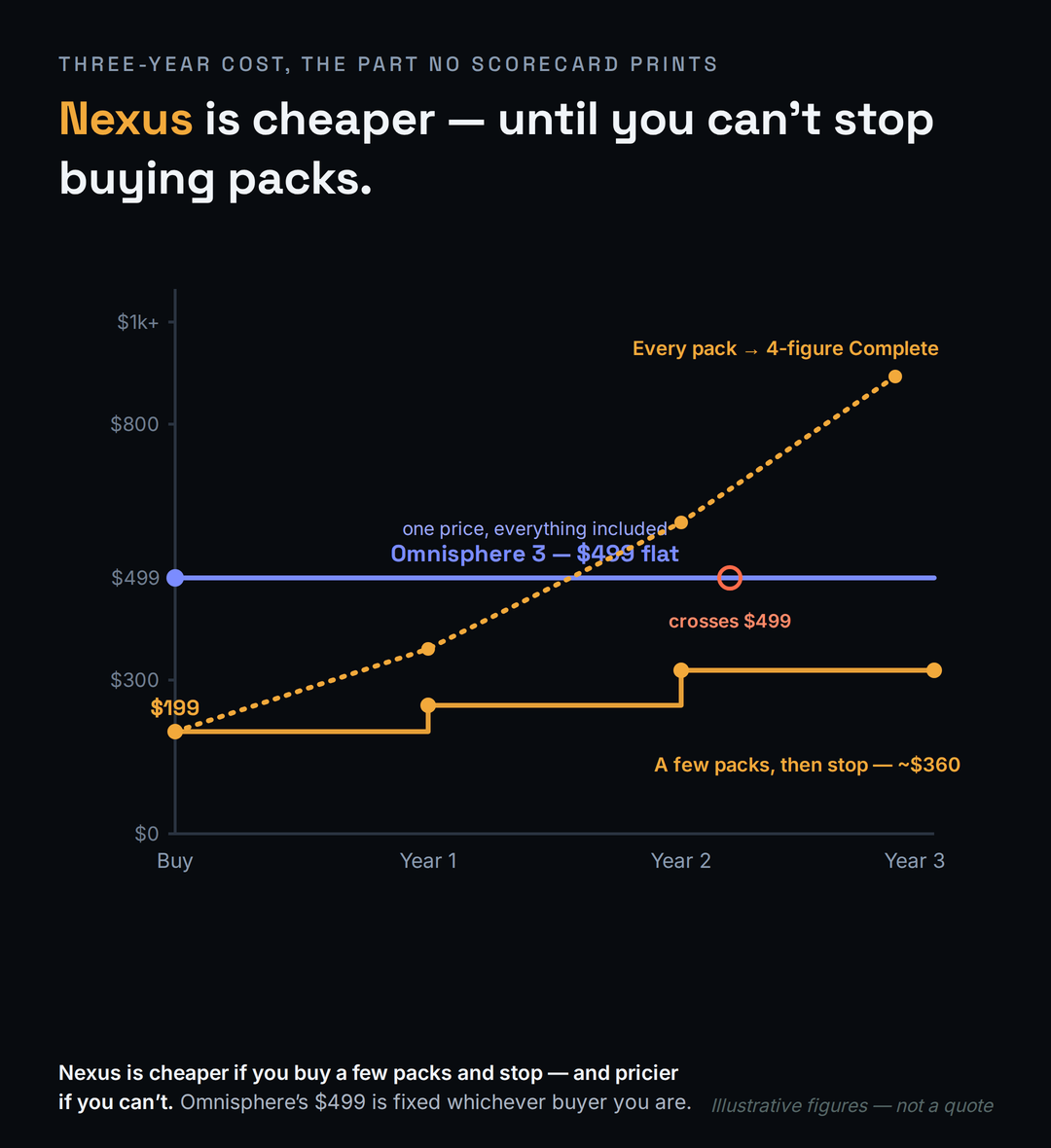
The number that decides real cost is the one no scorecard prints: the expansion spiral. Omnisphere’s $499 buys the whole library, full stop — 18 collections, 26,000+ patches, nothing else to purchase to be “complete.” Nexus’s cheap entry buys a strong but finite factory set, and reFX’s catalogue of expansion packs (roughly $40–$60 each, sold continuously, with a Bundle Builder offering 5, 10, 15 or 25 at a time) is engineered to keep you spending. A producer who buys Nexus and then ten or fifteen expansions over a couple of years can quietly pass Omnisphere’s flat price — and the reFX Complete bundle, which gathers everything, runs into four figures, well beyond a single Omnisphere licence.
So the honest value verdict flips depending on discipline. If you buy Nexus 5 and a couple of packs and stop, it is dramatically cheaper and the better value — which is why it still edges the value axis at 8.6 to 8.5. If you are the kind of buyer who collects every expansion, Omnisphere’s one-and-done $499 is the cheaper, calmer long-run choice. Map your own three-year spend before you let the entry price decide; the diagram below shows both trajectories.
Put real numbers on it. Buy Nexus 5 at around $199, add three expansions you actually wanted at roughly $50 each, and you are near $350 all-in — comfortably below Omnisphere and a clear win if those packs cover your needs. Keep going, though, and the curve bends: ten packs is another $500 on top of the instrument, fifteen is more, and reFX’s Bundle Builder (buy 5, 10, 15 or 25 packs at a discount) exists precisely because the company knows collectors keep buying. The reFX Complete bundle, which gathers the entire expansion catalogue, runs well into four figures — multiples of a single Omnisphere licence. Omnisphere’s flip side is that its $499 is genuinely everything, and Spectrasonics’ refusal to run sales, while frustrating when you are waiting for a discount, is the thing that keeps its cost predictable: there is no upsell path, no “complete your collection” prompt, nothing else to buy. Whether Nexus’s low entry or Omnisphere’s flat ceiling is the better deal is not a fact about the synths — it is a fact about your own buying discipline, and you should be honest with yourself about which kind of buyer you are before the entry price seduces you.
The Spec Table, Side by Side
| Spec | Nexus 5 (reFX) | Omnisphere 3 (Spectrasonics) |
|---|---|---|
| Released | Nov 2024 (ROMpler → full synth) | Oct 2025 (10 years after v2) |
| Engine type | Multi-engine, fast preset workflow | Sample + synth hybrid, deep multi-layer |
| Generators / synthesis | 8: VA, sampler, wavetable, time-stretch, retro, grain, cloud, FM | Sample, wavetable, FM, granular; 4 layers + Harmonia |
| Factory presets | 5,300+ (1,100+ new) | 26,000+ patches, 18 libraries |
| Sound-design depth | Open engine (new in v5), mod matrix, editors | Quadzone, 36 filters, dual freq shifter, Patch Mutation |
| Effects | Built-in FX (Bucket Brigade, Particle Reverb, etc.) | 35 new FX + standalone Omnisphere FX plugin |
| MPE | No | Yes (full MPE) |
| Hardware integration | — | 300+ profiles, 36 brands |
| Activation / dongle | Online activation, no dongle, offline use | Challenge/response auth, USB or download |
| CPU profile | Light, fast preset loading | Heavier; 64 GB library, optimised in v3 |
| Entry price | ~$199 (regional, frequent sales) | $499 ($199 upgrade from v1/v2) |
| Genre fit | Electronic-first (EDM, house, trance, hip hop) | Every genre; scoring, ambient, hybrid |
| Demo available | No | No (dealer demo only) |
Specs and prices verified June 23, 2026 against the reFX and Spectrasonics product pages and 2024–26 reviews (Sound on Sound, MusicRadar, Synth Anatomy). Nexus 5 pricing is quoted regionally and discounted often; Omnisphere 3 holds at $499. Confirm current figures at each vendor before purchase.
Who Should Buy Which — and Which to Buy First
Buy Nexus 5 if you make modern electronic music and your honest problem is finishing tracks. It is a momentum machine: cheap to enter, light on your CPU, and faster than anything else at turning a preset into a mix-ready idea. The 2024 engine means you are no longer locked out of designing your own sounds when you want to, but the reason to own it is speed, and for a producer who ships dance music week after week, speed is worth more than depth they would rarely use.
Buy Omnisphere 3 if your work is broad or deep — scoring, ambient, hybrid production, sound design, or simply a refusal to sound like everyone else. It is the career instrument: one $499 purchase that covers every genre, goes as deep as you will ever need, and keeps revealing new corners a decade in. If you already own Omnisphere 2, the $199 upgrade is close to a no-brainer for the new libraries, filters, effects and the standalone Omnisphere FX plugin alone.
To make those two cases concrete: the producer who should buy Nexus 5 is the bedroom EDM, future-bass or trap artist who releases regularly, works entirely in the box, wants sounds that are competitive the second they load, and would rather spend their energy on arrangement than on synthesis. Still learning the fundamentals? A free synth like the one in our Vital review — and our Serum 2 vs Vital comparison — is the smarter first stop. The producer who should buy Omnisphere 3 is the composer, scorer, ambient artist or sound designer whose value to a project is having sounds no one else has, who is happy to spend an evening building a patch, and who wants one instrument deep enough to last a career. Plenty of people are a blend of the two, which is exactly why “own both eventually” is the honest endgame — but blends still have a dominant need today, and that need is what should decide the first purchase.
And here is the answer the forums dodge, for the reader who can only buy one: choose the instrument that removes your current bottleneck, not the one with the bigger spec sheet. If you stall before the finish line, buy Nexus 5 first — the momentum it gives you is worth more right now than depth you are not yet using. If your tracks are competent but generic, buy Omnisphere 3 first — originality is your missing ingredient and depth is the cure. “Eventually both” is the honest long game, because they genuinely solve different problems. But the right first purchase is whichever fixes the problem you actually have today, and now you can name it.
If you already know you will eventually own both — many working producers do — the ordering still matters, because the first instrument should pay for itself fastest in your current work. A producer shipping electronic tracks now will recoup Nexus 5 in saved time and finished releases within weeks, then add Omnisphere later when their sound is ready to deepen. A composer building a scoring career will get more from Omnisphere 3 first, then add Nexus as a fast-idea sketchpad once the deep instrument is in place. Same destination, different on-ramp; let your present income and output, not the spec sheets, decide which one you buy this year.
Practical Exercises
- Open Nexus 5, browse to a lead or pluck in your genre, and time how long it takes to reach four bars you would actually keep in a track. Note the moment it felt “done.”
- Open Omnisphere 3 and do the same: find a comparable patch, shape it with the Adaptive Global Controls until it fits, and time that too.
- Compare the two clocks and, more importantly, which process you enjoyed. If Nexus got you there in seconds and that felt great, you are a speed buyer. If Omnisphere’s deeper search felt like the fun part, you are a depth buyer. That answer is your synth.
- In Nexus 5, start from a blank patch — not a preset. Add a virtual-analog generator and a wavetable generator, and detune them slightly against each other.
- Open the modulation matrix and route an LFO to the wavetable position and an envelope to the filter cutoff. Load one of your own samples into the sampler generator as a third layer for body.
- Save it as your own patch. You have just built an original multi-generator sound from scratch in “the preset synth” — the exact capability that did not exist before version 5, and the reason the old framing is obsolete.
- In Omnisphere 3, set up four layers: a granular pad, a deep-sampled organic source, a wavetable lead, and an analog-modeled bass.
- Use Quadzone to blend the four with a fader (or polyphonic aftertouch), so a single performance moves between texture, body and bite — the layering technique taken to its limit. Add the dual frequency shifter and a couple of the new filter colours for movement.
- Try to reproduce the result in Nexus 5. You will get close on the individual elements but not on the single-instrument, performance-blended whole — which is precisely the depth you are paying $499 for, and the clearest proof of what Omnisphere is for.