Search “reFX Nexus 5 review” and you land in a crossfire. One camp treats it as the secret weapon behind every chart hit and the other dismisses it as a preset crutch — a ROMpler you bolt on when you can’t be bothered to design a sound. Both takes are a generation out of date, and neither answers the question a working producer actually has. You don’t care whether Nexus is “cheating.” You care whether it gets you from a blank project to a finished, mix-ready idea faster than anything else — and what it costs you to get there.
So here is the honest version up front. Nexus 5 is the fastest path from nothing to a glossy, radio-ready sound that exists in software, and that speed is genuinely valuable. In late 2024 it also stopped being “just a ROMpler”: version 5 cracked open the sealed engine and added a real sample editor, a wavetable editor, FM and granular oscillators, virtual-analog with soft sync, a six-band EQ and a full modulation matrix. You can now build a patch from zero and see under the hood. But the speed is a workflow choice, not a sound-design tool, and the place people actually overspend is the editions and the expansion economy. Which version you buy, and when you stop buying expansions, is the real decision — bigger than any feature on the box.
How we approached this. We re-verified every edition, price, format, build number, and synthesis feature against reFX’s live product, version-history, and support pages this session, alongside current third-party coverage and the active user community — not older write-ups, several of which still describe the closed Nexus 2 engine. This is a reasoning-and-documentation review, not a first-party listening test: we did not run a controlled A/B in our own room, so every judgement about how Nexus sounds or how heavy a patch feels is framed as reasoning from documented behaviour and the consensus of producers who use it daily — never a fabricated “it sounded like” claim. Where a number can move with a sale, we tell you to confirm it live. One thing to be clear about before a single dollar changes hands, because it shapes everything below: reFX sells Nexus and its expansions direct-only — there is no Plugin Boutique or Sweetwater link, no third-party retailer, and nothing in this review earns us a commission. It exists to answer the question honestly.
reFX Nexus 5 is the fastest preset-to-finished-idea instrument a producer can run — glossy, mix-ready sounds in seconds, a 5,300-plus preset library, and, since v5, a genuinely capable synth engine underneath. Buy it if you make EDM, Trance, House, Hip-Hop, or Pop and want inspiration and finished sounds now, you value speed over designing patches by hand, and you’ll pick the right edition and stop. Skip it if you want to design your own sounds — that’s Serum, Vital, or Diva — if you don’t make its core genres and can’t justify the entry price, or if you’re wary of the expansion-cost spiral and want third-party return options. It’s not a rival to a sound-design synth; it’s a complement, and most producers benefit from owning one of each kind.
The Verdict
The fastest blank-project-to-mix-ready-idea instrument there is — and now a real synth too — as long as you treat it as a workflow choice, not a sound-design tool, and buy the edition you’ll actually use.
| Sound quality / polish (mix-ready factor) | 9.2 | |
| Speed to a finished idea | 9.4 | |
| Preset library breadth | 9.1 | |
| Sound-design depth (build-from-scratch) | 7.6 | |
| Workflow / browsing / GUI | 8.8 | |
| Value (edition-dependent) | 7.9 | |
| Who-it’s-for clarity | 8.6 |
That overall is a defended judgement, not an average, and the spread is the whole story. Speed to a finished idea (9.4) and sound quality (9.2) are where Nexus wins outright: nothing else gets you to a polished, mix-ready sound this fast, and the factory presets are engineered to sit in a modern mix with almost no work. Library breadth (9.1) reflects 5,300-plus presets across every club genre. Workflow (8.8) is the fast browser, the activity-lit routing page, and the one-click retro skin. The two numbers that pull the overall down to 8.5 are the honest ones. Value (7.9) is edition-dependent — the Starter is a fair deal, the Complete is a luxury — and the expansion economy is where budgets quietly bleed. And sound-design depth (7.6) is the catch worth dwelling on: the engine is now genuinely open and capable, a real upgrade, but it is not a from-scratch design environment the way Serum or Diva is, and pretending otherwise would be the same dishonesty the hype reviews trade in. Every one of these is defended below.
What Nexus 5 Actually Is in 2026
Get the category right first, because it’s the thing most people get wrong. For nearly two decades Nexus was a ROMpler — a preset playback instrument built on sampled and pre-designed sounds, with a sealed engine only reFX’s own designers could touch. You loaded a patch, nudged a few macros, tweaked the filter and effects, and that was the extent of your control. That closed design is exactly why purists sneered and why working producers loved it: you got world-class, finished sounds instantly, at the cost of being unable to build your own. If you wanted to design from scratch, you bought a different synth.
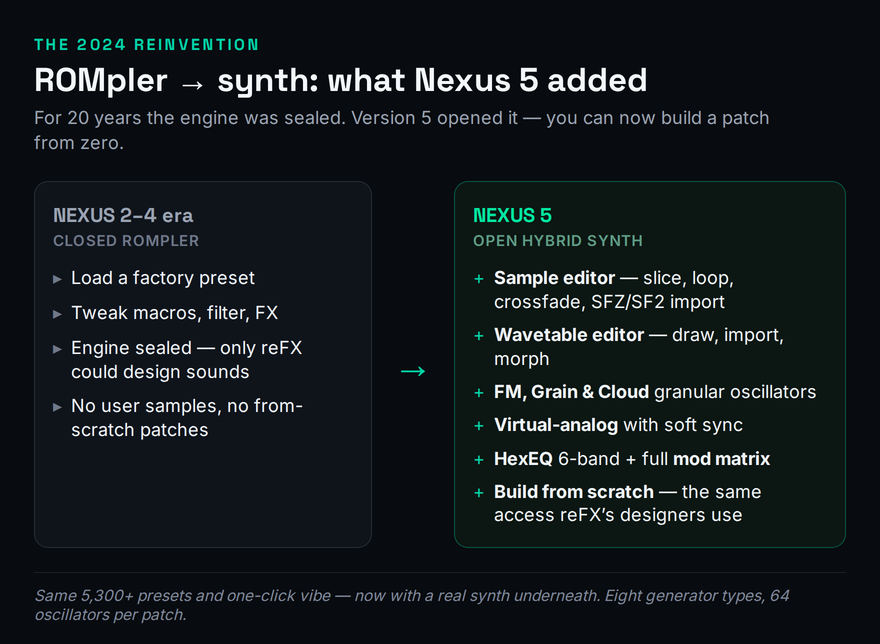
Version 5, released in November 2024 and now on the v5.4.11 build (March 2026), changed the premise without abandoning the appeal. reFX opened the architecture. You now get the same access the company’s own sound designers use: full reach into every engine parameter, the ability to import your own single samples, multisamples, and whole libraries, and the tools to package your own sounds as expansions. The eight generator types — Virtual Analog, Sampler, Time Stretcher, Wavetable, Retro Sampler, Grain, Cloud, and FM — can be layered and routed freely across up to four processing layers, with as many as sixty-four oscillators in a single patch. It still loads every preset and project from older versions, and a one-click retro skin brings back the classic Nexus 2 face for anyone who misses it. The honest one-line summary: it kept everything that made it the most-used club synth of the last twenty years and bolted a real synthesizer underneath.
Why does this matter to your buying decision? Because it means Nexus 5 now serves two producers who used to need two different plugins. The first is the producer Nexus always served — someone who wants a finished, professional sound right now and will tweak it lightly. The second is new: someone willing to dig into the engine, import their own samples, and shape a patch that didn’t ship in a factory bank. The first producer is who Nexus is built for and where it’s untouchable. The second is now genuinely served, but with a ceiling we’ll be honest about. If you’re newer to the underlying concepts, our primer on what a synthesizer actually is and the free synthesis-type selector will make the eight-generator spread far less abstract.
The Speed: Preset-to-Finished-Idea
Here is the thing the dismissive reviews refuse to credit: speed to a finished idea is a real, defensible feature, not a moral failing. The hardest part of a track is rarely the synthesis — it’s momentum. You open a project, you have a feeling, and the distance between that feeling and a sound that actually captures it is where most ideas die. Nexus collapses that distance. You browse a fast, well-tagged library, you audition presets that were engineered by professionals to be mix-ready, and within seconds you have a lead, a pluck, a bass, or a pad that already sounds like a record. No designing an oscillator stack, no EQ-ing the harshness out, no fighting the patch into the mix. The polish is baked in.
That polish is the 9.2 on the scorecard, and it’s earned. Nexus presets are loud, wide, and pre-balanced in a way that flatters a modern EDM or future bass arrangement. Each patch has a deep per-layer effects chain plus a global master section, so the reverb, delay, and saturation that make a sound feel finished are already dialled. The new effects — a Bucket Brigade Delay, a granular Particle Reverb, a Vowel Filter, a Rotary, a Pusher — add character without you reaching for third-party plugins. Stack that on the arpeggiator, which now saves its pattern directly with the preset, and the trance gate, and you get not just a sound but a moving, rhythmic part the moment you load it. For a producer chasing a feeling, that’s the difference between finishing a sketch tonight and abandoning it.
There’s a second, quieter reason producers reach for Nexus when the clock is ticking: it’s light and it doesn’t break. Because the core of its sound is sample-based playback rather than heavy real-time synthesis, Nexus is famously easy on the CPU — you can stack a dozen instances across a busy arrangement without the meter spiking the way a bank of wavetable or granular synths would. Preset loading is near-instant, and the plugin has a long-standing reputation for stability that matters more than it sounds: nothing kills momentum like a synth that stutters, drops out, or crashes mid-idea. That reliability is part of the 8.8 workflow score and a real practical edge over heavier instruments — it’s the difference between a tool you trust under deadline and one you babysit.
The honest framing is the one our thesis insists on: this is a workflow advantage, not a sonic one you couldn’t achieve elsewhere. A skilled sound designer can build any Nexus preset from scratch in Serum given time. Nexus’s value is that you don’t spend the time — you spend it on the song instead. If you measure a synth by how fast it helps you finish music, Nexus is at the top of the table. If you measure it by how much it teaches you about synthesis or how far it lets you push an original sound, that’s a different axis, and a lower score, which is exactly the tension the rest of this review unpacks.
“Don’t Call It a ROMpler”: The New Synthesis Depth
This is the section that justifies the “5” and the one most reviews either over-hype or ignore, so let’s be precise about what version 5 actually opened up. The sealed door is gone. You can now build a patch from scratch with full access to the engine, and the toolkit to do it is real. The sample editor imports single samples, multisamples, or whole libraries and lets you slice, loop, and crossfade them — with automatic drum-loop slicing and SFZ/SF2 import — so your own recordings become playable oscillators. The wavetable editor, added in the March 2026 build, lets you draw custom waveforms, import audio as wavetable sources, and morph between them in real time. There’s an FM oscillator, Grain and Cloud granular generators, a virtual-analog oscillator with soft sync, and a full modulation matrix that routes any source to any destination, with modulated controls showing an orange ring so you can see what’s moving. The new HexEQ six-band equaliser and a 40-plus effect roster round it out. On paper, that’s a hybrid synthesizer, full stop.
In practice, here is the honest limit, and it’s the 7.6 on the scorecard. Nexus 5’s engine is open, but it is not designed around from-scratch sound design the way a true design synth is. Serum, Vital, and Diva are built so the patch is the workflow — the entire interface exists to make designing a sound the fast, fluent, central act. Nexus is built so the preset is the workflow, with synthesis available underneath for those who go looking. That’s a meaningful difference in the doing. A producer who lives in Serum’s wavetable editor will find Nexus’s capable but secondary; a producer who lives in Nexus’s preset browser will rarely open the engine at all. And there’s a subtler nuance: many of Nexus’s most beloved sounds are heavily sampled — expansion presets built on recorded audio — so “build from scratch” doesn’t mean you can deconstruct a flagship factory patch down to first principles and rebuild it. You can build your own patch from zero; you can’t always reverse-engineer theirs.
It’s worth being honest about who that open engine actually serves, because the marketing implies everyone and the reality is narrower. Most Nexus buyers — the people the instrument is designed for — will open the synthesis page rarely, if ever; they bought a preset machine and they use it as one, and that’s a completely valid way to own it. The open architecture is a meaningful gift to a specific minority: the curious producer who wants to start learning sound design without leaving a familiar tool, and the power user who wants to import their own samples or push a patch past what the macros allow. If you’re in that group, the v5 engine adds genuine longevity to the purchase. If you’re not, it’s a feature you’ll appreciate exists but won’t miss — and you should price the instrument on its presets, not on a depth you won’t use.
So the fair verdict on depth is “genuinely real, genuinely a step change, genuinely not a Serum.” If you’ve never designed a sound and want to start, Nexus 5 is now a legitimate on-ramp, and our sound-design basics guide plus the synthesis-parameter reference will help you exploit it. But if your reason for buying a synth is to design original sounds as your primary craft, you should read this as “Nexus added a capable engine to a preset instrument,” not “Nexus became a design synth.” Buying it for the second reason is how producers end up disappointed by a genuinely good update. For the design-first buyer, the honest pointers are our best plugins for sound design roundup and the Serum 2 and Vital reviews.
The Editions: Starter vs Bundle Builder vs Complete
This is the decision the article is really about, because it’s where the money goes and where people overpay. Nexus 5 ships in tiers, all sold direct from reFX and all frequently on sale, so treat every figure here as a live-on-build-day number to confirm rather than a fixed price. The Starter edition is the entry point: 5,454 presets, 47 GB of content, and the full v5 synth engine, recently around $179 on sale (list $249). The middle option is the Bundle Builder, from around $269, which pairs Nexus 5 with your pick of 5, 10, or 15 expansions (and 25 during anniversary sales) at a discount versus buying the packs separately — so there’s no single fixed “mid” price, just a slider you build. At the top, the Complete edition includes all 204 expansions, 33,352 presets, and a colossal ~292 GB of content for around $1,999 on sale (against a $5,099 list).
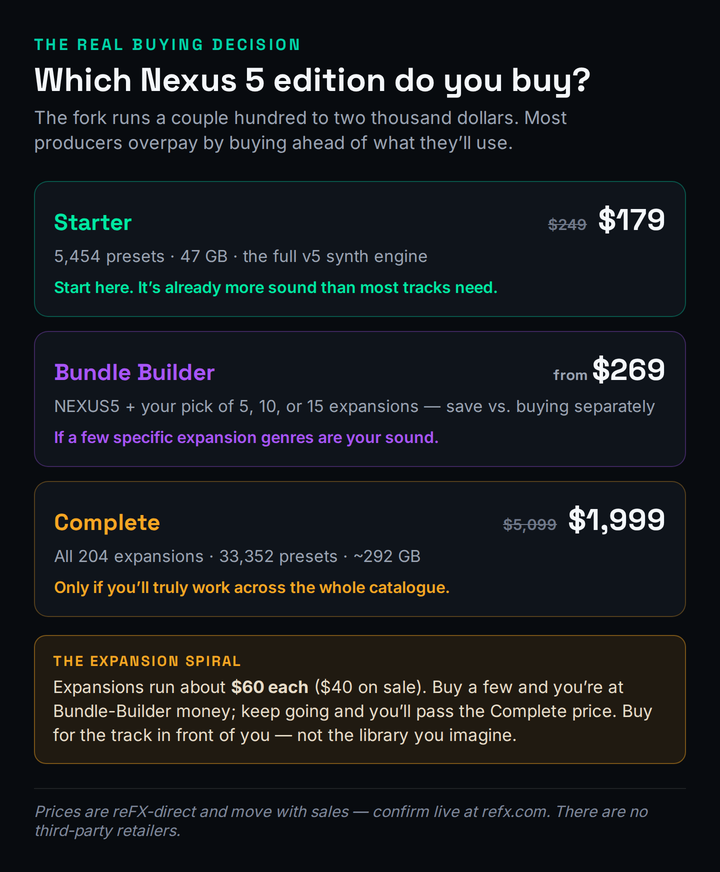
Here’s the buying logic stripped of reFX’s marketing. The Starter edition is the right call for the overwhelming majority of producers. Five thousand professionally-made presets across EDM, Melodic Techno, House, Hip-Hop, Lo-fi, Retrowave, Drum & Bass, Trance, and more is already far more sound than any one project needs, and it includes the complete synth engine, so you lose no capability by starting there — only some expansion content you can add later, à la carte, when a specific track demands it. The Bundle tiers make sense only if you already know that two or three specific expansion genres are your sound and you want them at a discount up front. The Complete edition is a genuine luxury: at $1,999 it’s a serious instrument purchase, justified only if you work across an enormous spread of styles and will actually open most of those 204 packs.
And then the trap, the thing nobody writing a glowing review will tell you: the expansion economy is where Nexus quietly becomes expensive. Expansions run about $60 each at list, often $40 on sale, with bulk discounts that stack as you add more to a cart. One pack a month is a coffee-budget habit that, within a couple of years, can out-cost the entire Complete edition — and because each pack is a fresh, genre-perfect dopamine hit, the habit is easy to feed. Producers on forums describe it bluntly as a “cash cow” built on expansions, and the criticism that the libraries can start to feel repetitive over time is fair: buy ten EDM packs and you’ll hear family resemblance. The discipline that keeps Nexus a great deal is simple and worth stating as a rule: buy for the track in front of you, not the library you imagine. The Starter plus the occasional targeted expansion is a phenomenal value; the open-ended pack habit is the overspend.
Nexus vs Serum vs Avenger vs Omnisphere
The right way to choose between these is not “which is best” — they answer different questions — but “which problem do I have.” The first and biggest fork is finished sounds fast versus designing your own. If you want glossy, mix-ready results and inspiration on tap, that’s Nexus. If you want to build a sound from a blank oscillator and learn synthesis as your craft, that’s Serum 2 or the free-to-start Vital — deep wavetable design environments where the patch is the whole point. These aren’t competitors so much as different tools for different stages of the same job, which is why our advice is the unfashionable one: most working producers benefit from owning one of each kind, a preset-first instrument for speed and a design-first synth for originality.
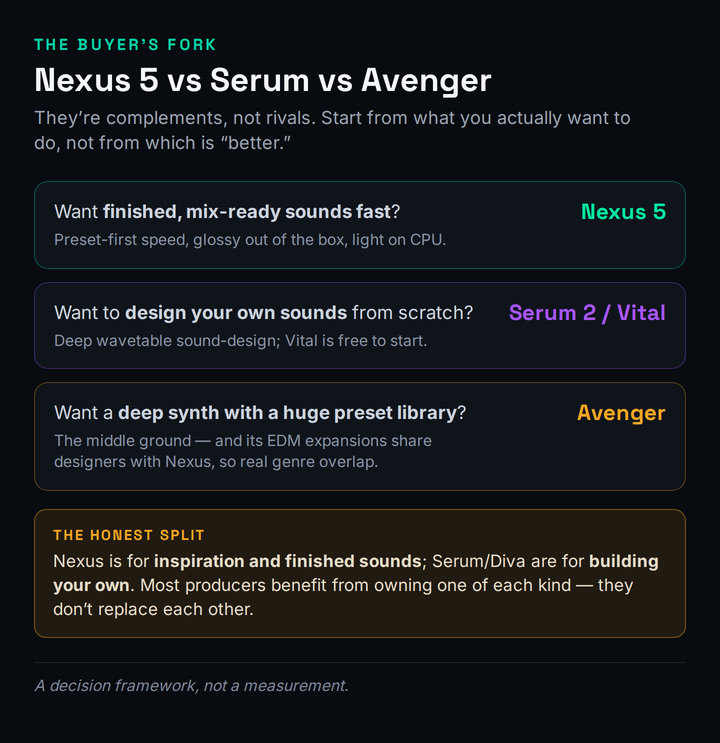
The most interesting comparison is the middle ground: Vengeance Avenger. Avenger is a deep, modern synthesizer that also ships with a huge, growing preset library and a constant stream of EDM-focused expansions — so it overlaps Nexus’s territory more than Serum does. There’s a real and honest connection worth naming: the EDM and club expansion content for both Nexus and Avenger is often crafted by the same Vengeance-Sound designers (Manuel Schleis and collaborators), who have a long history sound-designing for reFX. That shared lineage is why the two can sound like cousins on a club track. The practical difference is temperament: Avenger is the bigger, more powerful, more complex instrument — deeper to design in, but heavier on CPU and, by broad community consensus, buggier and harder to learn. Nexus is lighter, faster, more stable, and far simpler to get a result from, at the cost of that design ceiling. If you want maximum synthesis power with a big preset library and you’ll tolerate complexity, Avenger. If you want speed, polish, and stability, Nexus.
The fourth point of comparison, Omnisphere 3, is a different animal again — a sprawling sound-design workstation with an enormous core library and unmatched depth of synthesis and processing, aimed at the producer who wants a single deep instrument for cinematic, ambient, and hybrid work rather than club-ready EDM patches in seconds. It’s the workstation cousin, not the speed tool. For the full head-to-head between the design-synth heavyweights, our Omnisphere 3 vs Serum 2 comparison and the Massive and Arturia Pigments reviews map the rest of that field. The short version: Nexus is the one you reach for when the goal is a finished idea, not a designed sound — and knowing that going in is the difference between loving it and feeling let down.
Where It Falls Short
A review that only praises is an advertisement, so here are the honest knocks, named plainly. First, the expansion-cost spiral we’ve already covered — the single biggest way Nexus becomes a money pit, and the reason “it’s a cash cow” is a fair, recurring criticism rather than just cynicism. Second, genre lean: Nexus is unapologetically built for EDM, Trance, House, and adjacent club and pop styles. It has cinematic, lo-fi, and retrowave content, and the new engine widens its range, but if you make jazz, folk, orchestral, or anything outside the electronic/pop axis, much of the library won’t serve you and the “is it worth $179 if I don’t make EDM” question is a legitimate one to answer with “probably not, look elsewhere.”
Third, preset fatigue over time. The flip side of instantly-finished sounds is that thousands of producers are using the same instantly-finished sounds, and a heavy Nexus user can start to recognise the fingerprint — the same supersaws, the same plucks, the same vocal chops — in their own work and everyone else’s. The fix is to use Nexus as a starting point and then layer, process, and personalise rather than dropping a raw preset into a final mix; our guide to layering synths is the antidote to the “everyone’s track sounds the same” problem. Fourth, and not to be glossed over, is reFX’s DRM and customer-service history. The company has carried a reputation in the community for rigid licensing and uneven support over the years; activation is now cleaner than the old dongle era (more on that next), but the track record is real and worth knowing before you commit to an ecosystem you can only buy direct. Finally, the build-from-scratch nuance from earlier bears repeating as a limitation: the open engine is real, but heavily-sampled expansion presets aren’t fully editable down to their source the way a from-scratch synth patch is — so “open architecture” has a practical ceiling.
The reFX Direct-Sale Reality
Buying Nexus doesn’t look like buying most plugins, so know the shape of it before you commit. reFX sells direct-only: its own site is the sole retailer, with no Plugin Boutique, no Sweetwater, no Amazon, and explicitly no third-party stores for the plugin or the expansions. That has two consequences worth weighing. The upside is that pricing and bundles are controlled in one place and the company runs frequent site-wide sales, so patience is rewarded. The downsides are the absence of the third-party-retailer return windows, voucher stacking, and storefront protections some buyers prefer, and the fact that you’re committing to a single vendor’s ecosystem and support for the life of the product. If you value being able to buy through a familiar storefront or chase a marketplace deal, this is a genuine friction.
The mechanics themselves are modern and, notably, dongle-free — the old USB-eLicenser is gone. Everything is handled through the reFX Cloud app, which manages downloads, installation, and content location. Activation is a quick online step; after that, Nexus runs offline indefinitely, and you can activate on up to three of your own computers at once and deactivate from your account as needed. reFX also permits genuine second-hand license transfers (you contact them to initiate the transfer rather than just handing over account details), which is more owner-friendly than many subscription tools. The upgrade path is reasonable too: owners of Nexus 4 and earlier can move up to Nexus 5, often with a free expansion thrown in during promotions, and all existing Nexus projects and libraries load straight into v5. None of this is a dealbreaker, but it’s a different ownership model than a one-click Plugin Boutique checkout, and you should buy it with eyes open.
Who Should Buy It, Who Should Skip It
Buy Nexus 5 if you make EDM, Trance, House, Melodic Techno, Hip-Hop, Trap, Pop, or future bass and you want glossy, mix-ready sounds now. Buy it if you value speed and inspiration over designing patches by hand — if the bottleneck in your music is finishing ideas, not crafting original timbres, Nexus removes that bottleneck better than anything on the market. Buy it if you want a professional, low-CPU, stable instrument that loads fast and gets out of your way. And buy it if you’ll exercise edition discipline — start with the Starter, add expansions only when a specific track calls for one, and you’ll have a phenomenal value tool rather than an open-ended bill.
Skip it — or rather, buy a design synth instead — if you want to design your own sounds from scratch as your primary craft; that’s Serum, Vital, or Diva, and our best synth plugins and best plugins for EDM roundups will point you to the right one. Skip it if you don’t make Nexus’s core genres and can’t justify the entry price for a library you’ll barely use. Skip it if you’re wary of the expansion spiral and know yourself well enough to predict you won’t stop buying packs. And weigh it carefully if third-party-retailer protections, returns, or marketplace deals matter to you, since direct-only is the only way in. The honest test is the one we opened with: if your goal is a finished, mix-ready idea fast, nothing beats Nexus. If your goal is to build original sounds yourself, you’re shopping in the wrong aisle — and the two aisles are complements, not rivals.
Try It Yourself (Free Trial Mindset)
The fastest way to know whether Nexus fits your workflow is to put it through the three jobs below, in order — they move from “does the speed impress me” to “can I get past the preset.” If you don’t own it yet, run them in your head against the demos, or against the trial if reFX is offering one when you read this; the questions are what matter. Keep the free ADSR visualizer and synthesis-parameter reference open alongside — they make the engine’s controls click far faster.
- Open Nexus on an empty track and give yourself five minutes to browse the library and load three presets — a lead, a bass, and a pluck — that already sound like a record.
- Play them against a simple drum loop and notice how little you have to do to make them sit. That “already finished” feeling is the product.
- Now ask the honest question: did the speed help you capture an idea, or did it tempt you to accept the first thing you heard? Both answers are useful.
- Take one preset and resist using it raw. Open the layers, swap or detune an oscillator, reshape the filter envelope, and change the effects chain.
- Layer it with a second sound and process the stack so the “Nexus fingerprint” recedes and the part sounds like your track, not the demo.
- A/B your version against the factory patch. The distance you just covered is the work that keeps your music from sounding like everyone else’s.
- Start from an init patch and build a sound from zero using the new generators — a virtual-analog or FM oscillator, a custom wavetable, or one of your own imported samples sliced in the sample editor.
- Route a couple of modulation-matrix assignments and shape it with the HexEQ and effects until it’s a genuinely original patch.
- Judge honestly how the design experience compares to your main synth. That comparison — not the preset count — tells you whether Nexus 5’s depth matters to you.
The Verdict
reFX Nexus 5 is the best preset-to-finished-idea instrument a producer can buy in 2026 — the fastest route from a blank project to a glossy, mix-ready sound, a 5,300-plus preset library engineered to sit in a modern club or pop mix, low CPU, rock-solid stability, and, since the 2024 reinvention, a genuinely capable open synth engine underneath. At an 8.5 it earns a clear recommendation for the producer it’s built for. The half-point-and-then-some that keeps it from higher is the honesty the hype reviews skip: the synthesis depth is real but it’s a complement to a design synth, not a replacement; the value is excellent at the Starter tier and a luxury at the top; and the expansion economy will quietly drain a budget if you let it. Go in wanting finished sounds fast and an instrument that respects your momentum, and Nexus is superb. Go in expecting a sound-design rig or a one-edition-fixes-everything purchase, and you’ll write the “overrated” review yourself.