Here's the thing almost every “how to sell type beats” guide gets wrong: it treats type beats like a genre. They're not. A type beat is a YouTube search system with a licensing ladder bolted onto it — and there's a line in the title nobody warns you about that can get your video pulled. Win the title, you win the search. Win the ladder, you win the income. Get the legal part wrong and you lose both. This playbook covers all three, with the title formula spelled out, the platform fees checked this week, and the grey area told straight.
A type beat is an original instrumental made in a named artist's style and titled as such (a “Drake type beat”). You get paid by posting it free on YouTube to win search, then converting that traffic into licenses on a beat store — a tiered ladder running from a $20–$40 MP3 lease up to an exclusive sale. The title is the SEO; the ladder is the money; and the artist's name in the title is descriptive use, not a license to imply endorsement.
This article contains affiliate links. If you sign up for a platform through one, we may earn a commission at no extra cost to you. It never changes the recommendation — the fees and trade-offs below are reported as we verified them, not as anyone paid us to frame them.
What a “Type Beat” Actually Is
A type beat is an original instrumental built to sound like it belongs in a particular artist's catalog, and then labeled with that artist's name so the right buyer can find it. “Drake type beat,” “Travis Scott type beat,” “Lil Baby type beat” — each names a sound, not a song. The producer hasn't sampled anything the artist made; they've studied the textures, the drum patterns, the chord moods, the mix, and reverse-engineered the feel. A rapper or singer searching that phrase isn't looking for the artist's actual music. They're looking for a familiar, ready-to-write-to vibe they can lease cheaply and turn into their own song tonight.
That distinction is the whole business. The phrase “type beat” exists because buyers needed a search term for “give me something that feels like X,” and producers needed a way to be found by exactly those buyers. It is one of the highest-volume search behaviors in all of music: at any given moment a wall of people are typing an artist's name plus “type beat” into YouTube, and a smaller wall of producers are racing to be the result they click. The platforms underneath have moved real money — BeatStars alone reports having paid producers well over $200 million — and type beats are the engine of most of it.
It helps to picture the actual buyer, because the whole funnel is built for them. They're usually an independent rapper or singer without a producer on call — someone who needs a beat tonight, has a phone and a small budget, and wants something that already sounds like the lane they're chasing. They don't want to commission a custom track and wait two weeks; they want to audition fifty options in an afternoon, grab one that hits, and write to it. That's why “type” framing won: it lets a buyer describe the exact sonic neighborhood they're shopping in with two words and a name. Your job as the seller is to be standing on the corner of that neighborhood with a sign they can read from the search bar.
If you already know how to make trap beats, drill, or phonk, you have the production half. This article is the other half: how to package, title, host, and sell what you make so it actually earns. It's a sibling to our broader guide on how to sell beats online — this one zooms all the way in on the type-beat machine specifically, because that machine has its own rules.
Is It Legal to Make and Sell Type Beats?
Let's put the uncomfortable question first, because most guides bury it. The honest answer has two halves, and conflating them is where producers get into trouble.
Making an original beat in an artist's style is legal. A musical style — a vibe, a tempo range, a drum aesthetic, a mood — cannot be copyrighted. Copyright protects specific expression: a particular melody, a particular recording, a particular set of lyrics. It does not protect “dark, moody trap with a detuned bell lead.” So a beat that captures the feeling of an artist without reproducing any of their actual notes is your original work, full stop. This is the safe core of the entire practice, and everything else is built on it.
The grey area is the title. Putting “[Artist] type beat” on a video relies on what's called nominative or descriptive fair use — the idea that you're using the artist's name to describe what your beat sounds like, the way a generic-brand cereal box can say “compare to the leading brand.” That's a real legal concept, but applied to artist names in commercial beat titles it is unsettled. It has not been cleanly tested and won in the way producers casually assume. The exposure isn't usually copyright — it's trademark and right of publicity: a famous name has commercial value, and using it in a way that implies the artist made, approved, or endorsed your beat is where the risk lives. On top of that, platforms can remove a title on request regardless of who is technically right.
It's worth separating the three rights people blur together, because they fail in different ways. Copyright covers the actual notes and the actual recording — you infringe it only by reproducing a melody, a sample, or a master that someone else owns (it’s the same protection that, pointed the other way, lets you copyright your own music). Trademark covers brand identifiers — an artist's logo, a registered stage name used as a brand — and you brush against it by using those marks in a way that suggests an official association. Right of publicity covers a person's commercial identity — their name and likeness as assets — and it's the one most relevant here, because it's what an artist would invoke if your title or thumbnail implied they made or endorsed your beat. Make an original beat and you're clear of copyright; keep the name descriptive and skip logos and photos and you stay clear of the other two.
It also helps to know what enforcement actually looks like, because the dramatized version scares producers out of a viable business. In practice, the common outcome isn't a lawsuit — it's a takedown. A label or platform flags a title, the video comes down, and the producer moves on. Lawsuits over a clearly-original instrumental titled descriptively are rare, because there's little to win and the descriptive-use argument is real. That's not a promise of immunity; it's the realistic risk profile. You're managing the small, common annoyance and steering well clear of the rare, serious one — and the mitigations below are how you do both.
![Legal map for the '[Artist] type beat' title: green means safe — an original beat in an artist's style, because a style cannot be copyrighted; amber means manage the risk — an artist's name used descriptively in the title, an unsettled grey area, mitigated by keeping it descriptive and adding a not-affiliated note; red means stop — copied melody, logos, or a faked co-sign, which is copyright infringement or right-of-publicity exposure.](../images/type-beat-legal-map.png)
So the practical map is green / amber / red. Green: an original beat in an artist's style — build everything here. Amber: the artist's name in the title, used purely descriptively — the convention everyone uses, manageable with the mitigations below. Red: copying an actual melody, using the artist's logo or photo, or implying a co-sign that doesn't exist. The red zone is where “grey area” becomes “infringement,” and no title formula saves you there. Treat the artist name as risk management, never as a guaranteed right — and if a section of your catalog is high-profile enough to worry you, that's a conversation for a music attorney, not a forum thread.
A style is not protectable. A melody is. The instant you hum an artist's actual hook into your beat — even “just as a placeholder” — you've crossed from making a type beat to copying a song. Keep it original and the green core holds.
The Title Formula That Does the Ranking
Now the part that actually makes the money find you. On YouTube — which is where type-beat discovery overwhelmingly happens — the title is the SEO. Buyers don't browse; they search a specific phrase, and your title either matches that phrase or it doesn't. The genre has converged on a formula so consistent it reads like a template, because the template is the search string:
(FREE) [Artist] Type Beat 2026 | [Mood] [Genre] Instrumental
Every segment is doing a job. Decode it and you understand why the convention is so rigid:
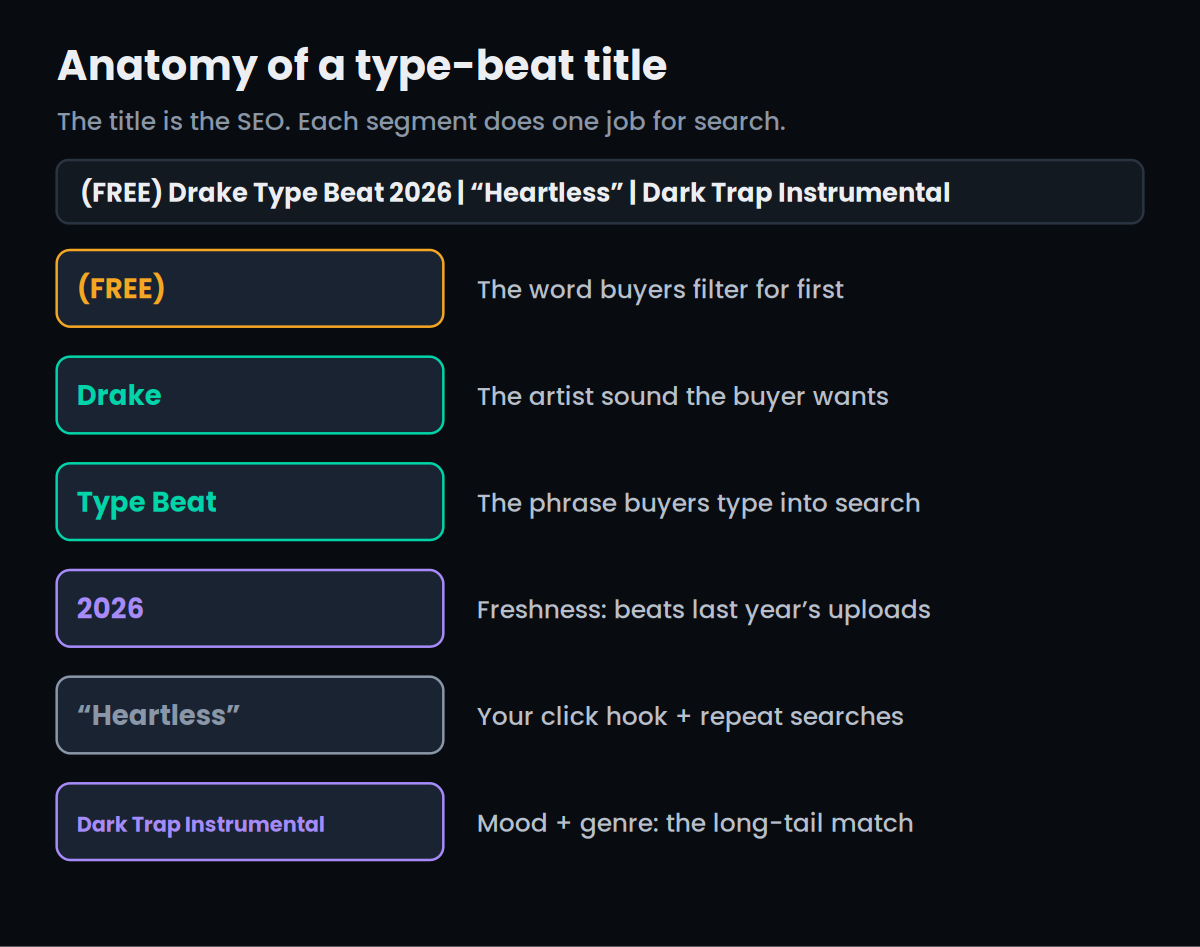
(FREE) is the filter word. A huge share of buyers specifically search “free type beat” because they want to try before they pay, and the free lease is your top-of-funnel lead magnet. [Artist] is the search anchor — the single most important word, because it's the sound the buyer is hunting. Type Beat is the literal phrase they type; omit it and you're invisible. 2026 is a freshness signal: buyers and the algorithm both favor current uploads, so dating the title pushes you above a pile of older results (and yes, you update the year). The quoted name (“Heartless”) is your hook for the click and a handle people use to find the beat again. [Mood] [Genre] Instrumental is the long-tail — “dark trap,” “sad drill,” “melodic R&B” — that catches the more specific searches with less competition.
Here's the discipline most producers miss: the artist you name has to actually match the beat. Mislabeling a generic loop as a “[big artist] type beat” to chase volume gets you clicks from disappointed buyers who bounce, which trains the algorithm that your videos don't satisfy the search — the opposite of what you want. Pick the artist whose sound you genuinely captured, and pick a few different ones across your catalog so you're not competing only against the most saturated name. The whole sequence — make it original, title it for search, tag and brand it, build the ladder, publish on a cadence, protect yourself — is the repeatable loop:
- Make it original. Produce a genuine beat in the artist's style. Imitate the feel, never the melody — the green core from the section above.
- Title it for search. Use the formula exactly:
(FREE) [Artist] Type Beat 2026 | [Mood] [Genre] Instrumental. The title is the ranking signal. - Tag, describe, brand. Artist-name and genre tags, a description with your license link and a not-affiliated note, and a consistent thumbnail and producer tag.
- Build the licensing ladder. Set MP3, WAV, trackout, and exclusive tiers on your host so a free YouTube lead can convert into a paid lease.
- Publish on a cadence. Upload at least weekly. Frequency and freshness are what compound a type-beat catalog.
- Protect yourself. Keep it original, keep the name descriptive, attach a written license to every sale, and never sell an exclusive built on un-cleared samples.
Walk one beat through it to see how concrete this gets. Say you made a slow, melodic instrumental with a detuned bell lead and rolling 808s that lands squarely in the Travis Scott lane, and you want to call it “Astroworld.” The title writes itself: (FREE) Travis Scott Type Beat 2026 | “Astroworld” | Dark Melodic Trap Instrumental. A buyer who searches “travis scott type beat” sees it; a buyer who searches the narrower “dark melodic trap” sees it too; and the “(FREE)” tag pulls the try-before-you-buy crowd. Now flip it — the same beat titled “crazy melodic beat 2026 💯” matches none of those searches and dies in obscurity no matter how good it sounds. Same audio, opposite outcome, and the only variable is whether the title speaks the buyer's search language. That's the entire lesson: in this business the title isn't marketing copy, it's the address.
Tags, Descriptions & Thumbnails
The title gets the click; the rest of the upload converts and reinforces it. Tags should mirror the search behavior: the artist name, “type beat,” the genre and mood, a couple of similar artists, and your producer name. Don't stuff fifty irrelevant tags — a tight, accurate set beats a noisy one.
The description is where you do the business. Lead with your purchase and contact links so the buyer never has to hunt for how to pay you, then state the lease terms in plain language, then add the legal housekeeping. A reusable skeleton:
| Description block | What goes in it |
|---|---|
| Purchase link | Direct link to this beat on your store (BeatStars / Airbit / Traktrain). |
| Lease summary | One line per tier: “MP3 lease $X · WAV $Y · Trackout $Z · Exclusive — DM.” |
| Usage terms | “Must credit (prod. [you]). Free lease = non-profit/demo use only.” |
| Contact | Email / Instagram for exclusives and custom work. |
| Disclaimer | “Not affiliated with or endorsed by [artist]. For promotional use only.” |
Thumbnails are your shelf presence. Pick one consistent layout — a recognizable color, your logo, big readable text naming the artist and mood — and reuse it so your channel reads as a brand at a glance. A buyer scrolling thirty near-identical search results clicks the one that looks like a store, not a screen recording. And put your producer tag (a short voice or sound stamp) into every free upload so a beat that gets passed around always points back to you. None of this is glamorous, but the producers who win the type-beat game treat the channel as a storefront, not a dumping ground — the same mindset as growing any music YouTube channel, applied to a producer's catalog.
Where to Host & Sell: BeatStars vs Airbit vs Traktrain
YouTube is the discovery engine, but you need a store to handle the licensing, delivery, and payment. Three platforms own most of this market, and they make different trade-offs. Fees and plans change often, so verify the current terms on each platform before you subscribe — the numbers below were checked in June 2026.
| Platform | Plans (2026) | Commission | Best for |
|---|---|---|---|
| BeatStars | Starter $19.99/yr · Growth $79.99/yr · Professional $179.88/yr | 0% seller commission on paid plans; a service fee is charged to the buyer at checkout | The most traffic and the deepest storefront tooling — where most producers start. |
| Airbit | Professional $7.99/mo · Platinum $19.99/mo | No marketplace commission on paid plans | Clean checkout and solid contract templates; owned by BandLab. |
| Traktrain | $9.99/mo (100 uploads) · $19.99/mo (unlimited) | No cut on core sales | Invite-only and curated; a more producer-focused audience, lower raw traffic. |
A few things the pricing tables don't say out loud. BeatStars restructured to annual plans with zero seller commission — the trade-off is a service fee added to the buyer's checkout total, which you can absorb or pass on. Its real advantage isn't price; it's traffic and search, since buyers also browse the BeatStars marketplace directly. Airbit's BandLab ownership and clean licensing flow make it a favorite for producers who care about contract clarity. Traktrain's invite-only curation means a smaller but more serious audience — less drive-by volume, more buyers who know what they want. Many producers host on one as their primary store and mirror to a second, but your YouTube channel is the asset you actually own; the store is plumbing. Pick the one whose economics and checkout you trust, and put your energy into the catalog and the titles.
The BeatStars buyer-fee mechanic is worth one concrete pass, since it surprises people. With 0% seller commission, a $30 lease used to mean $30 to you — but the platform now adds a service fee to the buyer's total, so the buyer pays something north of $30 at checkout while you still receive your full price (you can also choose to absorb the fee and net slightly less). It's not a cut taken from you so much as a markup shown to them, which mostly matters for how you set sticker prices and whether your checkout feels expensive next to a competitor's. None of the three platforms is obviously “cheapest” once you factor traffic in: BeatStars costs little per year and brings buyers to you; Airbit and Traktrain charge monthly but skew toward producers who value clean contracts or curation. The honest way to choose is to ask where your buyers already are — if your traffic comes from YouTube and search, almost any host works and BeatStars' marketplace traffic is a bonus; if you've been invited to Traktrain's curated pool, that audience can be worth the narrower reach.
The Licensing Ladder & Pricing
This is where a free YouTube view becomes income. A single beat isn't one product — it's a ladder of licenses, each granting more rights at a higher price, with a free lease at the bottom as bait and an exclusive sale at the top. Understanding the ladder is the difference between “I post free beats” and “I run a beat business.”
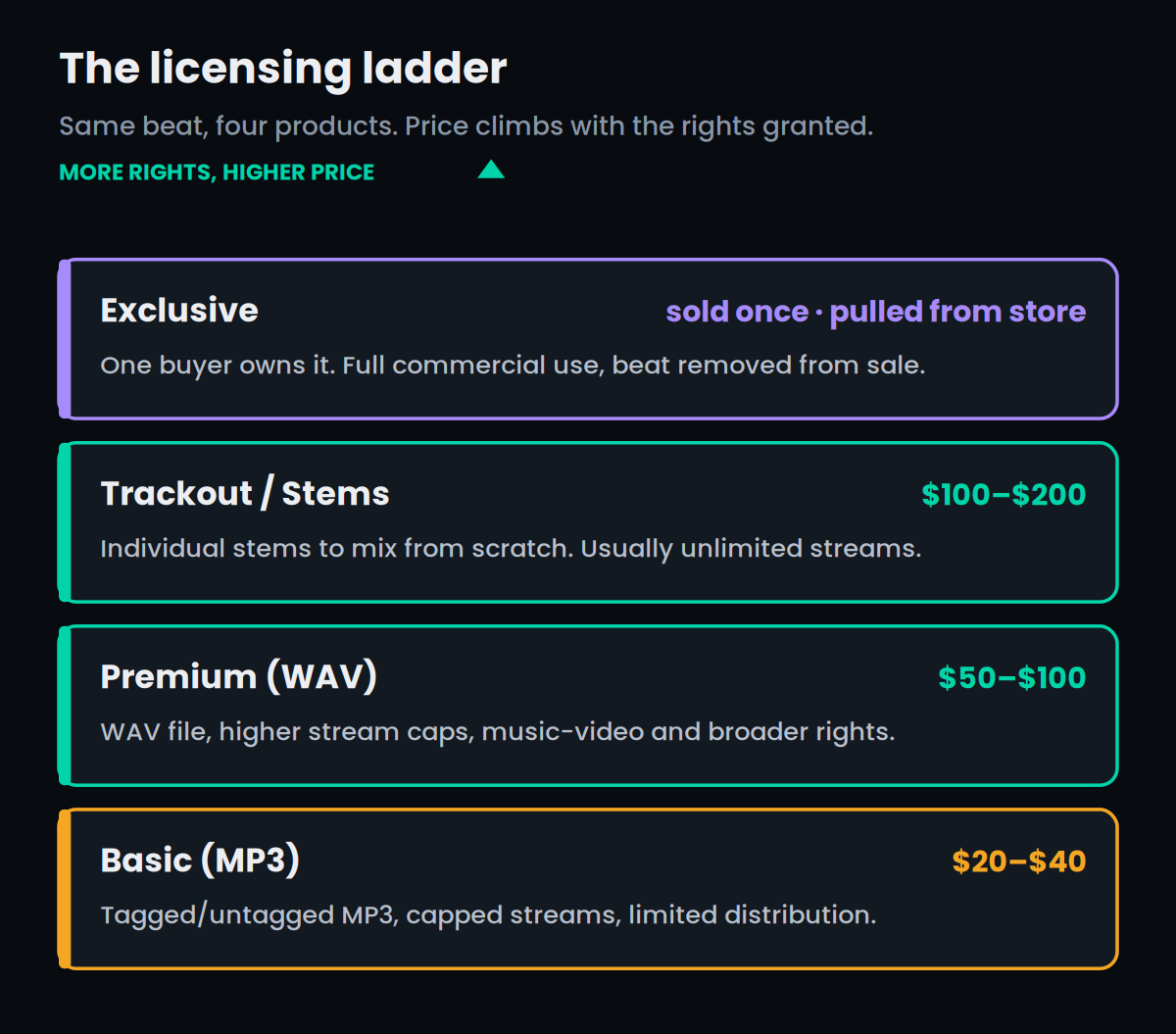
In 2026 the typical bands run roughly: a basic MP3 lease at $20–$40 (a tagged or untagged MP3, capped streams, limited distribution, often no radio); a premium WAV lease at $50–$100 (the higher-quality WAV file, larger stream caps, music-video and broader distribution rights); a trackout / stems lease at $100–$200 (the separated stems so the artist can mix the beat themselves, usually with unlimited streams and wider commercial rights); and at the top, an exclusive — one buyer pays a negotiated premium, the beat comes off your store, and no one else can license it again. Those are reported ranges, not fixed rates: a producer with placements charges multiples of this, a newcomer charges less, and sub-genre norms shift the numbers. We go deeper on the strategy in how to price your beats and on the contract mechanics in beat licensing explained — both worth reading before you publish a price.
The mistake here is treating the lease as the whole business. The lease is the volume; the exclusive is the margin. A free lease earns trust and a credit, a paid lease earns rent, and the exclusive is where a single beat can earn more than a hundred leases combined. Structure your ladder so a buyer can climb it: a rapper who leases your beat and has a hit needs to come back and buy it outright, and your terms should make that a clean, obvious next step. And whatever the tier, every license is a written contract — streams allowed, monetization rights, exclusivity, credit — never a handshake.
The free lease confuses new producers, so it's worth being explicit about why you give beats away. The free tier isn't charity and it isn't “exposure” in the empty sense — it's the top of a funnel. A free lease (typically credit-required, non-profit, demo-only) is what wins the YouTube search, gets a beat into a writer's hands, and earns the trust that converts later. Most free downloads never pay you, and that's fine; the model works on the small fraction that do. A writer leases free, the song catches on, and now they need the paid WAV to release it, or the exclusive to own it. You're trading cheap, infinite digital copies at the bottom for the occasional high-value sale at the top — which is exactly why the ladder has to be set up before the free beat goes live, with the paid tiers one click away in the description. A free lead with nowhere to climb is a wasted lead.
What Can You Actually Make?
Let's handle the question every guide either dodges or hypes, because both are dishonest. Type-beat selling is a real income stream for a lot of people and a get-rich scheme for almost none. The market is genuinely large — somewhere on the order of two million-plus producers sell beats online, and the platforms underneath have moved hundreds of millions of dollars over the years — but that scale cuts both ways: big opportunity, heavy competition. Reported earnings for producers who treat it seriously and consistently are commonly cited in the range of roughly $1,200 to $5,000 a month, with a long tail of producers earning far less and a thin top end earning much more. Those are reported ranges from people in the field, not promises — nobody can tell you what your catalog will earn, and anyone who guarantees a number is selling you something.
What actually separates the producers who earn from the ones who don't is rarely talent in isolation; it's the boring compounding of the system in this article. A deep, consistently-uploaded catalog with search-true titles and a working licensing ladder earns more than a smaller catalog of “better” beats with weak titles and no ladder, because discovery and conversion are doing the heavy lifting. The income is lumpy — a quiet month, then an exclusive sale that covers three — and it lags the work by months because the catalog has to accumulate before it compounds. Go in expecting a slow build that may become a meaningful side income, treat a windfall placement as upside rather than the plan, and you'll have a realistic relationship with the numbers. For the deeper pricing strategy behind those figures, how to price your beats is the companion read.
Using Artist Names Without Getting Taken Down
Back to the amber zone, now as a checklist. The artist name in your title is the convention, and you can run it for years without incident — if you stay on the descriptive side of the line. Four practical mitigations cover most of the risk:
It's worth being clear about why this is risk management and not a force field: a disclaimer doesn't grant you a legal right, it just evidences that you weren't trying to deceive anyone — which is most of what the right-of-publicity question turns on. The reason style imitation is safe and a named likeness isn't comes down to the same principle that runs through all of how music rights actually work: you can own and license a sound recording you made — and collect on it through the publishing system — but you can't appropriate a person's identity to sell it. Stay original, stay descriptive, and the convention stays low-risk. Push into implied endorsement and you've handed someone a reason to act.
Cadence & Channel Growth
Type-beat discovery rewards depth and freshness, which makes consistency the single highest-leverage habit. One brilliant beat a month loses to a steady stream of good ones, because every upload is another search-string lottery ticket and another signal to the algorithm that your channel is active. The common baseline is weekly or more; many producers building a catalog upload several beats a week early on, then settle into a rhythm they can hold for months without burning out. The producers who quit almost always quit during the quiet middle — after the novelty and before the compounding — so design a cadence you can actually sustain.
The way to hold a cadence without burning out is to batch. Separate the work into modes: a few sessions where you only make beats, a session where you only title, tag, and build thumbnails, and a scheduled upload rhythm so publishing is a calendar event, not a daily decision. Producing in bulk and scheduling releases turns “I have to post today” into “this week's uploads are already queued,” which is the difference between a habit that survives a busy month and one that collapses the first time life gets in the way. And keep the long view in mind while you grind: every titled, licensed beat you publish is an asset that keeps surfacing in search and selling leases for years, with no further work from you. A type-beat catalog is closer to a rental property than a paycheck — slow to build, then quietly earning in the background — and that appreciating-asset quality is the real reason the model is worth the patience.
Around the cadence, the growth levers are familiar: a recognizable brand (consistent thumbnails, tag, channel art), titles that match real searches, and cross-promotion to where your buyers already are. Short-form is a real multiplier here — a fifteen-second clip of a beat with the artist-style label can pull search-intent traffic back to the full upload, the same mechanics covered in promoting music on TikTok. Treat the channel as a long game: the catalog you build this year is an asset that keeps surfacing in search and selling leases while you sleep, long after the upload date. That compounding is the entire reason the type-beat model works.
Common Mistakes That Kill a Beat Store
Most type-beat channels fail for a handful of avoidable reasons. A quick tour of the ones that cost producers the most:
If your beat is built on a loop or one-shot from a sample library, read that library's license before you sell it — especially as an exclusive. Many royalty-free packs let you use sounds in your productions but do not let you resell or transfer exclusive rights to material you don't own. Sell an exclusive on an un-cleared sample and you've sold something that isn't fully yours to sell. When in doubt, use your own sounds for anything you'll sell exclusively, and lean on beat licensing terms that match what you actually have the rights to.
“Hard beat 🔥🔥” ranks for nothing. If the title doesn't contain the artist-plus-“type beat” phrase a buyer searches, the beat is invisible no matter how good it is. The title isn't where you express yourself — it's where you get found.
Taking money without issuing a written license is how disputes — and chargebacks — start. Every tier, including free leases, needs terms in writing. Your platform provides templates; use them on every sale.
The model compounds, which means it's slow before it's fast. Producers who post for three weeks and stop never reach the part where the catalog starts working for them. Pick a cadence you can hold for six months and hold it.
Get those four right — clear rights, search-true titles, written licenses, sustained cadence — and you've already beaten most of the field. The rest is reps. Once your catalog is earning, the natural next step is putting that music everywhere it can earn, which is where music distribution picks up the story.
Before You Post: 3 Checks
Three quick exercises to run on your next upload, scaled from first beat to full catalog.
- Pick a finished beat and name the single artist whose sound it genuinely matches — honestly, not the biggest name you can think of.
- Write the title in the exact format:
(FREE) [Artist] Type Beat 2026 | [Mood] [Genre] Instrumental. - Search that exact phrase on YouTube. If a wall of similar results appears, you’re speaking the buyer’s language; if nothing related shows up, your label is off.
- On your chosen host, set up all four tiers — MP3, WAV, trackout, and exclusive — with prices inside the 2026 ranges, plus a free, credit-required lease.
- Attach the platform’s written license template to every tier, including the free one, so each sale has terms in writing.
- Put the direct purchase link and a one-line price summary at the top of every video description, so a free lead can climb the ladder in one click.
- List every beat you’re selling and flag any built on third-party loops, one-shots, or sample packs.
- For each flagged beat, open the sample library’s license and confirm it permits resale — and never sell an exclusive on a beat whose samples you don’t fully own.
- Confirm every title stays descriptive (no logos, photos, or implied co-signs) and carries a “not affiliated with [artist]” note. Fix anything that crosses from the green core into the red zone.
Frequently Asked Questions
A type beat is an original instrumental made in the style of a named artist and titled as such — for example a “Drake type beat.” It is not the artist's music and contains none of their copyrighted work; the artist's name describes the sound a buyer is looking for. Producers sell type beats to rappers and singers who want a familiar vibe to write to.
Making an original beat in an artist's style is legal, because a musical style cannot be copyrighted. The grey area is the title: using “[Artist] type beat” relies on nominative or descriptive fair use, which is unsettled, not a clean right. Keep the beat genuinely original, keep the artist name descriptive, avoid implying endorsement, and the practice is low-risk. Copying an actual melody, or using an artist's logo or photo, is not.
It's the standard convention, and most producers do, but it carries trademark and right-of-publicity risk if the title implies the artist made or endorsed the beat. Best practice is to keep the name purely descriptive of the sound, avoid logos and photos, and add a short “not affiliated with [artist]” disclaimer. Platforms can also remove titles on request, so treat it as risk management, not a guaranteed right.
Lease prices in 2026 typically run roughly $20–$40 for a basic MP3 lease, $50–$100 for a premium WAV, and $100–$200 for trackout stems, with exclusive sales priced much higher and negotiated per beat. These are reported ranges, not fixed rates; producers with placements charge more and newer producers charge less. See how to price your beats for the strategy behind the numbers.
BeatStars has the most traffic and an integrated storefront; Airbit, owned by BandLab, has a clean checkout and no marketplace commission on paid plans; Traktrain is invite-only and curated toward serious producers. Most sellers host on one of these and drive discovery from YouTube, where the title formula does the ranking. Verify current plan fees on each platform before subscribing — they change.
Consistency matters more than any single number. A weekly-or-more cadence is the common baseline because type-beat discovery rewards a deep, fresh catalog. New producers often upload several beats a week to build a library quickly, then settle into a sustainable rhythm they can hold for months. The producers who win are usually the ones who simply didn't quit.
Yes. Every sale, including free leases, should come with a written license stating exactly what the buyer can and cannot do: how many streams, whether they can monetize, whether it's exclusive. Selling beats without a contract is how disputes start. Beat-selling platforms provide license templates — attach one to every transaction. Beat licensing explained walks through the lease types in detail.
Only if you have the rights to those samples for resale. Royalty-free libraries typically license you to use sounds in your own productions, but selling an exclusive built on an un-cleared one-shot or loop can violate the library's terms. Read the license of any sample pack before you build a beat you intend to sell exclusively, and when in doubt use your own sounds.
Platform plans and fees (BeatStars, Airbit, Traktrain) and lease-price ranges verified against vendor pages and current industry guides, June 19, 2026. Pricing and policies change — confirm current terms before subscribing or publishing a price. This article is general information about the music business, not legal advice; for the trademark and right-of-publicity questions around artist names, consult a qualified music attorney about your specific situation.