For almost fifty years the Sequential Prophet–5 has occupied a strange place in music production: it is one of the most recorded synthesizers ever built, and for most of us it has also been the one sound we could only ever approximate. The 1978 original — Dave Smith’s five–voice analog polysynth, the first instrument to marry polyphony, patch memory, and hands–on control — defined a tone that runs through decades of records, from Genesis to Madonna to Radiohead to Aphex Twin. And for that same half–century, the way most producers reached for that tone was through someone’s unofficial recreation: Native Instruments’ old Pro–53, u–he’s Repro–5, the Arturia and Cherry Audio takes. Good emulations, some of them great. None of them blessed by Sequential.
That is what changed in June 2026. GForce Software — the team already trusted by Tom Oberheim to make the official Oberheim plugins — partnered with Sequential to ship the first–ever officially licensed Prophet–5 software instrument. The badge on the box is the headline, but it is not the review. “Official” tells you Sequential handed GForce the keys and put its name on the result; it does not, by itself, tell you whether you should spend money you could keep. So this review deliberately spends very little time on the question everyone else leads with — is it accurate? It is; the modeling is excellent and the people who own the hardware say so. The question worth your time is the harder one: does the official version earn the upgrade over the cheaper and free Prophet–flavored synths a lot of producers already use to get “close enough”?
How we approached this. Every price, format, and feature below was re–pulled this session from GForce’s live product page and store, the official Sequential listing, and a spread of current independent reviews — not from older write–ups, and never from another article on this site. This is a reasoning–and–documentation review, not a first–party listening test: we did not run a controlled CPU benchmark or a blind A/B against the hardware in our own room, so every judgement about how it sounds is framed as reasoning from documented behavior and the consensus of producers and reviewers using it now — never a fabricated “it sounded like” claim. Where a figure can move — and the intro price moves on July 31 — we tell you to confirm it live.
GForce’s Prophet–5 is the most authentic Prophet–5 you can run in a DAW, and the first one Sequential actually endorses — faithful oscillators and mixer, a filter that switches between the warm SSM (Rev 1/2) and punchy Curtis (Rev 3) designs, the original 1978 factory presets, and a genuinely useful modern layer on top: full MPE, dual–layer architecture, the redesigned X–Modifiers, and a premium effects suite. Buy it if you want the poly–analog sound with modern recall, MPE, and Sequential’s blessing — synthwave, pop, film, and anyone who’ll actually use the Rev switching and the layer engine. Think twice if a free or cheap Prophet–flavored synth already gets you 90% there and you don’t need MPE, the layers, or the badge. The authenticity is not in question; the value depends entirely on whether the modern extras matter to your work.
The Verdict
The most authentic Prophet–5 in software and the first with Sequential’s blessing — a near–definitive emulation whose only real question is whether its modern extras justify the price over the cheaper Prophets you may already own.
| Authenticity / analog character | 9.4 | |
| Filter flexibility (SSM/Curtis, Rev 1–3) | 9.1 | |
| Modern features (MPE / dual–layer / X–Modifiers) | 8.9 | |
| Presets & immediacy | 8.7 | |
| Workflow / UI | 8.8 | |
| Value vs cheaper / free Prophet–flavored synths | 7.9 | |
| Who–it’s–for clarity | 8.8 |
That 8.8 is a defended judgement, not an average, and the spread is the argument. Authenticity (9.4) and filter flexibility (9.1) are where this plugin leads outright: it is the first Sequential–endorsed Prophet–5, the Rev 1/2 SSM and Rev 3 Curtis filter characters are both onboard, and the people who own the hardware describe the model as a new high–water mark. Modern features (8.9), workflow (8.8), and presets (8.7) are real strengths — MPE, dual layers, and the X–Modifiers add genuine capability the 1978 hardware never had, wrapped in a resizable interface that stays out of your way. The number that pulls the overall down is the one that decides your purchase: value versus the cheaper and free Prophet–flavored synths (7.9). It is not bad value — the intro price is fair and you own it perpetually — but “most authentic” is a smaller jump than it sounds when several rivals already get you most of the way for less or for nothing. Every number above is defended in the sections that follow.
What the GForce Prophet–5 Actually Is
Get the category right first, because it frames everything. This is an analog–modeling synthesizer plugin — a software recreation of a specific piece of 1978 hardware, not a generative tool and not a do–everything wavetable monster like Serum 2 or Arturia Pigments. You load it, you get a faithful Prophet–5 with two oscillators, a noise source, one classic resonant filter, and the immediacy that made the original famous: one knob per function, nothing buried. If you have never met the architecture before, our primer on what a synthesizer is and the Bible entry on subtractive synthesis will make the panel read like a sentence rather than a wall of dials.
The word doing the heavy lifting is official. There have been excellent unofficial Prophet–5 plugins for years — this is simply the first time Sequential has put its name on one and collaborated on the modeling. In practical terms that buys you two things. The first is confidence: the company that owns the instrument vetted the result, and GForce had hardware on the bench to compare against, which is the single biggest factor in capturing the subtleties that separate a convincing model from a generic “analog poly.” The second is a legal nicety — the Prophet–5 name is used under license, so the branding, the revisions, and the original factory bank are all there by right rather than by homage. What “official” does not automatically buy you is value, and that is the thread we keep pulling.
It is worth understanding why that endorsement is a genuine coup rather than a marketing line. The history of software synthesis is bound up with the Prophet — Native Instruments’ old Pro–Five and Pro–53 were among the plugins that popularized the whole idea of running a famous hardware synth in modeled form — yet in nearly five decades Sequential never put its name on one. GForce earned the call by doing exactly this work on the Oberheim catalog with Tom Oberheim’s blessing, and the collaboration shows in small, practical ways: you get two fully–resizable interfaces, one that faithfully replicates the 1978 hardware layout for players who know the original, and a modern fold–out advanced panel that surfaces the new modulation and effects without cluttering the classic face. That dual–UI choice is a quiet statement of intent — honor the instrument, then extend it — and it is the design philosophy that runs through the whole plugin.
One clarification that saves confusion: this is the Prophet–5, the 1978 analog poly, recreated in software. It is a different product from Sequential’s modern hardware Prophet–6, which is a current–production instrument you buy as a physical synth. If you are shopping for the hardware lineage rather than a plugin, that review is the one to read next; if you want the classic five–voice sound inside your session with modern recall, you are in the right place.
The Authenticity Story: SSM, Curtis, and the Rev 1/2/3 Switch
The reason a Prophet–5 emulation lives or dies on its filter is history. The earliest units, Rev 1 and Rev 2, used SSM chips — the SSM2040–family filter — prized for a slightly unstable, organic, lush warmth that producers still chase. The Rev 3 switched to Curtis chips (the CEM3320, designed by Doug Curtis), which were more reliable and more consistent, with a punchier, more present, slightly brighter voice. That single component change is most of why people argue about “which Prophet” they love. GForce models both filter characters and lets you switch between the Rev 1/2 SSM and Rev 3 Curtis designs inside one instance, which neatly resolves a choice the original hardware forced you to make at the point of purchase.
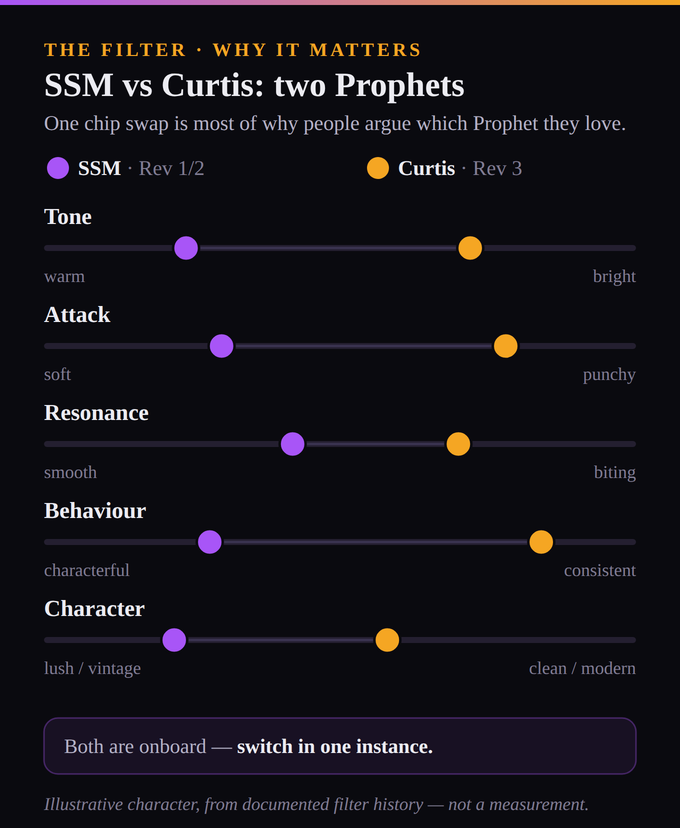
Does it actually sound like the hardware? Here is the honest answer, framed honestly. We did not A/B it against a real Rev 3 in our room, and the most candid independent reviewers say the same about their own coverage — very few people own a vintage Prophet to verify against. What we can report is the strong, consistent consensus: reviewers describe the core, slightly unstable character of the original as present and convincing, the SSM warmth and the Curtis punch as clearly differentiated, and the overall result as among the best — if not the best — software Prophet to date. Treat “the most authentic” as the reported critical consensus plus Sequential’s own endorsement, not as a measurement we performed. On the strength of that evidence the authenticity score is high and, we think, deserved.
If you care how that authenticity was achieved — and it is genuinely instructive — GForce has been unusually open about the method. The modeling starts from standard circuit models of the actual components, the SSM and Curtis chips, which gives a solid foundation, and then refines through an iterative process of comparing the model to the real hardware by ear and by measurement. The team has described the hardest part as capturing how the filter behaves dynamically: how resonance, distortion, and biasing shift as you change cutoff frequency and oscillator input level, because that interplay is what makes a filter read as “Prophet” rather than generically analog. The subtle Rev 1/2–versus–Rev 3 differences are the most demanding of all, which is why owning hardware to A/B against matters so much — and why an official partnership, with access and accountability, tends to produce a more faithful result than a clean–room clone.
How the Sound Is Built
Under the vintage panel the signal path is textbook subtractive, which is exactly the point — the Prophet–5’s genius was never exotic routing, it was a beautifully voiced version of the standard chain. Two oscillators (with the classic sawtooth, pulse, and triangle shapes, rich PWM, and hard sync between them) plus a noise source feed the mixer; the mix runs into the resonant low–pass filter — the SSM or Curtis character you selected — and on into the amplifier, each stage shaped by its own envelope. The famous Poly–Mod section lets the filter envelope and oscillator B modulate pitch, pulse width, and filter cutoff for the FM–ish, sync–sweep, and growling timbres the instrument is known for. If the envelope vocabulary — attack, decay, sustain, release — isn’t second nature yet, our ADSR visualizer makes the shapes tangible, and the synthesis parameter reference is a handy companion while you learn the panel.
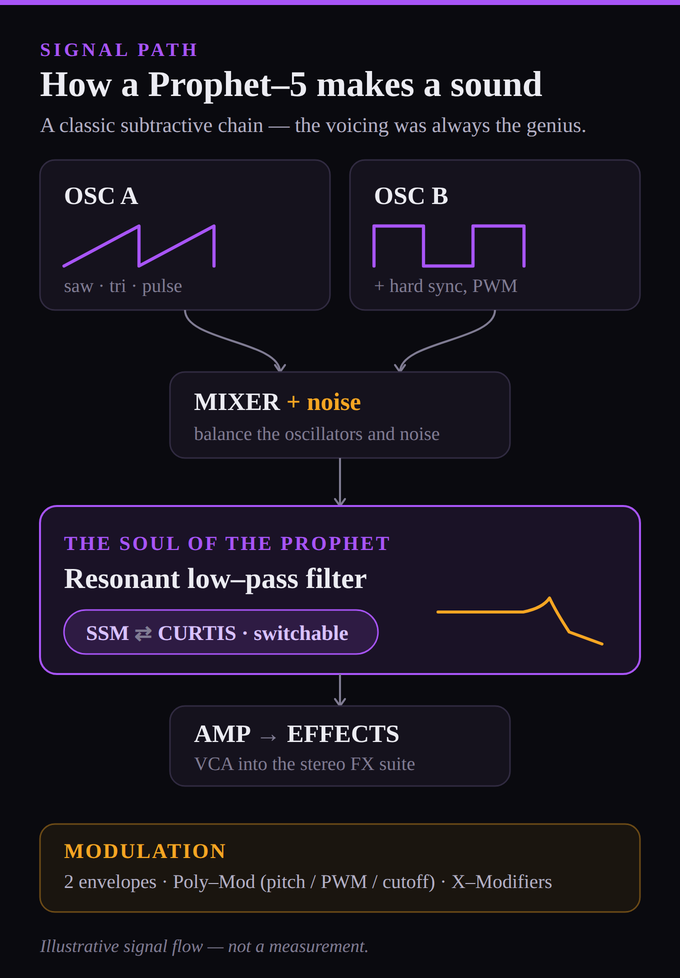
This is also why the Prophet–5 is such a good teacher. Because every control does one obvious thing and the chain is short, it is one of the cleanest ways to actually hear subtractive synthesis happening — tweak the filter cutoff with a little resonance and you can follow exactly how the harmonics move. If you are building that skill deliberately, it pairs naturally with our guide to layering synths, where a faithful poly–analog like this one is the warm bed you put underneath brighter digital tones.
Three classic behaviors are worth knowing because they are where the Prophet’s personality lives. Pulse–width modulation slowly sweeps the width of a pulse wave, producing the hollow, chorus–like shimmer that defines so many Prophet pads and strings. Oscillator sync forces oscillator B to restart with oscillator A, and sweeping B’s pitch under sync produces the hard, tearing lead tone that turns up on countless records. And the Poly–Mod matrix — routing the filter envelope and oscillator B to pitch, pulse width, and cutoff — is the original’s secret weapon, capable of FM–like clangs, sync sweeps, and growling, evolving timbres that feel far more complex than two oscillators and one filter should allow. GForce reproduces all of it, with the rich PWM, sharp sync, and clean FM via Poly–Mod that reviewers single out as evidence the oscillator section was taken as seriously as the celebrated filter.
The Modern Layer: MPE, Dual–Layer, X–Modifiers, and Effects
If GForce had stopped at a faithful 1978 recreation, this would be a narrower product. The reason it can justify a premium is the modern layer wrapped around the vintage core, and there is more of it than the marketing bullet list suggests. Full MPE support turns a static analog poly into an expressive instrument: with an MPE controller you get per–note pitch, pressure, and timbre, plus polyphonic pitch handling that even brings Ableton Live tuning–system support to a 1978 design. Dual–layer architecture gives you two independent Prophets in one instance — Layer, Split, and Alternate modes, up to ten voices per layer, each with its own arpeggiator and chord mode — so stacks, keyboard splits, and round–robin performance patches are native rather than a workaround.
The X–Modifiers are GForce’s own redesigned modulation system, and they are the single biggest departure from the hardware: almost every parameter can be handed its own dedicated envelope and LFO, so a sound can move and evolve while keeping the immediacy and tone of the original. That is the bridge between “museum–accurate” and “usable in a modern production.” On top sit two user–selectable effects slots — chorus, phaser, filter, distortion, tremolo, compressor — plus dedicated delay, reverb, and pan–spread, and GForce’s effects have long been a genuine signature rather than throwaways. Rounding it out: over 460 presets including the original 38 factory patches from 1978, a resizable patch browser with tagging and search, and comprehensive MIDI CC mapping throughout. For the deeper modulation vocabulary — unison, detune, and the broader behavior of analog circuits — the Bible entries fill in the theory behind the knobs.
The voice engine is more flexible than the vintage face lets on, too. Each layer is a full ten–voice Prophet that can be played monophonic, legato, polyphonic, or in a ten–voice unison with adjustable detune for huge, stacked tones, and there is independent voice panning and a per–voice level control — plus the “Alternate” round–robin mode borrowed from the vintage Prophet–10. The effects deserve their own mention because GForce’s delay and reverb have been a signature across the company’s line for years rather than the usual bolted–on afterthoughts; here they are joined by two freely–assignable slots offering chorus, phaser, filter, distortion, tremolo, and compressor, and a dedicated pan–spread for width. The net effect is that you can take a museum–accurate raw Prophet tone and finish it inside the plugin — movement from the X–Modifiers, space and character from the effects — without ever leaving the instrument, which is a real workflow win when you are sketching fast.
Where It Genuinely Shines
The first thing that lands is the immediacy. Load almost any factory patch and you are inside a usable, characterful sound in seconds — this is a synth you play first and program second, which is exactly the right feel for a Prophet. For synthwave and retro–leaning pop the plugin is almost unfairly on–target: lush pads, hollow PWM strings, fat unison basses, and the brass–ish stabs that define the era are a few tweaks away, and the Rev switch lets you choose warm or punchy to taste. For cinematic music, the SSM character plus the new reverb makes the kind of slow, evolving analog bed that sits beautifully under strings and sound design.
The second thing is that the modern layer is not decoration. The dual layers turn it into a quick scoring and sound–design tool — a soft pad on one layer, a brighter pluck on the other, split or stacked — and the X–Modifiers give you movement that an authentic Prophet emulation normally can’t reach without external automation. Add MPE and you have something the 1978 hardware fundamentally could not be: an expressive, per–note–controllable analog poly. If your work leans on warm, characterful polysynths, this slots in alongside the other heavyweights in our best synth plugins roundup and earns its place in the best polyphonic synthesizers conversation rather than coasting on nostalgia.
To make that concrete: a slow–attack SSM pad with gentle PWM and a touch of the built–in chorus is the bed of a hundred synthwave intros; a Curtis–filtered unison saw with a short, snappy filter envelope is an instant retro–pop bass; a synced lead with a little Poly–Mod gives you the tearing hook tone without reaching for a separate plugin; and a detuned dual–layer stack — warm pad under bright pluck — covers the “big emotional chord” moment in a film cue. None of these take long to dial, which is the real point: the immediacy of the original survives the translation, so the plugin rewards playing and tweaking rather than menu–diving. That combination of authentic core tone and fast, tactile programming is why it slots so naturally into a synthwave or cinematic workflow.
The MPE side rewards a little experimentation specifically. On a controller that sends per–note expression, you can add vibrato to a single sustained note in a chord without touching the others, slide pitch expressively into a lead, or open the filter with pressure as you lean into a pad — the kind of articulation a 1978 hardware Prophet simply could not produce. It will not turn the instrument into something it isn’t, but for players who own MPE hardware it meaningfully widens what a classic poly can express, and it is one of the clearest examples of the “honor it, then extend it” philosophy paying off in actual performance.
Where It Lags: The Honest Limitations
No fabricated complaints — here is what reviewers and the spec sheet actually flag. At launch there is no NKS support and no dedicated hardware–controller integration, which is a real miss on an instrument whose whole soul is tactile; the comprehensive MIDI CC mapping makes it a few minutes’ work to map a controller, so it is an annoyance rather than a dealbreaker, but it is a fair knock. There is no CLAP format at launch — it ships as standalone, AU, AAX, VST2, and VST3 — which rivals like Repro–5 can claim. There is no sub–oscillator, unlike some Prophet–flavored tools, so if you build on a dedicated sub you will reach for the mixer and Poly–Mod instead.
On performance, treat this as reported rather than measured: hands–on impressions put CPU use in the same neighborhood as u–he’s Repro–5 with its high–quality and multi–core options engaged — in other words, a serious analog model, not a lightweight, so budget voices on big sessions and freeze when you commit. And the largest caveat is not a flaw at all but a market fact: this lands in the most crowded emulation category there is. Unlike the relatively thin field for some classics, “a Prophet in your DAW” has been a solved problem for years, and the long–standing community default has been Repro–5. Being the official, arguably most–authentic option is a strong position, but it is a position staked in a busy room.
It is worth naming that field so the value question has teeth. The community’s long–standing default has been u–he’s Repro–5, loved for its filter–FM character and CLAP support; Arturia and Cherry Audio both ship well–regarded Prophet–style instruments inside larger collections; and there are capable budget and even free options that get a producer a recognizable Prophet tone for a fraction of the price or for nothing at all. Against that backdrop, GForce’s pitch is specific: it is the official one, it carries both Rev filter characters, and it adds MPE and the dual–layer engine that most rivals don’t. Whether those differentiators are worth the premium is the entire decision, and it is genuinely personal — which is why the value axis sits where it does and why the trial matters more here than on a plugin with no real competition.
The Real Question: Does It Earn the Upgrade?
This is where the score lives. If you already own a capable Prophet–flavored synth — or use a free one — and you only ever needed “close enough,” the honest truth is that GForce’s extra authenticity is a refinement, not a revelation, and you can keep your money. The upgrade earns itself in three specific cases. First, if MPE or the dual–layer engine matters to you — those are real capabilities the cheaper options often lack, and they change what the instrument can do, not just how it sounds. Second, if you want both Rev characters in one switchable instance rather than committing to a single filter flavor. Third, if Sequential’s endorsement and the original factory bank carry weight for you — for some producers, “the official one” is worth a premium on its own.
There is one underrated point in its favor on cost. Unlike vocal synths and big sample–based instruments that sell you a base price and then a ladder of paid expansions, the Prophet–5 is a single purchase that includes the whole instrument — every revision, every effect, the full 460–plus preset library, and free updates within the version. The number you pay is the number you pay, which makes the value comparison cleaner than it is for tools where the “real” cost only reveals itself after you have bought the content you actually wanted. For a producer weighing this against a subscription instrument or an expansion–heavy library, perpetual ownership of a complete, focused tool is a genuine part of the math.
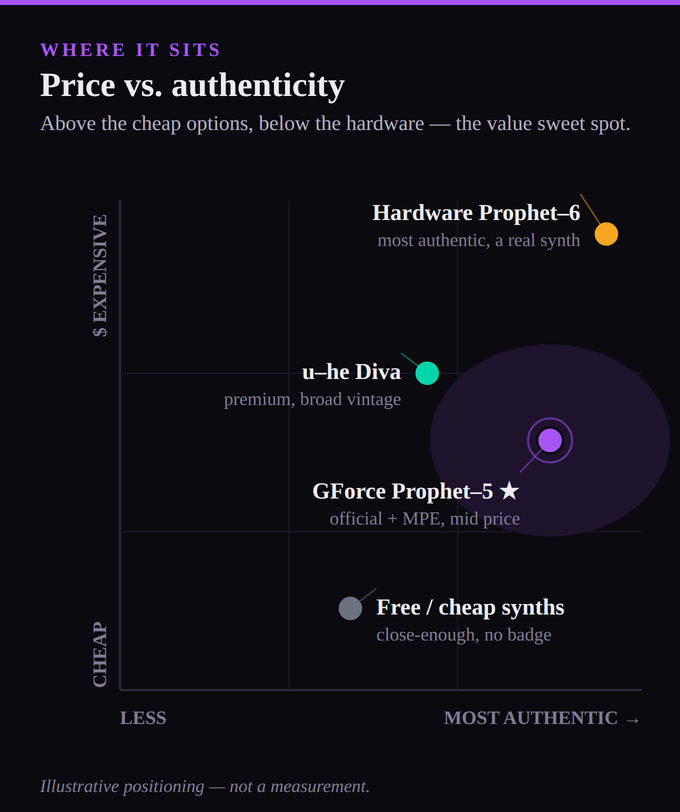
It also helps to know what it is not competing with. The hardware Prophet–6 is a different purchase entirely — a physical instrument at a physical–instrument price. u–he Diva is the obvious other premium vintage–analog plugin to weigh, but it is a broad, multi–character analog emulator rather than a Prophet–specific model, so the two answer slightly different questions: Diva for range across classic analog voices, the GForce for the Prophet, officially. If your taste runs to vintage poly more generally, Arturia’s recent Memory V is worth a look alongside it, and for everything–and–the–kitchen–sink workstation needs, Omnisphere 3 plays a different game. The point of the positioning is simple: the GForce is excellent and fairly priced, but “most authentic” is the smallest of the differences for a producer who only needed the vibe, which is exactly why the value axis, not the authenticity axis, is the one that should drive your decision. For sound–design–heavy work specifically, our best plugins for sound design guide widens the field.
Price & What You Actually Pay
At the time of writing, the GForce Prophet–5 is on an introductory price of $83.99 / £69.99 / €83.99 until July 31, 2026, after which it rises to its regular $119.99 / £99.99 / €119.99 (UK prices include VAT). That is a meaningful window — roughly a 30% discount — so if you have decided to buy, the intro deadline is a real reason to do it before the end of July rather than after. It is sold direct from the GForce store and through distributors including Plugin Boutique, so check for the best current offer at your usual retailer. Because that intro figure expires on a fixed date, confirm the live price on the product page before you purchase — this review will read “intro” long after the number has changed.
For your money you get the full instrument — there is no upsell ladder of paid voice packs the way some tools have — in standalone, AU, AAX, VST2, and VST3 formats, for macOS 10.15 or later (Intel and Apple Silicon native) and Windows 7 or later, with 8 GB of RAM the stated minimum. There is a 7–day trial, which is the right way to settle the only question this review can’t answer for you: whether, in your music, the official Prophet earns the upgrade over whatever you are using now. If you are still building your core instrument set, our beginner hardware synth guide covers the other side of the buy–hardware–or–plugin question.
Who Should Buy It, Who Should Skip It
Buy it if you want the definitive, Sequential–endorsed Prophet–5 in your DAW and you’ll actually use what makes this version special — the switchable Rev 1/2/3 characters, MPE expression, the dual–layer engine, and the X–Modifiers. Synthwave, retro pop, film, and ambient producers who lean on warm analog polys are the core audience, and the intro price makes the decision easier before July 31. Buy it too if the idea of owning the official one, with the original 1978 bank, genuinely appeals — that is a real and legitimate reason, not a silly one.
Skip it — or at least demo it hard first — if a free or inexpensive Prophet–flavored synth already covers your needs and you don’t care about MPE, the layers, or the badge. The authenticity gap is smaller than the price gap in that scenario, and there is no shame in “close enough” when close enough is genuinely close. And skip it if your work calls for a do–everything modern synth rather than a focused vintage poly — that is a wavetable or workstation purchase, a different category with a different review. Knowing which of those producers you are is the whole decision, and it is why the 7–day trial exists.
Try It Yourself (7–Day Trial)
The cleanest way to settle the value question is to run the free trial through the three jobs below, in order. They move from “does the sound impress me” to “does the modern layer earn the upgrade,” which is the question that actually decides your purchase. The synthesis type selector and note–to–frequency tools are handy alongside it.
- Install the trial, open a lush pad from the 1978 factory bank, and play a slow chord progression — note your honest first reaction to the raw character.
- Flip the filter between the Rev 1/2 SSM and Rev 3 Curtis settings on the same patch and listen for warm–versus–punchy — this is the authenticity story in one control.
- Sweep the filter cutoff with a little resonance and follow how the harmonics move; that motion is the model earning its score.
- Use the dual–layer engine: a soft, slow–attack pad on Layer A and a brighter PWM pluck on Layer B, stacked.
- Assign an X–Modifier LFO to the pad’s filter cutoff for slow movement, and a short envelope to the pluck for snap.
- Add the built–in chorus and a touch of the dedicated reverb, then A/B it against a single–layer patch — decide whether the layers earned their keep.
- Recreate one of your go–to patches from a free or cheaper Prophet–flavored synth here, as closely as you can.
- Now use what only this version offers — MPE expression, the switchable Rev character, or a second layer — to do something your old tool can’t.
- Drop both into a real mix and ask the only question that matters: is the difference worth the price to you? Your answer is the review.
The Verdict
The GForce Prophet–5 is the best software Prophet–5 you can buy in 2026 — the most authentic, the only one Sequential endorses, and the rare emulation that earns its modern features instead of bolting them on. At an 8.8 it is an easy recommendation for the producer it is built for: someone who wants the poly–analog sound with the switchable Rev characters, MPE, dual layers, and the original 1978 bank, inside their DAW. The fraction of a point it gives up is the fraction that should give you pause in exactly one situation — when a free or cheaper Prophet already gets you where you’re going and the modern extras don’t move your work. Authenticity is solved here; value is personal. Run the trial, decide whether the upgrade is real for your music, and buy before the intro window closes on July 31 if the answer is yes.