The Moog Memorymoog has a reputation that precedes any plugin claiming to bottle it: the fattest, most powerful, and least reliable polyphonic synthesizer Moog ever built — three oscillators per voice, six voices, a ladder filter on every one, and a temperament so legendary that engineers talked about coaxing it rather than playing it. Restored hardware now trades north of $15,000, and most producers will never touch one. So when Arturia released Memory V in May 2026 — only the third commercial software emulation of the instrument in history — the interesting question was never “does it sound like a Moog.” Arturia’s TAE modelling has answered that one for two decades. The interesting question is the one a working producer actually asks: is this a synth you reach for on a deadline, or a museum piece you admire for an afternoon and forget?
Here is the honest version up front. Memory V is a genuine workhorse, not a novelty — but it earns that on the strength of its modern layer, not its authenticity. The faithful, panel-only Memorymoog inside it is gorgeous and a little impractical, exactly like the hardware. What makes it a 2026 instrument is everything Arturia bolted on around the emulation: Poly 12 voicing, drag-and-drop modulation lifted straight from Pigments, a four-layer Multi-Arp, a four-slot effects rack, and the Vintage and Dispersion controls that let you dial the instability up or down. The catch — and there is always a catch — is CPU. Three free-running oscillators per voice, multiplied across twelve voices and a six-voice unison stack, is a lot of analog modelling to ask of a core, and independent reviewers are consistent that it gets heavy fast. You will print to audio. This review is about that trade, because it is what decides whether Memory V is your synthwave-and-scoring secret weapon or a CPU hog you open twice.
How we approached this. Every price, spec, format, and feature line below was re-verified against Arturia’s live product page this session, cross-checked against current independent reviews and the active user community — not older write-ups, several of which already mis-state the bundle situation. This is a reasoning-and-documentation review, not a first-party listening test: we did not run Memory V through a controlled CPU benchmark in our own room, so every claim about how it performs is framed as reasoning from documented behaviour and the consensus of producers using it daily — never a fabricated number. Where a figure can move — and post-introductory pricing is exactly that — we tell you to confirm it on the live store. Let’s get into it.
Memory V is the most complete Memorymoog you can run in a DAW — component-accurate triple-oscillator tone, the legendary 24 dB ladder filter, and a modern modulation-and-effects layer that takes the sound somewhere the hardware never could. Buy it if you make synthwave, cinematic, ambient, or modern electronic music and want one synth that can carry towering brass, dense basses, evolving pads, and an 18-oscillator unison wall from a single key press — and you’re willing to freeze tracks to audio. Think twice if you mainly need a clean, transparent, low-CPU pad machine; u-he Diva or Pigments may serve that better. At $149 standalone it is fairly priced for what it is. Used as a character instrument, it’s superb. Bought expecting a featherweight utility synth, it will frustrate you.
The Verdict
The Memorymoog kept the fat and lost the temperament — Memory V is a synthwave and cinematic workhorse with a real CPU appetite, not a museum piece.
| Sound & analog character | 9.3 | |
| Authenticity (vs. the hardware target) | 9.0 | |
| Modern features (mod / Multi-Arp / FX) | 9.1 | |
| Presets & immediacy | 8.6 | |
| Value (price vs. what you get) | 8.4 | |
| CPU / efficiency | 7.6 | |
| Who-it’s-for clarity | 8.8 |
That overall is a defended judgement, not an average, and the spread tells the story. Sound & analog character (9.3) is where Memory V leads: across the launch reviews, the one point of near-total agreement is that it sounds enormous, dense, and convincingly analog, with a low end and a midrange weight that few software polysynths match. Authenticity (9.0) reflects Arturia’s component-level TAE modelling of the oscillators, filter, mixer, drive, and non-linearities — faithful, though by Arturia’s own design choice it is an enhanced Memorymoog, not a museum-locked one. Modern features (9.1) is the real differentiator and the reason this is a 2026 instrument at all. Presets & immediacy (8.6) and value (8.4) are strong-but-honest: 300-plus presets get you working fast, and $149 is fair, but it is a character synth you buy on top of whatever else you own. The number that pulls the overall down to 8.7 is CPU / efficiency (7.6) — the one amber axis above, and the honest one. Triple-oscillator analog modelling at twelve voices is expensive, and you will manage it. Every number here is defended in the sections below.
What Memory V Actually Is
Get the category right first, because it frames everything. Memory V is a software synthesizer — specifically a subtractive, virtual-analog emulation of a single, specific piece of 1982 hardware: Moog’s Memorymoog. It is not a do-everything sound-design platform in the mould of Serum 2 or Omnisphere 3, and it isn’t trying to be. It has one voice architecture, one filter topology, and one sonic identity, and it commits to them completely. What you are buying is that identity — the dense, slightly unstable, unmistakably Moog wall of sound — with a modern workflow wrapped around it so you can actually use it on a record without an analog tech on call.
The architecture is faithful to the original. Each voice runs three free-running oscillators — stackable Ramp, Triangle, and Square waveforms with pulse-width control — plus a noise source feeding the mixer. Oscillators can be hard-synced (1↔2 and 1↔3) for the screaming sync leads the Memorymoog was loved for, and oscillator 3 doubles as an audio-rate modulator when you switch its keyboard tracking off, giving you FM-style metallic motion from inside the voice itself. That signal hits the part everyone came for: a per-voice 24 dB low-pass ladder filter, switchable to a 12 dB slope, capable of self-oscillation, with a Bass Compensation switch that holds the low end together when you push resonance. A dedicated amplitude envelope and filter envelope shape the rest. It is, in other words, exactly the signal path the hardware ran — modelled at the component level rather than sampled.
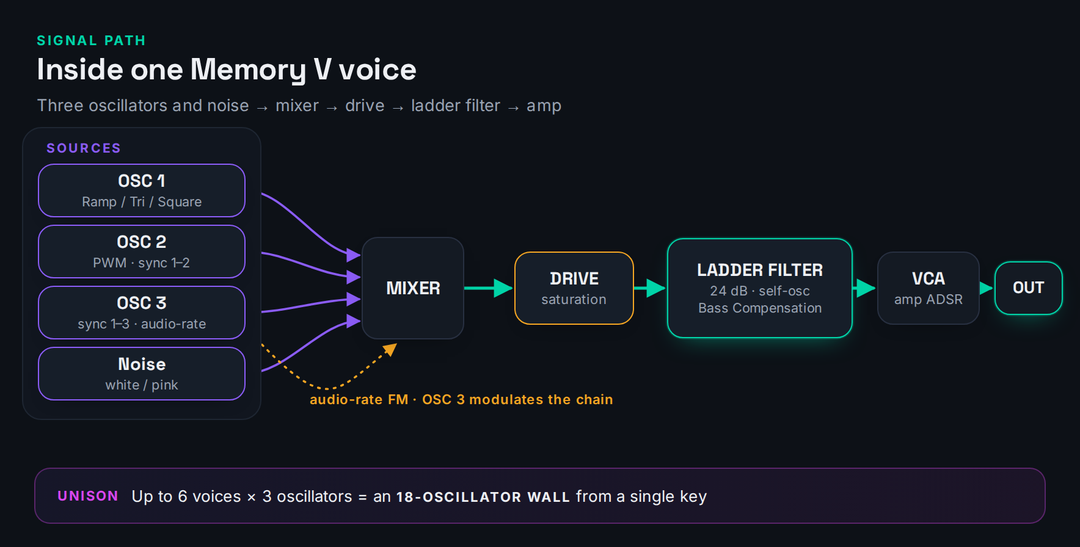
Then comes the part the hardware could never do. Memory V runs in the original six-voice mode or an expanded Poly 12. Its Unison mode stacks up to six of those triple-oscillator voices, lets you detune and spread them across the stereo field, and produces an eighteen-oscillator monster from a single key — the “wall of sound” that made the Memorymoog a monosynth-killer in mono mode. And two continuous controls, Vintage and Dispersion, let you dial in the instrument’s instability: from clinical and locked to warm, drifting, and gloriously imperfect, with per-voice variation spread across pitch, pulse width, level, cutoff, emphasis, modulation, and envelope times. That last detail matters more than it sounds. The Memorymoog’s magic was partly its drift; being able to tune that drift instead of fighting it is the single best argument for the emulation over an idealized clone.
The Memorymoog and Why It Still Matters
To understand who Memory V is for, you have to understand what it is channelling. Released in 1982 and built until 1985, the Memorymoog was Moog Music’s most ambitious polyphonic statement and its last before the company declared bankruptcy in 1987. It was conceived as a polyphonic answer to the Minimoog — the same three-oscillator richness, opened up for chords, layered brass, and wide harmonic movement — and it sat alongside the Prophet-5 and the Oberheim OB-Xa as one of the defining polysynths of the early eighties. It was also, by every account, a nightmare to keep in tune. The same dense circuitry that produced the sound made it notoriously unstable.
Its fingerprints are on records you know. Geddy Lee of Rush built the iconic lead of Subdivisions on it; Tony Banks of Genesis used it on Mama; Stevie Wonder and Tangerine Dream wove its dense tone through their work, and a generation of film composers leaned on it for scale. That heritage is exactly why the sound reads as “cinematic” and “retro-futurist” to modern ears — it is the sound of a particular, expensive, slightly broken era of polyphony. Memory V exists to give that to producers who were not alive when these machines were new and could never afford one now. If your music lives anywhere near synthwave, vaporwave, retro-scoring, or the lush end of modern electronic, that lineage is the point, and you can lean on it for authority the way you would a vintage hardware classic — without the $15,000 and the maintenance.
How It Actually Sounds
We did not run a blind A/B in our own room, so treat what follows as reasoning from documented behaviour and a striking consensus across independent reviews, not a first-party verdict on tone. With that stated plainly: the single most repeated observation about Memory V is weight. Reviewers describe it as monumentally broad, dense, and front-of-mix — epic brass, fat pads, powerful leads, and the meandering, slightly unstable “wall” that gives the synth myth its character. That is consistent with the architecture. Three detuned oscillators per voice, run through a self-oscillating ladder filter with Drive saturating into both the filter and the amplifier, is a recipe for harmonic density, and the Bass Compensation switch is there specifically to keep that density from collapsing at high resonance.
Where the honest tension lives is between the authentic presets and the modern layer. Play the panel straight, the way the hardware worked, and you get sounds that are gorgeous but unmistakably of their era — which is exactly right if period authenticity is what you want. Reach into the Advanced panel, though, and the instrument becomes something the Memorymoog never was: a flexible, modulation-rich, effects-laden machine that can do evolving textures, rhythmic patterns, and polished, mix-ready tones. Several reviewers make the same practical point — the built-in effects are good, but the raw engine is so characterful that it is worth auditioning sounds with the FX bypassed first, then adding space and grit deliberately, rather than judging the instrument through a wall of reverb. If you want to study how to stack those triple-oscillator voices into something even bigger, our guide to layering synths applies directly here, and the analog character entry in the Bible explains why the drift you are hearing reads as “warmth” in the first place.
For specific jobs it is close to ideal. Towering synth brass and stabs sit at the front of a mix with almost no effort. Dense, saturated basses have the low-end authority the Bass Compensation circuit is built to preserve. Slow, drifting pads — with Dispersion opened up — have the living, breathing quality that static digital pads lack, which is why it slots so naturally into cinematic and scoring work and why it can stand in for lush string-section textures the way a dedicated strings plugin would. Where it is least suited is transparent, clean, clinical pad duty — the kind of glassy, neutral tone where you specifically don’t want analog grit and movement. For that, a cleaner-leaning instrument is the better tool, and we get into exactly which one below.
The Modern Layer — What Makes It a 2026 Instrument
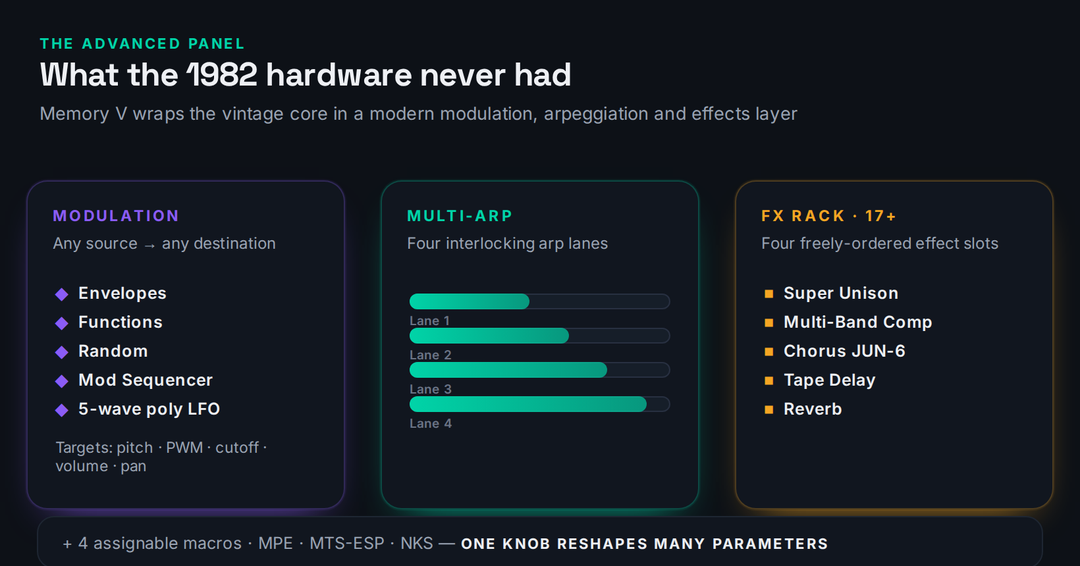
If the emulation is the heart, the Advanced panel is the reason to buy this over a cheaper or more purist Memorymoog clone. Three things matter most. First, drag-and-drop modulation: three modulator slots that host envelopes, function generators, random sources, voice modulators, and a Mod Sequencer — the same modulation philosophy Arturia built into Pigments, where you drag a source onto any destination and hover to set the amount in seconds. On top of that sits a polyphonic LFO with five waveforms (Triangle, Saw, Ramp, Square, and Sample & Hold) that can sync to host tempo or run free and retrigger per voice. For an instrument whose original had a comparatively simple modulation section, this is transformative; it turns a static vintage voice into something that evolves.
Second, the four-layer Multi-Arp. Rather than a single arpeggiator, Memory V stacks up to four independent arpeggiator layers, so you can build counterpoint, polymetric movement, and transposed melodic lines that interlock — the kind of hypnotic, generative patterning that suits synthwave and modern electronic production and that the original architecture simply had no way to produce. Third, the four-slot FX rack with seventeen-plus engines, including Super Unison, a multiband compressor, a JUN-6-style chorus, tape delay, and reverb. It is a complete, studio-grade signal chain inside the instrument, and crucially you can modulate the effect parameters too, which keeps them from sounding static. Add four assignable macros, full MPE support, MTS-ESP microtuning, and NKS integration, and the picture is clear: Arturia’s strategy here is “authentic core, modern everything-else,” and it is the right call. If you build sounds from the ground up, the techniques in our sound-design plugins guide map cleanly onto this modulation system.
The Honest Caveat: CPU
This is the amber axis on the scorecard, and it deserves its own section because it is the thing most likely to shape your day-to-day experience. We did not benchmark Memory V on a controlled rig, so we will not invent a percentage — but the reasoning is straightforward and the independent reviews are consistent. Each voice runs three free-running, component-modelled oscillators plus noise through a modelled ladder filter and drive stage. Multiply that by twelve voices in Poly 12, then layer a six-voice Unison stack on top, and you are asking a single CPU core to model a very large amount of analog circuitry in real time. Arturia’s own recommended spec — a four-core, 3.4 GHz machine — is a tell: this is not a lightweight utility synth.
The practical reality
Stacked unison patches at a small buffer size can stutter on a busy project, and the honest workflow is the one producers have used with heavy analog emulations for years: track it, then freeze or bounce it to audio and reclaim the headroom. This is a manageable inconvenience, not a dealbreaker — but if your machine is older or your sessions routinely run dozens of soft-synth instances live, weigh it seriously before you buy.
Two things soften it. First, you rarely need Poly 12 plus full Unison at once; most patches are comfortable at six voices, and the heaviest settings are reserved for exactly the towering, single-key wall-of-sound moments where freezing to audio is natural anyway. Second, this is a known, bounded cost — it does not get worse as you learn the instrument, and it is the same tax every serious virtual-analog charges for the density that makes it worth using. We score it 7.6 rather than lower precisely because it is predictable and works around cleanly. But we will not pretend it isn’t there, because pretending is how the hobby reviews lose your trust.
Price & What You Actually Get
Memory V is $149 for the standalone license, confirmed live on Arturia’s store this session. It launched with a lower introductory price that ended on June 14, 2026, so if you read an older write-up quoting a cheaper figure, that window has closed — confirm the current number on the live page before you buy, since Arturia runs seasonal sales. Existing Arturia customers get discounted upgrade pricing through their account, and Arturia also sells a bundle pairing it with V Collection 11 Pro for $699. One point worth clearing up, because the early coverage muddled it: as of this writing Memory V is a standalone purchase, positioned by Arturia as the lead-in to the forthcoming V Collection 12 rather than a title already folded into the current V Collection 11 instrument list. If your goal is the whole library, the smart move is to weigh the bundle and the coming Collection 12 against buying Memory V alone — check your account for the personalized number.
For the money you get every format that matters — standalone, VST, VST3, AU, and AAX, 64-bit only — plus NKS, MPE, and MTS-ESP, on Windows 10 and up or macOS 11 and up (note: Arturia lists no ARM support on Windows, though Apple Silicon is fine on Mac). You also get 300-plus presets spanning vintage brass, basses, keys, cinematic pads, evolving textures, and modern electronic tones, with the original Memorymoog factory presets included for direct comparison — a genuinely nice touch for anyone who wants to hear the “before and after” of the modern layer. Sounds also carry over to Arturia’s AstroLab stage hardware, which matters if you perform live. At $149 for a faithful, expanded emulation of a $15,000 instrument with a full modern toolkit attached, the value case is sound; it loses a little only because it is, by nature, a specialist character synth rather than a first, do-everything purchase.
Where It Sits: Memory V vs. Diva, Pigments, and the Hardware
The most useful way to place Memory V is on two axes — how authentic versus modern it is, and how immediate versus deep it is to program — against the instruments a buyer is most likely to cross-shop. u-he Diva is the obvious Moog-flavoured rival: arguably the most revered analog emulation in software, with a cleaner, more surgical character and famously heavy CPU of its own, but without Memory V’s specific Memorymoog identity or its drag-and-drop modern layer. Pigments is Arturia’s own modern flagship — vastly more flexible and a far better general-purpose sound-design tool, but a clean, contemporary, do-anything synth rather than a characterful vintage one. And a real Memorymoog is the authentic extreme: the actual sound and the actual instability, at fifteen thousand dollars and a standing appointment with a technician.
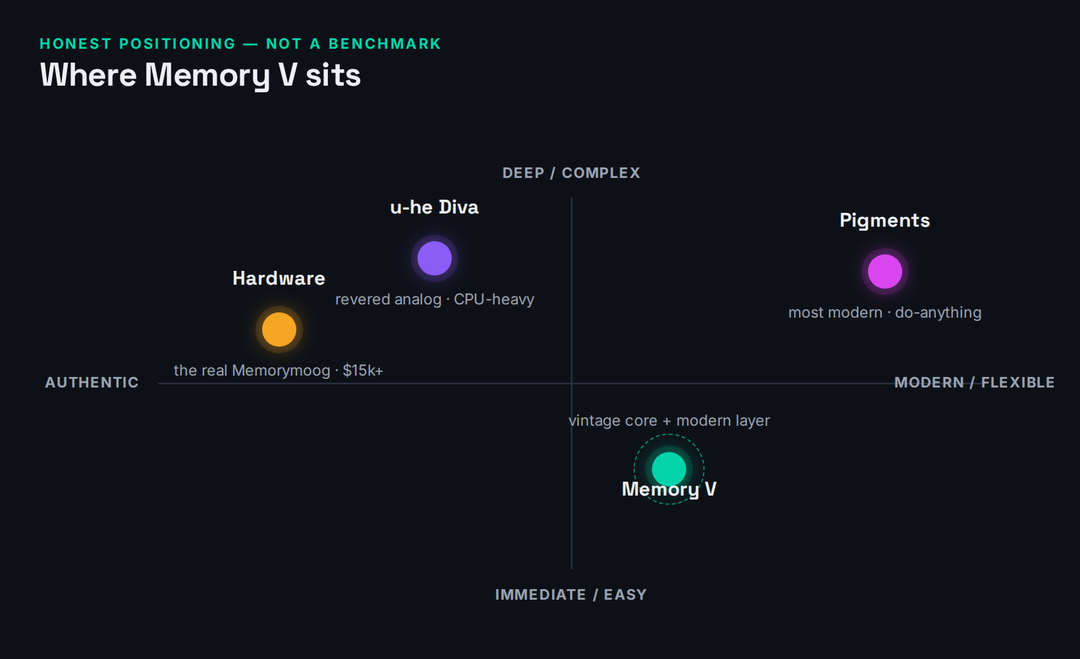
So the decision resolves cleanly. If you want a specific, characterful, Memorymoog-flavoured instrument with a modern workflow — brass, basses, pads, and unison walls with vintage drift you can dial — Memory V is the pick, and it is what the rest of a synth-plugin collection or a polyphonic-synth shortlist is often missing. If you want the most revered general analog emulation and don’t need the Memorymoog identity, audition Diva. If you want maximum flexibility and clean modern sound design, Pigments is the better daily driver. And if you have $15,000 and a love of maintenance, the hardware is the hardware. Memory V’s honest claim is not “best synth” — it is “the best way to get this sound into a modern session,” and on that claim it delivers.
Who Should Buy It, Who Should Skip It
Buy Memory V if you make synthwave, retro-electronic, cinematic, ambient, or alt-R&B music and want one synth that can carry a whole track — towering brass, dense basses, evolving pads, screaming sync leads, and an eighteen-oscillator unison wall, all with authentic analog weight. Buy it if you specifically want the Memorymoog character — that dense, slightly unstable, front-of-mix tone — and have no realistic path to the hardware. Buy it if you value Arturia’s modern layer: drag-and-drop modulation, the four-layer Multi-Arp, the FX rack, MPE, and the Vintage and Dispersion drift controls that let you tune the instability instead of fighting it.
Skip it — or at least audition the alternatives first — if your main need is clean, transparent, low-CPU pad and utility duty, where Diva or Pigments will likely serve you better. Skip it if you’re on an older or CPU-constrained machine and run many soft-synths live without freezing, because the triple-oscillator density is genuinely demanding. And skip it if you were hoping for a do-everything sound-design platform; this is a committed character instrument, not a Swiss-army synth, and that focus is a feature, not a flaw — as long as it matches the music you actually make. The honest test: if you want this specific sound in a modern session, nothing at this price gets you closer.
Try It Yourself (Free Demo)
Arturia offers a time-limited demo, and the fastest way to know whether Memory V fits is to run it through the three tasks below, in order — from “does the character grab me” to “can my machine live with it.” If you want a quick refresher on the synthesis terms as you go, keep the synthesis parameter reference and the synthesis-type selector open in another tab.
- Install the demo, open it on an empty channel, and browse to a brass or bass preset — then bypass the FX rack entirely.
- Play sustained chords and single notes and listen to the unprocessed engine: that weight and density is the actual Memorymoog tone, before any reverb or chorus.
- Now switch on the FX and A/B. Decide for yourself whether you prefer the raw engine or the polished version — that choice tells you how you’ll use it.
- Load a clean pad, then slowly raise the Vintage and Dispersion controls and listen to the patch loosen from clinical to living and imperfect.
- Open the Advanced panel and drag a Random or Function modulator onto filter cutoff; set a gentle amount with the ADSR shapes in mind so the movement breathes rather than wobbles.
- Add one Multi-Arp layer and a second transposed layer. You’ve just turned a static vintage voice into an evolving, generative texture — the modern layer in miniature.
- Build the heaviest patch you can: Poly 12, full six-voice Unison, detuned and spread, with several FX slots active — an eighteen-oscillator wall.
- Drop your buffer size to a realistic tracking value and play dense chords while watching your DAW’s CPU meter. Note where it strains; cross-check intervals against the note-to-frequency reference if you’re tuning the unison.
- Now freeze or bounce that track to audio and confirm the headroom returns. That is the real Memory V workflow — and the honest answer to whether your machine can live with it.
The Verdict
Memory V is the most complete Memorymoog you can put in a session in 2026 — a component-accurate emulation of one of the rarest and fattest polysynths ever built, wrapped in a modern modulation, arpeggiation, and effects layer that takes the sound places the hardware never could. At an 8.7 it earns a clear recommendation for the producer it’s built for: anyone making synthwave, cinematic, ambient, or modern electronic music who wants authentic analog weight without a five-figure restoration project. The reason it isn’t higher is the same reason it sounds so good — the triple-oscillator density that gives it that front-of-mix authority is genuinely CPU-hungry, and you will freeze tracks to audio. Go in understanding that it’s a character instrument you direct and manage, and it’s superb. Go in expecting a featherweight, do-anything utility synth, and you’ll be the one writing the “CPU hog” review. The Memorymoog kept the fat and lost the temperament. So did its emulation — and that is exactly the point.