Buy the Sony MDR-7506 (about $100) if the job is mixing, editing or vocal clarity: its bright, slightly hyped top end works as a flaw-finder, exaggerating harshness and sibilance so you catch problems early — and it costs less. Buy the Audio-Technica ATH-M50x (about $150–160) if you want a do-everything pair for tracking, monitoring and casual listening: it is more comfortable, better built, has detachable cables, and its fuller V-shaped sound is more fun to live with. The honest catch most pages skip: neither is a true flat reference, so the real question is not which sounds nicer — it is what job you are buying it for, and whether you know how to mix on a coloured can. Below is exactly how to tell which one is yours, and how to use either one without it ruining your mixes.
This article contains affiliate links. If you purchase through our links, we may earn a commission at no extra cost to you. This does not affect our editorial independence — every recommendation here is based on genuine, source-checked assessment.
| Axis | MDR-7506 | ATH-M50x |
|---|---|---|
| Mixing accuracy / reference | 8.9 | 7.6 |
| Tonal-balance honesty | 8.2 | 7.9 |
| Detail retrieval | 8.7 | 8.3 |
| Comfort (long sessions) | 7.4 | 8.4 |
| Build & cables | 7.2 | 8.8 |
| Versatility | 7.3 | 8.9 |
| Value | 9.1 | 8.2 |
| Overall | 8.3 | 8.2 |
Scores are MPW editorial judgement, defended section by section below — a decision framework, not a first-party measurement. Specs and prices verified June 23, 2026 against the Sony, Audio-Technica, Sweetwater and Equipboard listings and 2023–26 reviews. Prices are USD; street pricing moves constantly, so confirm at the retailer before you buy.
Updated June 2026 — Sony MDR-7506 vs Audio-Technica ATH-M50x
Read the overall line and you will think it is a coin-flip: 8.3 to 8.2. It is not a coin-flip — it is a fork. The 7506 wins the axes that matter when you are working on a mix (accuracy 8.9, detail 8.7, value 9.1). The M50x wins the axes that matter when you are living with a pair of headphones all day (comfort 8.4, build 8.8, versatility 8.9). The near-tie at the bottom is not a verdict, it is a warning: ignore the average and read the axis that matches your job. That is the entire comparison, and every number above is argued below.
Why "Which Sounds Better" Is the Wrong Question
Almost every Sony MDR-7506 vs ATH-M50x page you will find runs the same script: a spec table, a paragraph about the 7506's bright highs and the M50x's bigger bass, and a shrug that lands on "get the Sony for accuracy, get the Audio-Technica for fun." It is not wrong, exactly. It is just answering a question that does not help you. You are not buying a vibe. You are buying a tool to do a specific job — make records — and the two headphones are genuinely better at different parts of that job.
Here is the framing that actually decides it. A pair of monitoring headphones is not there to sound nice; it is there to tell you the truth about your mix, or at least a consistent and learnable version of it. The moment you accept that, the question stops being "which is more pleasant" and becomes "which coloration helps me make better decisions, and for which task." The 7506 and the M50x give you two very different answers, and the rest of this piece is about matching the answer to your work. If you are still deciding whether headphones belong in your workflow at all, our guide to headphones vs studio monitors covers where each one earns its place — but if you have landed on these two, the decision below is the one that counts.
One thing to settle up front, because it reframes everything: both of these have been described for years as "studio standards," and both are closed-back cans you will see on real sessions. But standard does not mean flat, and neither of these is a flat reference. Understanding how each one is not flat is the whole game.
It helps to know how these two ended up as the default recommendation in the first place, because it explains their reputations. The 7506 is the studio descendant of the MDR-V6 from the 1980s, adopted by broadcast, film and recording engineers because it was cheap, rugged and revealing — and it has barely changed since, so you are buying a thirty-year-old tool that survived precisely because it does one thing well. The M50x descends from the M50, a monitor that went viral with consumers and producers alike for sounding bigger and more exciting than its price. One was adopted by professionals for work; the other was adopted by everyone for enjoyment. Those origins still describe exactly what each is best at today, and they are why the 7506 feels like a clinical instrument while the M50x feels like a great pair of headphones that happens to wear a studio badge.
Neither Is a Flat Reference — And That's the Point
If you want a genuinely flat-ish, reference-grade listen, you are looking at open-back cans like the Sennheiser HD 600 or carefully-corrected monitoring rigs — and even those need translation checks. Neither the 7506 nor the M50x is that headphone, and pretending otherwise is the mistake that ends with you "fixing" problems that only exist in your cans. So let us be precise about how each one lies to you, because a known lie is something you can work with. A surprise lie is what wrecks a mix.
The 7506 is close to neutral through the low end and mids, then lifts the upper-treble — that famous "sizzle." It is not a smooth, hi-fi tilt; it is a slightly hyped, sometimes peaky top that makes cymbals, sibilance and any digital nastiness leap forward. People call this fatiguing, and over a long session it can be. But fatiguing and revealing are the same property viewed from two angles. The M50x does something almost opposite: it bumps the bass, scoops the mids a little, and lifts the treble — the textbook V-shape. That curve is engineered to be enjoyable. It makes a kick feel solid and a vocal feel smooth, which is exactly why it flatters a half-finished mix into sounding more done than it is.
This is also where the spec sheet starts to matter in a way producers actually feel. The 7506 is a 63-ohm load; the M50x sits at 38 ohms (measured closer to 37). Both will run loud enough off a laptop or phone, but the M50x is the easier drive and the 7506 likes a real headphone output to wake up. If "ohms" is a word you nod along to without quite owning, our Bible entry on impedance explains what it does to volume and tone, and the entry on frequency covers the bands we keep referring to. The short version: impedance affects how loud and how clean each can plays from a given source, but it does not change the fundamental character — the 7506 stays the bright truth-teller and the M50x stays the fuller crowd-pleaser regardless of what you plug them into.
It is worth being clear about what "flat" would even mean here, because the word gets thrown around loosely. A flat headphone reproduces every frequency at the level it was recorded, adding nothing and subtracting nothing, so what you hear is what is actually in the file. No closed-back headphone at this price is truly flat — the sealed cup itself creates bass and resonance behaviour a perfectly neutral response would not have. The 7506's 40 mm driver and the M50x's larger 45 mm driver each impose their own character on top of that, and neither was voiced to be a measurement instrument. That is not a defect; it is the normal reality of affordable closed-back cans, and it is exactly why the workflow further down — learn the coloration, mix against it, check translation — matters more than chasing a flatness neither of these will ever deliver.
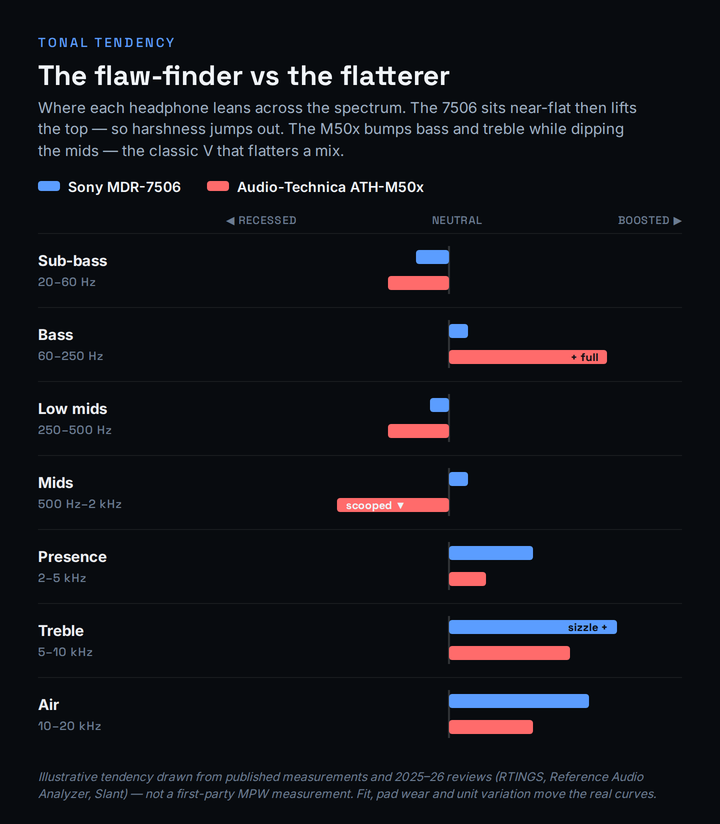
The 7506's "Sizzle" Is a Mixing Tool, Not a Flaw
Spend an hour reading forums and you will find the 7506's treble described as harsh, sharp, brittle, fatiguing. All true, and all beside the point if you are using it as a work tool. A flaw-finder is supposed to be uncomfortable. The whole value of that lifted top is that it refuses to let problems hide: a slightly sibilant vocal becomes a glaringly sibilant vocal, a harsh hi-hat becomes a piercing one, an edit click you would never notice on a smooth headphone jumps out like a cough in a quiet room. You hear the problem on the 7506, you fix it, and the fix translates everywhere — because if it is not harsh on the headphone that exaggerates harshness, it will not be harsh anywhere.
This is exactly why the 7506 has been a broadcast and dialogue-editing reference for over thirty years (we cover it on its own in the Sony MDR-7506 review). When your job is catching a mouth click, a stray breath, or a hum under a voiceover, you want the headphone that makes small ugly things loud. The same property that makes it tiring for casual music makes it the better editor's tool. Producers use it the same way for mix cleanup: ride it for de-essing decisions, for finding resonances, for hearing whether your top end is genuinely airy or just harsh. The classic engineer's line — "if it sounds good on the 7506, it sounds good everywhere" — is really shorthand for "this headphone won't let me get away with anything in the top end."
Here is what that looks like in practice. Say you are mixing a pop vocal and the singer has a sharp "s." On a smooth headphone you might not register it until someone plays the track in their car and winces; on the 7506 it is unmissable from the first chorus, so you reach for a de-esser and tame it then and there. The same goes for a ride cymbal that is splashing too hard, a synth with a brittle high resonance, or a reverb tail that has gone glassy. The 7506 surfaces all of it early, while the mix is still malleable, which is worth far more than the comfort you give up. Engineers who have used it for decades are not being nostalgic — they keep it because catching problems early is cheaper than fixing them late.
The trap is using that bright top to make tonal decisions in the wrong direction. If you EQ until the highs sound smooth on the 7506, you will pull out air that was never excessive, and your mix will sound dull and lifeless on every other system. The 7506 is a detector, not a target. Use it to find harshness, then make the actual call with the headphone's coloration in mind — which is the technique we will get to. For a fuller workflow, our guide to how to mix in headphones goes deep on exactly these decisions, and the broader best headphones for mixing roundup shows where the 7506 sits against pricier reference options when accuracy is the only thing you care about.
The M50x Flatters Your Mix — The V-Shape Trap
The M50x is the more universally-loved headphone of the two, and for good reason: it sounds great (our full Audio-Technica ATH-M50x review goes deeper on its strengths). Big, confident bass, smooth highs with a pleasant shimmer, a wide-feeling presentation that makes almost anything you play through it more enjoyable. As a pair of headphones to own and use, that is a genuine strength. As a mixing reference, it is a quiet liability, and it is the single thing most people get wrong when they buy the M50x "for the studio."
The problem is precisely that it is flattering. Because the bass is lifted, your low end will sound full and powerful even when it is thin — so you will under-cook your kick and bass, then wonder why the track sounds weak in the car. Because the mids are slightly scooped, vocals and guitars sit back politely, so you will not notice when they are masked or harsh; the V-shape literally moves the harsh region down in level so you stop hearing it. And because the bass is not just elevated but, per measurement reviews, somewhat loose and inconsistent depending on fit and seal, your low-end decisions on the M50x are the least trustworthy thing about it. RTINGS flags exactly this: the bass response shifts with how the cups seat, and even leaks at higher volumes. None of that matters for enjoying a playlist. All of it matters when you are trying to decide how much 60 Hz a track needs.
The classic failure mode is worth spelling out, because almost everyone who mixes on an M50x hits it at least once. You build a track that sounds enormous in the cans — deep, warm, smooth, finished — then send it to a friend or play it in the car, and it is thin, harsh and small. What happened is that the M50x's bass bump fooled you into thinking you had low end you did not, so you never added it; its smoothed mids hid an aggressive vocal you never tamed; and its scoop flattered a midrange that was actually cluttered. None of those mistakes were audible on the headphone that made them. This is not hypothetical — it is the single most common reason new producers' mixes fail to translate, and it is entirely fixable once you stop trusting the M50x's easy, pleasant balance at face value.
This does not make the M50x a bad headphone — it makes it a do-everything headphone that happens to be only okay at the one job people most often buy it for. If you mix on it, you have to actively distrust the easy low end and go hunting for the harshness it is hiding from you. That is a learnable skill, covered below, but it is real work, and it is why the M50x scores 7.6 on mixing accuracy against the 7506's 8.9 — not because it is low-resolution, but because its tuning actively works against honest decisions. If a smoother, more comfortable can is the goal and mixing is secondary, the M50x is a joy; if mixing is the point, you are fighting the headphone. Our best studio headphones for music production guide lays out where flattered listening helps and where it hurts.
Comfort, Build, Cables, and the Daily Reality
Sound is where the 7506 claws back the lead; everything physical is where the M50x earns its higher price. Start with the cables, because it is the difference people feel most. The 7506 ships with a fixed, non-detachable coiled cable that has been the same since 1991. It is long, it is springy, it gets in the way, and when it eventually frays you are looking at a repair or a replacement, not a $15 cable swap. The M50x comes with three detachable cables — a coiled one, a long straight one, and a short straight one — so you pick the right length for the desk or the stage, and a damaged cable is a trivial fix. Over a five-year ownership horizon, that detail alone changes the math.
Comfort follows the same pattern. The 7506's clamp is moderate and its pads are shallow; they get warm, they press, and famously the stock pads flake and peel into a black confetti after a couple of years (third-party replacement pads are cheap and fix it, but you will be doing it). The M50x has deeper, plusher pads and a lighter perceived clamp, so it is the easier wear across a long session — with one real caveat: its cups are physically smaller and shallower than something like the Beyerdynamic DT 770 Pro, so if you have larger ears they can touch the inner baffle, which some people find uncomfortable in exactly the opposite way. Build quality also favors the M50x: it feels sturdier and more modern, where the 7506 feels like the indestructible-but-plasticky tool it has always been. Both fold for transport; both come with a pouch. If isolation for tracking is your priority, both are closed-back and block reasonably well, though neither is exceptional — the M50x edges it, and our best closed-back headphones for mixing guide ranks them against the field.
There is a longevity angle that cuts both ways. The 7506 is close to indestructible in the parts that matter — people are still using units from the 1990s — but its weak points are that fixed cable and those flaking pads, both of which you will eventually deal with. The M50x is less battle-proven over decades but far easier to maintain: a worn cable is a quick swap, and replacement pads click on without tools. Speaking of pads, know that changing them changes the sound on both headphones — thicker aftermarket pads can tame the 7506's brightness or deepen the M50x's bass, which is a useful tuning lever but also means a re-pad is effectively a new voicing you will need to re-learn. If you want a fit-and-forget pair you will own for fifteen years, the 7506's track record is unmatched; if you want easy, modular upkeep, the M50x is the friendlier long-term companion.
Tracking vs Mixing vs Casual: The Job-by-Job Split
Put the sound and the physical reality together and a clean split appears — one that almost no "which is better" page bothers to name. These two headphones are not competing for the same seat. They are good at different jobs, and the right buy is whichever job you do most.
For mixing and critical listening, the 7506 wins on the strength of its flaw-finding top and honest mids. For editing, comping vocals and chasing dialogue clarity, the 7506 wins again — it is a broadcast tool for a reason. For tracking and monitoring — sitting in a session, taking a guitar or vocal pass, needing comfort, isolation and a cable that survives — the M50x wins; detachable cables and deeper pads matter more there than perfect tonal honesty, and a little bass flattery actually keeps performers happy in the cans. For long sessions and pure comfort, the M50x. For casual, off-the-clock listening, the M50x, easily — the V-shape is built for enjoyment. And for the person buying one pair to do everything on a budget, it genuinely depends on which of those jobs dominates your week.
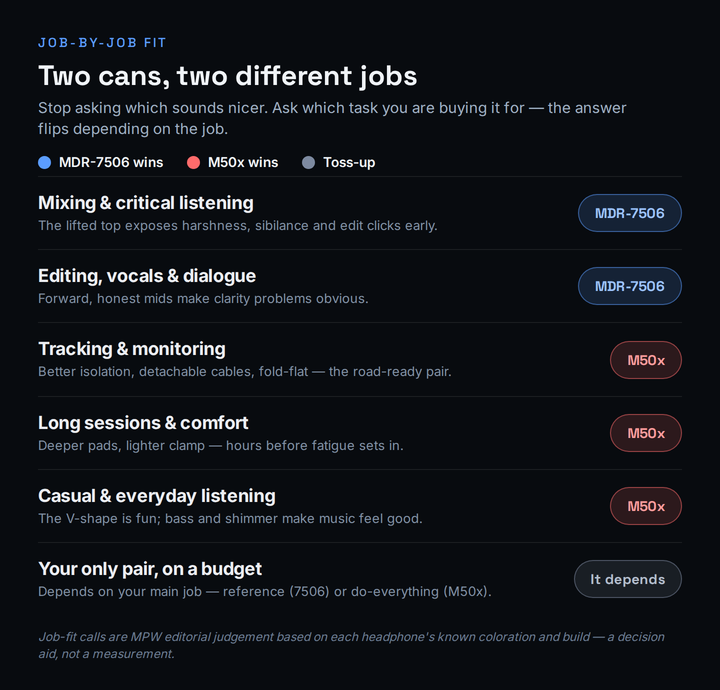
The reason this split is durable is that the trade-off is structural, not incidental. The very tuning that makes the 7506 a good flaw-finder (lifted, slightly harsh top) is what makes it tiring for casual listening. The very tuning that makes the M50x comfortable and fun (bass bump, smoothed mids) is what makes it a weaker mixing reference. You cannot have both in one headphone at this price, which is why so many working producers quietly own both — the 7506 lives on the desk for reference, the M50x goes in the bag for tracking and everything else.
One tracking detail deserves a flag, because it is easy to overlook until it bites you. Neither of these isolates exceptionally well, and the M50x in particular has been measured leaking sound at higher volumes — fine for the artist, but a problem if a vocalist's headphone bleed creeps into a sensitive condenser mic on a quiet take. For loud sources it is a non-issue; for intimate vocals or acoustic work, keep the cans' volume sensible and check for bleed. The 7506's tighter, less bass-heavy presentation can actually be the safer monitoring choice in that scenario, even though the M50x is the more comfortable can to wear — another reminder that the "better" headphone depends entirely on the job in front of you.
How to Actually Mix on Either One
This is the part the rest of the internet skips, and it is the part that matters most: neither of these is flat, so mixing well on either one is a skill, not a purchase. The good news is that it is a learnable skill, and it is the same three moves whichever can you own. Master them and a "coloured" headphone stops being a handicap and becomes a perfectly good reference — because you do not actually need a flat headphone, you need a known one.
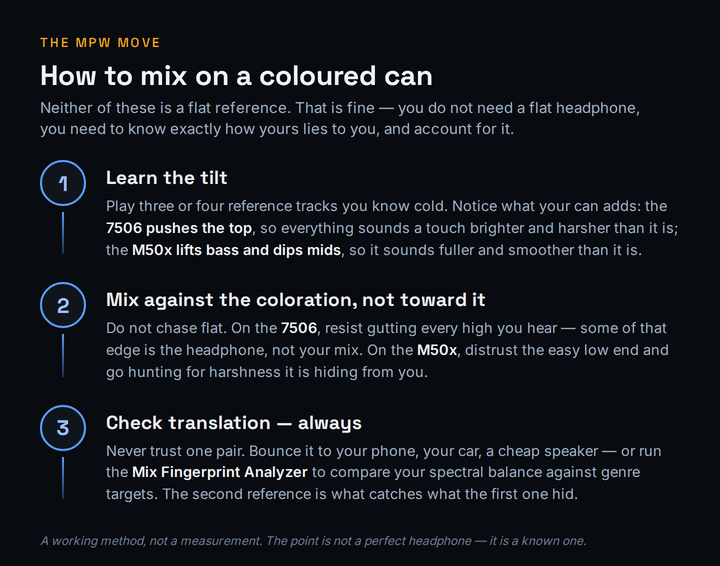
First, learn the tilt. Take three or four tracks you know intimately — commercial references in the genre you make — and listen on your headphone until you can feel what it is adding. On the 7506 you will notice everything skews a little bright and edgy; on the M50x you will notice a fuller low end and a smoother, more recessed midrange. You are building a mental EQ curve of your own headphone. Once you can hear that curve, you can subtract it in your head while you work.
Second, mix against the coloration, not toward it. This is where most people go wrong. On the 7506, when the top sounds harsh, do not automatically reach for a high cut — ask whether the harshness is in the track or in the headphone, and reference a known track to calibrate. On the M50x, do the opposite: distrust how good the low end sounds and how smooth the mids are, deliberately push your faders and EQ to expose problems the V-shape is smoothing over, and check your vocal is actually present and your bass is actually controlled rather than just feeling that way. You are compensating for the headphone's bias in the direction opposite to its lie.
Third, and non-negotiable: check translation. No single headphone, coloured or not, should ever be your only reference. Bounce the mix and listen on your phone, your car, a cheap Bluetooth speaker, your laptop — the more ordinary the system, the better the reality check. This is the single habit that separates mixes that fall apart outside your studio from mixes that hold up everywhere, and it is the heart of our guide to how to make music that translates on any system. To make that check fast and objective, run your bounce through the free Mix Fingerprint Analyzer: it compares your track's spectral balance against genre targets so you can see, not just hear, whether the bright 7506 talked you into a dull mix or the M50x let your low end run wild. The deeper principle of using multiple references is covered in mixing headphones vs studio monitors — the point is never to find the one perfect speaker or can, but to triangulate the truth from several known-imperfect ones.
Two habits make all three steps easier and cost nothing. First, build a small library of reference tracks — five or six songs in your genre that you know are mixed well — and keep them in your session so you can A/B at any moment; your headphone's coloration becomes obvious the instant you switch from your mix to a known-good track. Second, do your most important balance decisions at a low, conversational volume. Loud listening exaggerates bass and treble on any headphone and tires your ears fast, which plays straight into both these cans' weaknesses; quiet listening keeps your judgement honest and your sessions longer. Add an occasional mono check to catch phase and centre-image problems, and you have a workflow that turns either of these imperfect headphones into a dependable reference.
The Spec Sheet, Side by Side
With the thinking done, here is the reference table. Note how few rows actually decide anything — the sound character and the cable/comfort split carry almost the whole comparison, and the rest is context.
| Spec | Sony MDR-7506 | Audio-Technica ATH-M50x |
|---|---|---|
| Type | Closed-back, circumaural | Closed-back, circumaural |
| Impedance | 63 ohm | 38 ohm (measured ~37) |
| Driver | 40 mm neodymium | 45 mm neodymium (CCAW) |
| Sound signature | Bright, detailed, treble-forward | Slight V-shape (boosted bass + treble) |
| Bass | Tight, not deep; honest | Full, powerful; can feel loose |
| Treble | Lifted "sizzle" — flaw-finder | Elevated but smoother shimmer |
| Cable | Fixed coiled (non-detachable) | 3 detachable (coiled + 2 straight) |
| Comfort | Shallow pads; pads flake over time | Deeper pads; smaller cups (ears may touch) |
| Build | Tough, plasticky; folds; pouch | Sturdier, modern; folds flat; pouch |
| Bluetooth | No (wired only) | No on M50x (BT2 is a separate model) |
| Best for | Mixing, editing, dialogue/clarity | Tracking, monitoring, casual, all-day |
| Street price | ~$95–113 | ~$149–169 |
Specs and prices verified June 23, 2026 against the Sony, Audio-Technica, Sweetwater and Equipboard listings and 2023–26 measurement reviews (RTINGS, Reference Audio Analyzer). Prices are USD street and move constantly — confirm at the retailer before purchase.
Who Should Buy Which
Strip away the spec sheet and it comes down to one honest question: what do you spend most of your headphone hours doing? Match yourself to a row below and the decision is made for you.
Genre nudges the call too. If you make bass-heavy electronic music, the 7506's honest, tight low end keeps you from over-trusting sub you cannot really feel on headphones anyway, and its bright top helps you place the aggressive high-mid content those styles live on — though you will lean hard on translation checks for the lowest octave. If you record acoustic music, podcasts or dialogue, the 7506's clarity and the way it exposes room noise, breaths and edits make it the obvious pick. If you make beats and want a single pair that is also genuinely enjoyable for listening back to your library, the M50x's fun factor is a real quality-of-life win. None of these override the job-based logic above, but when two rows feel close, your genre usually breaks the tie.
And the honest meta-answer, because we would rather you make a record than a purchase: at this price either headphone is enough to make finished, translating mixes — what stops most people is not the gear, it is not knowing how their gear lies and not checking their mixes anywhere else. Get one of these, learn its coloration, build the translation habit, and you are equipped. If you later outgrow closed-back cans entirely and want a true reference listen, the open-back route — covered in our best open-back headphones for mixing guide — is the next step up, not a different brand of the same thing.
Practical Exercises
Reading about coloration is one thing; feeling it is another. Work through these three graded exercises on whichever headphone you own — or on both — and the abstract idea of "mixing on a coloured can" becomes a concrete, repeatable skill.
- Pick three commercial tracks in your genre that you consider perfectly mixed. Listen to all three on your headphone, back to back, paying attention only to tonal balance.
- Write down one sentence describing what your headphone seems to add or remove — for the 7506, likely "highs feel hot, bass feels lean"; for the M50x, likely "bass feels big, vocals sit back."
- That sentence is your headphone's tilt. Tape it to your monitor. From now on, mentally subtract it whenever you make a tonal decision.
- Take a rough mix and finish it entirely on your one headphone, deliberately compensating: on the 7506, resist cutting highs that may just be the headphone; on the M50x, push to expose hidden harshness and verify the low end is controlled, not just loud.
- Bounce it. Now listen on your phone and in a car or on a cheap speaker.
- Note every surprise — too dull, too bright, too boomy, vocal buried. Each surprise is a place your headphone's tilt fooled you. Re-mix, and watch the surprises shrink as you learn to discount the coloration.
- Finish a mix on your primary headphone. Run the bounce through the Mix Fingerprint Analyzer and note where your spectral balance diverges from the genre target.
- Make corrective moves based on the data, not just your ears, then re-check on a second system (monitors, car, or a friend's M50x/7506 if you own the other).
- Repeat until the headphone, the analyzer and the second system all agree. That convergence — not any single device — is what a reliable mix actually sounds like, and it is a workflow you can run on a $100 headphone for the rest of your career.