Buy Serum 2 ($249, and free if you own Serum 1) if your goal is finished music, fast: it is the guided workhorse with the quickest path from idea to track and the largest third-party preset economy in software synthesis. Buy Phase Plant ($199 list, often ~$99 on sale) if your goal is original sound built from scratch: it is an open, semi-modular canvas with a higher sound-design ceiling, baked-in Snapin effects and a CPU-light engine. The feature checklist no longer decides this — both now do wavetable, sample and granular synthesis. The real question is workflow philosophy: do you want an instrument handed to you, or a box of parts to wire yourself? Most producers should buy Serum 2. Sound designers and bass-music heads should buy Phase Plant. Below is exactly how to tell which one you are.
This article contains affiliate links. If you purchase through our links, we may earn a commission at no extra cost to you. This does not affect our editorial independence — every recommendation here is based on genuine, source-checked assessment.
| Axis | Serum 2 | Phase Plant |
|---|---|---|
| Sound quality & engine depth | 9.2 | 9.1 |
| Workflow speed (idea → track) | 9.3 | 8.4 |
| Sound-design ceiling (build from scratch) | 8.7 | 9.4 |
| Preset & 3rd-party ecosystem | 9.5 | 8.2 |
| Modulation system | 8.8 | 9.3 |
| CPU efficiency | 8.1 | 9.0 |
| Learning curve (gentleness) | 8.9 | 8.1 |
| Value | 8.6 | 9.1 |
| Overall | 9.0 | 8.9 |
Scores are MPW editorial judgement, defended section by section below — a decision framework, not a first-party measurement. Specs and prices verified June 22, 2026 against each vendor's current product page and 2025–26 reviews. Prices are USD list; sale and loyalty pricing move constantly, so confirm at the vendor before you buy.
Updated June 2026 — Serum 2 vs Phase Plant
The overall scores are nearly tied on purpose, because an honest reading of these two synths does not produce a winner — it produces a fork. Serum 2 leads on the axes that get a track finished: workflow speed (9.3), the preset economy (9.5) and a gentler learning curve (8.9). Phase Plant leads on the axes that produce sounds nobody else has: the sound-design ceiling (9.4), the modulation system (9.3) and raw CPU efficiency (9.0). The 0.1-point gap at the bottom is not a tie-breaker; it is a signal that you should ignore the overall number entirely and read the axis that matches your goal. That is the whole comparison, and every number above is defended below.
The Feature War Is Over — Why Every Other Comparison Is Out of Date
Here is the problem with almost every "Serum vs Phase Plant" page you will find: it argues about specs, and the spec gap it argues about closed two years ago. The old framing went something like "Serum is a wavetable synth, Phase Plant is a semi-modular one, so pick your camp." That was a useful distinction in 2021. It is useless in 2026, because both instruments have quietly grown into each other's territory. Serum 2's 2025 rebuild added sample, multisample, granular and spectral oscillators on top of its wavetable core. Phase Plant added a granular generator back in 2023, and it has always done analog, wavetable, sample and noise sources. If your decision hinges on "which one has granular," the answer is both, and you have been reading stale pages.
Look at the matrix honestly and the wash is striking. Wavetable: both. Sample and multisample playback: both. Granular: both. FM and audio-rate cross-modulation: both. The only pure source-engine difference is spectral resynthesis, which Serum 2 has and Phase Plant does not — a genuine Serum edge, but a narrow one that matters mostly to resynthesis-focused sound designers. On native sequencing, Serum 2 ships a real arpeggiator and a twelve-slot clip sequencer; Phase Plant approximates the same results through a Snapin or your DAW, which is a workaround rather than a missing capability. None of this is where the decision lives.
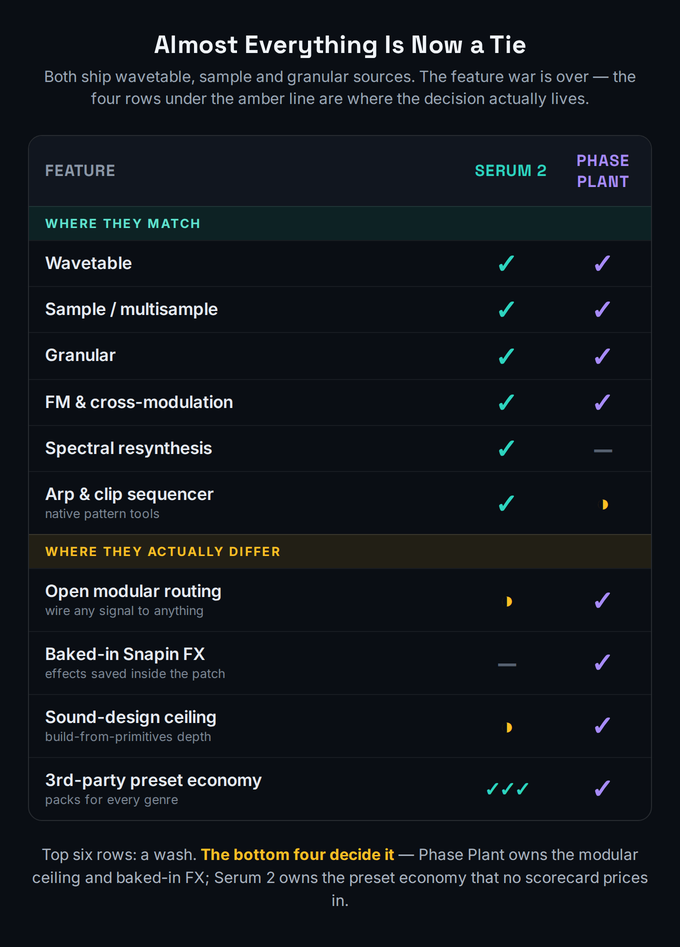
Once you accept that the engines have converged, the four rows under the amber line are all that is left to argue about, and they do not split along "wavetable versus modular" — they split along how the instrument wants you to work. Phase Plant gives you open, freely-wired modular routing and lets you bake Kilohearts Snapin effects directly into the patch. Serum 2 gives you a fixed-but-deep architecture and the largest preset, pack and tutorial ecosystem any soft synth has ever had. Those are not feature differences you can settle with a checklist; they are workflow philosophies. The rest of this page is about that philosophy gap, because that — not the oscillator count — is what determines which one you will still be using in a year.
It is worth being precise about what "converged" does and does not mean, because the convergence is asymmetric. Serum 2 reached Phase Plant's territory by adding engine types inside a still-fixed architecture: you now get granular and spectral oscillators, but they live in the same three-slot, signal-flows-downward structure Serum always had. Phase Plant reached Serum's territory the opposite way — it had the open structure first and added the sound sources later. So even where the feature lists overlap, the way you reach a given sound differs, and that difference is exactly the workflow philosophy this comparison turns on. Two synths can both "do granular" and still feel nothing alike to use.
Two Philosophies: The Guided Instrument vs the Modular Kit
The cleanest way to understand these two synths is to picture what each one hands you when you open it. Serum 2 hands you a finished instrument. There is a signal path already in place — oscillators flow into filters flow into an effects rack flow into the output — and your job is to shape the sound travelling through it. The architecture is opinionated and largely fixed, and that constraint is a feature: it means you are never staring at a blank routing canvas wondering where to begin, and it means a preset someone else made will load and behave predictably on your machine. Serum 2 is the synth for people whose goal is music, where the patch is a means to a track rather than the project itself.
Phase Plant hands you a box of parts and a blank canvas. Instead of a fixed path, you get primitives — generators for sound sources, modulators for movement, and Snapins for effects — and you wire them together however you like. Nothing is assumed; the instrument is whatever you build. That openness is the entire point, and it is also the cost: there is more friction between opening the plugin and hearing something finished, because you are assembling the instrument before you play it. Phase Plant is the synth for people whose goal is sound — original timbres, evolving textures, the patch as the creative object in its own right.
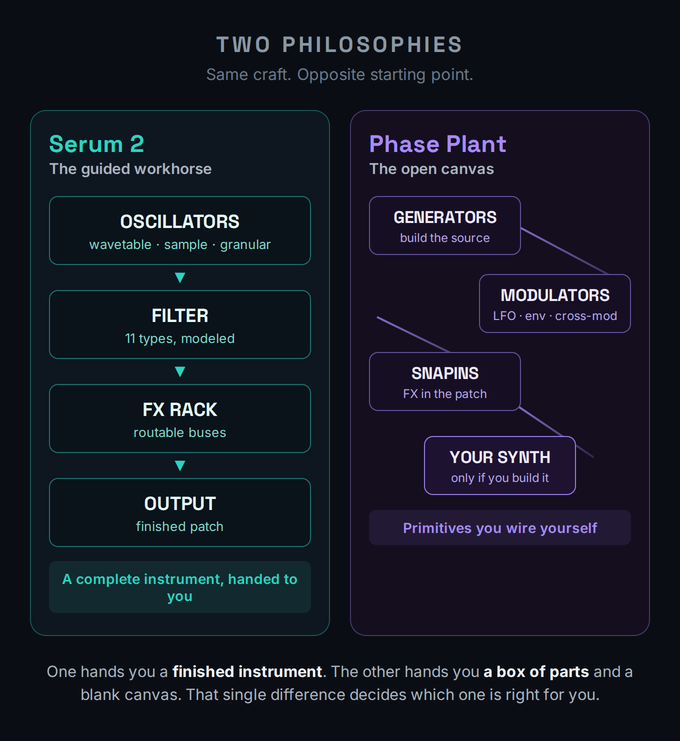
This is why "which is better" is the wrong question. A guided instrument is better for someone who wants to finish tracks; a modular kit is better for someone who wants to invent sounds. Neither is a deficiency of the other. The mistake producers make is buying Phase Plant because it looks more powerful and then resenting the friction every time they just want a quick bass, or buying Serum 2 because it is the safe default and then feeling boxed in when they try to build something genuinely strange. Match the tool to the way you actually work, and both are superb. Mismatch it, and both will frustrate you. If you are still learning the fundamentals of synthesis itself, our primer on what a synthesizer is and the basics of sound design will make the rest of this comparison land harder.
Sound & Engines, Honestly Compared
On raw sound quality the two are close enough that anyone claiming a clear winner is selling something. Both produce clean, modern, professional output; both hold up under aggressive processing; both can be the source of a finished commercial record. Where they genuinely diverge is character and the route you take to get there. Serum 2's oscillators are famously clean and surgical — the wavetables are crisp, the interpolation is smooth, and the new analog-modelled filters add warmth the original lacked. That clarity is exactly why it became the default for bass-forward electronic music: a Serum sound tends to sit in a mix with very little fighting, which is its own kind of quality.
Phase Plant's sound has a slightly different fingerprint, owing less to the oscillators themselves and more to what you do after them. Because effects are Snapins wired into the patch and modulated like anything else, the character of a Phase Plant sound often comes from heavily-processed, deeply-modulated signal chains that would be awkward to build inside Serum 2's more fixed effects section. That is where the famous Phase Plant bass and neuro textures come from — not a magic oscillator, but the freedom to abuse the entire chain. Serum 2's counter is its multi-engine spread across three oscillator slots: you can run a wavetable, a granular and a spectral source at once, layering synthesis types inside a single instance in a way Phase Plant's generator approach handles differently.
The one clear engine asymmetry is spectral resynthesis. Serum 2's spectral oscillator analyses a sample down to its harmonic components and lets you reshape them in real time; Phase Plant has no direct equivalent. If your sound design leans on resynthesis — pulling a sample apart and rebuilding it spectrally — that is a real reason to favour Serum 2. Going the other way, Phase Plant's audio-rate cross-modulation and self-modulation between generators reach places Serum 2's architecture does not, which matters for the gnarlier end of sound design. For a full breakdown of where each engine type shines, our sound-design plugin guide and the synthesis type selector tool map the territory; if you want the deep-dive on Serum 2 itself, the Serum 2 review covers every engine in detail.
Filters deserve their own mention because they are where a lot of a synth's musical character actually lives. Serum 2's 2025 rebuild added eleven new filter types, including analog-modelled designs and a phase-and-zero state-variable filter, on top of the dual-filter routing it already had — and crucially they are right there in the fixed signal path, one click from any oscillator. Phase Plant handles filtering through Snapins you place in the chain, which is more flexible in principle (you can put a filter anywhere, modulate it freely, and stack several) but slower to reach and less immediately visual. The practical upshot mirrors the rest of the comparison: Serum 2 gives you excellent filters instantly; Phase Plant gives you filters you can route and abuse more creatively if you are willing to build the chain. Neither is short on quality — the difference is, again, speed versus openness.
Workflow: How Fast You Get From Nothing to a Usable Patch
This is the axis where the scorecard gap is widest, and it is the most important one for most readers. Serum 2's workflow advantage (9.3 versus 8.4) is not a small UX nicety — it is the practical difference between finishing a track tonight and spending the session building an instrument. Open Serum 2, and you are seconds from sound: load a preset, twist a macro, and you have something usable before you have finished your coffee. Even building from scratch, the fixed signal path means every control is where you expect it, the visual feedback is immediate and literal, and the path from "I want a supersaw" to "I have a supersaw" is about as short as synthesis gets.
Phase Plant asks more of you before it gives anything back. To make a sound from scratch you place a generator, then a filter Snapin, then maybe a modulator, then wire them — and only then do you start shaping. That is more steps, and for a producer whose goal is a finished track this evening, those steps are friction. The flip side is real: once you have built a Phase Plant patch, the modular structure gives you control that a fixed architecture cannot, and many sound designers find the build process itself is where the inspiration lives. But be honest with yourself about which producer you are. If "I want finished music fast" describes you, the workflow gap is decisive, and it is why Serum 2 remains the EDM and pop default — see the best EDM plugins guide for where it sits in a typical chain.
Presets sharpen the divide further. Serum 2's vast preset library and third-party economy mean you frequently start from someone else's finished sound and tweak, which is a legitimate and fast way to work. Phase Plant ships a respectable factory bank, but the culture around it is build-it-yourself, and the third-party pack market is a fraction of Serum's size. If you learn synthesis by reverse-engineering presets — a genuinely good method — Serum 2 gives you orders of magnitude more material to learn from. If you would rather build than browse, Phase Plant rewards that instinct. Either way, the technique of stacking sources to thicken a patch is worth mastering; our guide to layering synths applies to both.
Visual feedback is the quiet half of why Serum 2 feels so fast. Its real-time displays — the wavetable view, the moving filter response, the animated modulation — show you what every control is doing the moment you touch it, and the 2025 rebuild made the whole interface resizable and cleaner on a 4K display. That immediacy is a genuine teaching tool: you learn synthesis faster when you can see the waveform deform as you turn a knob. Phase Plant is far from blind — its module view is clear and its wavetable editor is excellent — but its feedback is more diagrammatic than literal, showing you the structure of the patch rather than an animated picture of the sound. For producers who think visually, that gap is part of what makes Serum 2 the gentler learning curve and Phase Plant the more cerebral build.
Modulation & the Sound-Design Ceiling
If workflow is Serum 2's home turf, modulation is Phase Plant's. The scorecard reflects it: Phase Plant takes modulation (9.3 to 8.8) and the sound-design ceiling (9.4 to 8.7), and both gaps come from the same root cause — its open architecture lets you route anything to anything. You can add as many envelopes, LFOs and randomisers as a patch needs, modulate modulators with other modulators, and use audio-rate signals as modulation sources to create movement and grit that a fixed mod matrix struggles to reach. For the producer who wants a patch that evolves on its own, mutates over eight bars, and never quite repeats, Phase Plant's ceiling is genuinely higher.
Serum 2's modulation is deep but bounded. It has a generous mod matrix, multiple envelopes and LFOs, the new four-envelope layout, and Chaos modulators for controlled randomness — more than enough for the overwhelming majority of sounds, and faster to set up because the routing options are curated rather than open-ended. The trade-off is the same one that runs through this whole comparison: Serum 2 makes the common cases fast and the exotic cases harder, while Phase Plant makes the exotic cases possible at the cost of making the common cases slower. For ninety percent of patches you will never hit Serum 2's ceiling. For the other ten percent — the self-evolving, audio-rate-modulated, deeply-recursive patches that define a certain kind of sound design — Phase Plant is simply built for territory Serum 2 only approaches.
The baked-in Snapin effects compound Phase Plant's modulation advantage. Because Kilohearts effects live inside the patch and modulate like any other module, a Phase Plant sound can have its reverb size, distortion drive and filter cutoff all moving together under a single modulator, saved as one preset that travels with the sound. Serum 2 has a strong, routable effects section, but it is a section attached to the synth rather than a set of modules woven into the patch. If your sound design depends on modulated, integrated effects as part of the instrument itself, that structural difference favours Phase Plant in a way no feature checkbox captures. To put either synth's modulation through its paces, the ADSR visualizer and synthesis parameter reference are useful companions.
The Ecosystem Nobody Scores: Presets, Packs & Tutorials
This is the advantage that never shows up on a spec sheet and quietly decides more purchases than any oscillator: Serum has the largest third-party preset and sound-pack economy of any synthesizer on earth, full stop. Whatever genre you make — dubstep, future bass, trap, techno, pop, cinematic — someone sells professional Serum presets for it, usually dozens of someones, and a huge share of the sound-design tutorials on YouTube are demonstrated in Serum. That ecosystem is a compounding asset. It means you are never short of starting points, never short of learning material, and never short of a quick way to chase a reference sound. For a working producer on a deadline, that is worth real money, and it is why the scorecard puts Serum 2's ecosystem at 9.5.
Phase Plant's ecosystem is healthy but a fraction of the size. There are excellent commercial Phase Plant banks — particularly for bass music, where the synth's strengths are well understood — and Kilohearts maintains a solid factory library and its own content. But you will not find the same wall-to-wall coverage for every micro-genre, and the tutorial base, while strong among sound designers, is far smaller than Serum's mainstream presence. The Phase Plant culture is build-your-own rather than buy-and-tweak, which fits its target user but is a genuine disadvantage if you rely on presets to move quickly or to learn.
The learning dimension compounds the ecosystem advantage in a way that is easy to underrate. Because Serum is the de facto teaching synth, the overwhelming majority of sound-design tutorials, preset-walkthroughs and "how they made that sound" breakdowns on YouTube are demonstrated in it — so when you want to learn a technique, you can almost always follow along in the exact instrument the teacher is using. There is a real network effect here: producers standardise on Serum partly because everyone else has, which means collaborators can open your project, packs are guaranteed to exist, and help is one search away. Phase Plant has a passionate, knowledgeable community, but it is a specialist one; the mainstream learning gravity still sits with Serum, and for a producer who learns by imitation that gravity is worth money.
The strategic read: if you value the ecosystem, that alone can settle the decision in Serum 2's favour even where Phase Plant scores higher on raw capability — because an instrument is only as useful as what you can do with it on a Tuesday night, and the preset economy is a multiplier on everything else. If you are the kind of producer who never opens a preset and builds every sound from a blank patch, the ecosystem gap is irrelevant to you, and Phase Plant's higher ceiling wins. Be honest about which one you are; most producers underestimate how much they lean on presets. For the wider field of what is worth owning, our best synth plugins roundup places both, and the best free VST plugins guide covers what to try before spending anything.
CPU, Performance & the Laptop Reality
Here the advantage flips back to Phase Plant, and it is the most under-reported difference between the two. Kilohearts has built its entire ecosystem around low CPU load, and Phase Plant is genuinely light for what it does — you can run many instances on a modest machine without the meter climbing into the red. Serum 2's situation is more nuanced. The synth as a whole is more efficient than the original in many respects, but its new granular and spectral engines are heavier than the marketing lets on, and a project stacked with multi-engine Serum 2 instances using those modes can tax a laptop in a way Phase Plant rarely will. That is why the scorecard puts Phase Plant at 9.0 and Serum 2 at 8.1 on efficiency.
There is a second Serum 2 caveat worth stating plainly: the multisample engine, while a genuine addition, is still maturing, and the heaviest new modes reward a workflow habit — print or freeze the track once the sound is finalised. That is normal practice with any CPU-hungry instrument, but it is more often necessary with stacked Serum 2 instances than with Phase Plant, whose low-load design means you can frequently leave many instances live and editable to the end of a mix without thinking about it. If your way of working depends on keeping every synth un-frozen so you can tweak late, Phase Plant's headroom is a quiet daily convenience; if you happily bounce sounds once they are done, Serum 2's heavier engines will rarely bother you. It is a difference of working style as much as raw horsepower.
For most producers on a current desktop or a strong laptop, neither will be a bottleneck on a typical track. The difference becomes real at the margins: large arrangements, lots of synth instances, the new Serum 2 engines running in parallel, or an older machine. If you regularly build dense projects on a laptop and you live in the heavier oscillator modes, Phase Plant's lighter footprint is a practical, every-session advantage that compounds over a long mix. It is rarely the deciding factor on its own, but it belongs in the decision, and almost no other comparison states it plainly. Both run native on Apple Silicon, both are 64-bit VST3, AU and AAX plugins, and neither offers a standalone app — so on platform support there is nothing to separate them.
Price, Upgrades & the Free-Serum-2 Loophole
On paper Serum 2 is the pricier synth at $249 list against Phase Plant's $199, and Phase Plant is discounted far more aggressively — it regularly drops to around $99–119 in retailer promotions, and the lowest recorded prices sit near $92. On a strict budget, that is a meaningful gap, and if money is the deciding constraint, Phase Plant on sale is the cheaper route to a serious synth. But frame that honestly: you are not buying a cheaper Serum, you are buying a different tool. Choosing Phase Plant to save money only makes sense if Phase Plant is also the right instrument for how you work — otherwise the savings buy you friction.
The pricing picture has one detail that quietly tilts the whole comparison: if you already own Serum 1, Serum 2 is free. Xfer's lifetime-free-updates policy is not marketing fluff — buy Serum once and you got a substantially different synth in 2025 at no cost. For the enormous installed base of Serum 1 owners, this is nearly a decision-free path: the upgrade costs nothing, the workflow is familiar, and the entire preset library still applies. No comparison should bury that. If you are in the Serum ecosystem already, the math is close to settled before you read another word. The $189 introductory price for new buyers ended on 1 June 2025, so today's new-buyer price is the full $249, with Splice rent-to-own at $9.99 a month for 25 months if you prefer to spread it.
Phase Plant's value story is its own kind of strong. It also offers lifetime free updates — Kilohearts does not charge for major versions — and a Subscribe-to-Own option through the Kilohearts Subscription at $9.99 a month that eventually converts to ownership while bundling subscriber rewards. Bear in mind that Phase Plant's deeper power often assumes the wider Kilohearts ecosystem; the free Essentials Snapins are generous, but the Premium effects are sold separately, so a maxed-out Phase Plant rig can cost more than the headline sticker. Across both synths the takeaway is the same: list price is only the start of the real cost, and the genuinely cheapest path for many readers is to learn first in a free synth — see Serum 2 vs Vital for why the free option covers most of what either flagship does.

By Genre & Use-Case
Genre is a useful shortcut because it usually encodes how you work. If you make EDM, pop, festival, future bass or commercial sound-pack material, Serum 2 is the default and it is not close — the workflow speed, the preset economy and the clean, mix-ready oscillators are exactly what those genres reward, and the entire scene already speaks Serum. If you make dubstep, neuro, riddim, drum-and-bass or anything where the bass design itself is the hook, the answer genuinely splits: Serum 2 is still excellent there, but Phase Plant's modular routing and baked-in FX are purpose-built for the gnarly, evolving, heavily-processed basses those styles live on, and many of the producers defining that sound have moved to it. Our guides to making dubstep and making bass music lean on exactly the techniques where Phase Plant shines.
For cinematic, ambient, game-audio and sound-design-for-media work, Phase Plant pulls ahead on the strength of its ceiling — evolving textures, generative modulation and integrated effects are its native language. For hip-hop and lofi, either is fine; both make great keys, plucks and pads, and the choice comes down to whether you want to browse presets fast (Serum 2) or sculpt something specific (Phase Plant). The pattern across every genre is the same one this whole page keeps returning to: the more your genre is about finishing tracks quickly with a known palette, the more Serum 2 fits; the more it is about inventing a signature sound, the more Phase Plant fits.
A few more genres are worth calling out because they break the simple split. For techno and house, either works, but the instinct differs: Serum 2's speed suits the "build the track, not the patch" tempo of dance production, while techno sound designers chasing unusual, mangled textures will find Phase Plant's routing rewarding. For ambient and experimental music, Phase Plant's generative, self-evolving capability is close to ideal — patches that drift and mutate are its home turf. For hip-hop, trap and lofi, both make superb keys, plucks, 808s and pads, and the deciding question is purely whether you would rather pull a finished 808 from Serum's vast preset shelves or sculpt one from scratch in Phase Plant. Notice the pattern holding across every genre: the split is never really about the music, it is about whether that music's workflow rewards presets-and-speed or build-and-invent.
Who Should Buy Which
Buy Serum 2 if you are most producers reading this. You want finished music fast, you are happy living in presets and tweaking, you make bass-forward electronic, pop or commercial work, and you value the largest ecosystem in software synthesis. And if you already own Serum 1, the decision is effectively made — Serum 2 is free, familiar, and your whole preset library carries over. It is the guided workhorse, the synth that gets out of your way and lets you finish, and for the majority of careers that is the right tool. The full Serum 2 review and the Serum 2 vs Pigments comparison are the natural next reads if it is your pick.
Buy Phase Plant if your goal is original sound rather than fast tracks. You design from scratch, you make bass music, neuro, cinematic or game audio, you want the higher modular ceiling and the baked-in Snapin effects, and you would rather build an instrument than browse for one — and the frequent ~$99 sale price is a welcome bonus rather than the reason. It is the open canvas, the connoisseur's pick, and in the hands of a sound designer it reaches places Serum 2 only gestures at. Just go in clear-eyed about the friction: it asks more of you before it gives anything back, and that is the trade you are choosing on purpose.
If you are still genuinely torn after all that, do not agonise — test it. Both synths offer demos, so spend an evening with each and pay attention not to which sounds "better" in the abstract but to which one you actually enjoyed using and which got you to a sound you liked faster. That subjective reaction is more reliable than any scorecard, because it measures the one thing that decides whether a synth becomes a daily tool or an expensive folder you never open: whether its way of working fits your brain. The producer who has fun in Phase Plant's build-it-yourself flow and the producer who has fun flicking through Serum 2's presets are different people, and both are right.
And if the budget genuinely allows, owning both is not extravagant — it is how plenty of working producers operate. Serum 2 becomes the everyday workhorse you reach for first; Phase Plant stays installed as the specialist you open when a track needs a sound nobody else has. They overlap less than the spec sheets imply, because the thing each does best is the thing the other does only adequately. For most readers that is a next-year decision rather than a today one — but it is worth knowing the two are complements, not strictly either/or. For the broader synth landscape, the Omnisphere 3 vs Serum 2 and original Serum review round out the picture.
Spec Sheet, Side by Side
| Spec | Serum 2 | Phase Plant |
|---|---|---|
| Released | 2025 (ground-up rebuild) | Mature; granular added 2023 |
| Architecture | Fixed, deep signal path | Open, semi-modular |
| Oscillator / generator types | Wavetable, sample, multisample, granular, spectral | Analog, wavetable, sample, noise, granular |
| Spectral resynthesis | Yes | No |
| Effects | Routable FX section, multi-bus | Snapins baked into the patch (3 lanes) |
| Native arp / clip sequencer | Yes (12-slot clip seq) | Via Snapin / DAW |
| Modulation | Deep mod matrix, bounded | Open, unlimited routing, audio-rate |
| CPU footprint | Heavier on new engines | Optimised, low |
| Apple Silicon | Native | Native |
| Formats | VST3, AU, AAX (no standalone) | VST, VST3, AU, AAX (no standalone) |
| Price | $249 (free for Serum 1 owners) | $199 list, often ~$99–119 on sale |
| Updates | Lifetime free | Lifetime free |
Specs and prices verified June 22, 2026 against the Xfer Records and Kilohearts product pages and 2025–26 reviews. Prices are USD list; sale, loyalty and subscribe-to-own pricing vary — confirm at the vendor before purchase.
Practical Exercises
The fastest way to feel the difference between these two is to build with them. Work through these three graded exercises in whichever you own — or in both demos — and the philosophy gap stops being abstract.
- In Serum 2, load a single wavetable oscillator, pick an aggressive table, add a touch of unison, and drop a low-pass filter with an LFO on the cutoff. Time how long it takes to reach a usable sound.
- In Phase Plant, recreate it from a blank patch: place a wavetable generator, add a filter Snapin, wire an LFO modulator to the cutoff, and shape it. Time that too.
- A/B the two. Notice how much faster Serum 2 gets you to a usable patch, and how different the raw character is — and ask yourself which workflow you actually enjoyed more. That answer is your synth.
- In Phase Plant, build a self-evolving pad: route multiple LFOs and an envelope to different Snapin parameters, send an audio-rate signal into a generator for grit, and let two effects lanes move together under one modulator.
- Now try to approximate that same self-evolving patch in Serum 2 using its mod matrix, Chaos LFOs and routable effects.
- Note exactly where Serum 2 makes you compromise — the freely-recursive, audio-rate modulation is the part hardest to match. That gap is what Phase Plant's open routing buys you.
- In Serum 2, build one bass from three engine types at once: a wavetable mid, a sampled or multisample fundamental, and the spectral engine for upper-harmonic bite, routed through both filters in series.
- Import or draw a custom wavetable and assign a macro to morph it across the layer.
- Try to reproduce the spectral-resynthesis component in Phase Plant — and discover where the absence of a spectral generator stops you. This exercise demonstrates, rather than asserts, the one real engine gap.