Buy the AKG C414 XLII (~$1,249) if you want one microphone that does everything: nine polar patterns, pads and filters, a marginally lower self-noise figure, and a shock mount, pop filter and case in the box — usually for less money all-in than the Neumann. Buy the Neumann TLM 103 (~$1,295) if you mostly track a single voice and want a fast, classic, forward Neumann vocal sound on one cardioid you cannot set wrong. Here is what almost every other comparison gets backwards: the TLM 103's usual selling points — "it's the quiet one, the cheap one, the classic" — don't survive the current spec sheet. The C414 is quieter on paper and cheaper in the box. The real reason to choose the TLM 103 is that it makes no decisions and gives you one purpose-built vocal sound. Versatility was never the tie-breaker. Decisions are. Below is exactly how to tell which of those two studios is yours.
This article contains affiliate links. If you purchase through our links, we may earn a commission at no extra cost to you. This does not affect our editorial independence — every recommendation here is based on genuine, source-checked assessment.
| Axis | Neumann TLM 103 | AKG C414 XLII |
|---|---|---|
| Lead-vocal sound | 9.1 | 8.9 |
| Versatility (patterns & sources) | 7.0 | 9.4 |
| Top-end & air | 8.7 | 9.2 |
| Self-noise | 9.0 | 9.2 |
| Build & accessories | 8.2 | 9.3 |
| Ease (no decisions) | 9.3 | 8.0 |
| Value (all-in) | 8.4 | 9.1 |
| Overall | 8.5 | 9.0 |
Scores are MPW editorial judgement, defended section by section below — a decision framework, not a first-party measurement. Specs and prices verified June 23, 2026 against each vendor's current product page (neumann.com, akg.com) and 2025–2026 reviews. Prices are USD; sale, bundle and loyalty pricing move constantly, so confirm at the vendor before you buy. Frequency-character claims are sourced from manufacturer-published responses, not first-party measured.
Updated June 2026 — Neumann TLM 103 vs AKG C414 XLII
The overall numbers tell the honest story in one line: the C414 XLII takes the higher mark (9.0) because it is the better mic to own, and the TLM 103 (8.5) wins exactly two axes — ease/no-decisions (9.3) and lead-vocal sound (9.1) — which are precisely the two things that justify buying it. Look at what the C414 carries: versatility (9.4), build and accessories (9.3), value all-in (9.1), more air (9.2), and even a hair more quiet (9.2 vs 9.0). If you read only the overall, you'd buy the AKG and never think about it again, and for most studios that would be the right call. But if your life is a single voice in front of a single mic, those two TLM 103 wins can outweigh everything else. Ignore the overall, find the axis that matches the work you actually do, and the right mic stops being a coin-toss. Every number above is defended below.
Why the Usual Verdict Gets This Backwards
Open any "TLM 103 vs C414" page and you'll meet the same verdict, almost word for word: the Neumann is the warm classic with one cardioid; the AKG is the brighter, more flexible mic with nine patterns and a bag of switches; therefore the C414 is "more versatile," and more versatile wins. Some of those pages will even tell you the C414 has five patterns — a spec that's been wrong since 2009, when AKG moved the XL-series to nine. When a page can't get the pattern count right, it's a fair bet it hasn't checked anything else either, and it usually hasn't.
Here's the part that should change how you read every one of those comparisons. The reasons people actually give for buying the TLM 103 over the C414 — "it's the quieter one," "it's the cheaper one," "it's the classic" — mostly don't survive the current spec sheet. On self-noise, the C414 XLII is rated 6 dB-A against the TLM 103's celebrated 7 dB-A: the AKG is, on paper, the quieter mic. On price, the TLM 103 streets around $1,295 and barely discounts, while the C414 XLII sits near $1,249, goes on sale constantly, and ships with a shock mount, pop filter and case the Neumann makes you buy separately. Counted all-in, the C414 is the cheaper box too. The "classic" claim is real but slippery, and we'll settle the "budget U87" version of it below. Strip away the myths and the TLM 103's case gets narrower — and, oddly, stronger, because what's left is the one thing that's genuinely true and genuinely valuable.
That one thing is this: the TLM 103 makes no decisions. It is a single fixed cardioid with no pad and no filter, voiced for a fast, forward, classic Neumann vocal sound you point and forget. The C414 XLII is the opposite philosophy — a whole mic locker compressed into one body, capable of almost any source if you set it correctly. Neither is "better." They are answers to two different questions. The cookie-cutter verdict asks "which sounds nicer or does more?" The question that actually decides it is "how many decisions do you want to make every time you hit record?" That's the spine of this comparison, and the rest of the page argues it source by source. For the wider framing on why a condenser like either of these is the studio standard in the first place, our condenser vs dynamic microphone guide sets the scene, and the Bible entry on the condenser microphone covers the underlying mechanism.
Two Different Jobs: One Voice vs a Mic Locker
Think of the TLM 103 as a specialist tool and the C414 XLII as a Swiss Army knife, and you're already 80% of the way to the right purchase. The specialist does one job superbly and asks nothing of you; the knife does twenty jobs well and asks you to pick the right blade each time. Both are excellent. The mistake is buying the knife when you only ever do the one job, or the specialist when your work changes shape every session.
The TLM 103's whole design is a series of deliberate subtractions. One pattern — cardioid — so there's nothing to switch to the wrong setting at the start of a take. No pad, because it's not aimed at the screaming-loud close-miked sources that need one. No low-cut, so you manage proximity with distance and EQ rather than a switch. That sounds like a list of missing features, and on a spec sheet it is. In a vocal booth it's a feature in itself: you cannot mis-configure a TLM 103. Put it up, set your gain, and the only variable left is the performance. For a singer-songwriter, a voiceover artist, or anyone who records their own voice over and over, that absence of decisions is worth real money. Its case is made fully in our Neumann TLM 103 review.
The C414 XLII is the philosophy inverted: every switch the Neumann leaves off, the AKG hands you. Nine polar patterns — omnidirectional, wide cardioid, cardioid, hypercardioid, figure-8, plus four intermediate stops between them — so one mic captures a tight vocal, a natural room, a stereo pair or a figure-8 duet. Three pads (−6, −12, −18 dB) push its ceiling to a colossal 158 dB SPL, enough for a snare or a cranked amp inches away. Three low-cut filters (40, 80, 160 Hz) tame proximity boom without touching an EQ. A peak-hold LED flags overloads, and a lock mode freezes your settings for live use. It is, almost literally, a mic cupboard in a single body — the mic you buy once and reach for on nearly everything. The full breakdown lives in our AKG C414 XLII review.
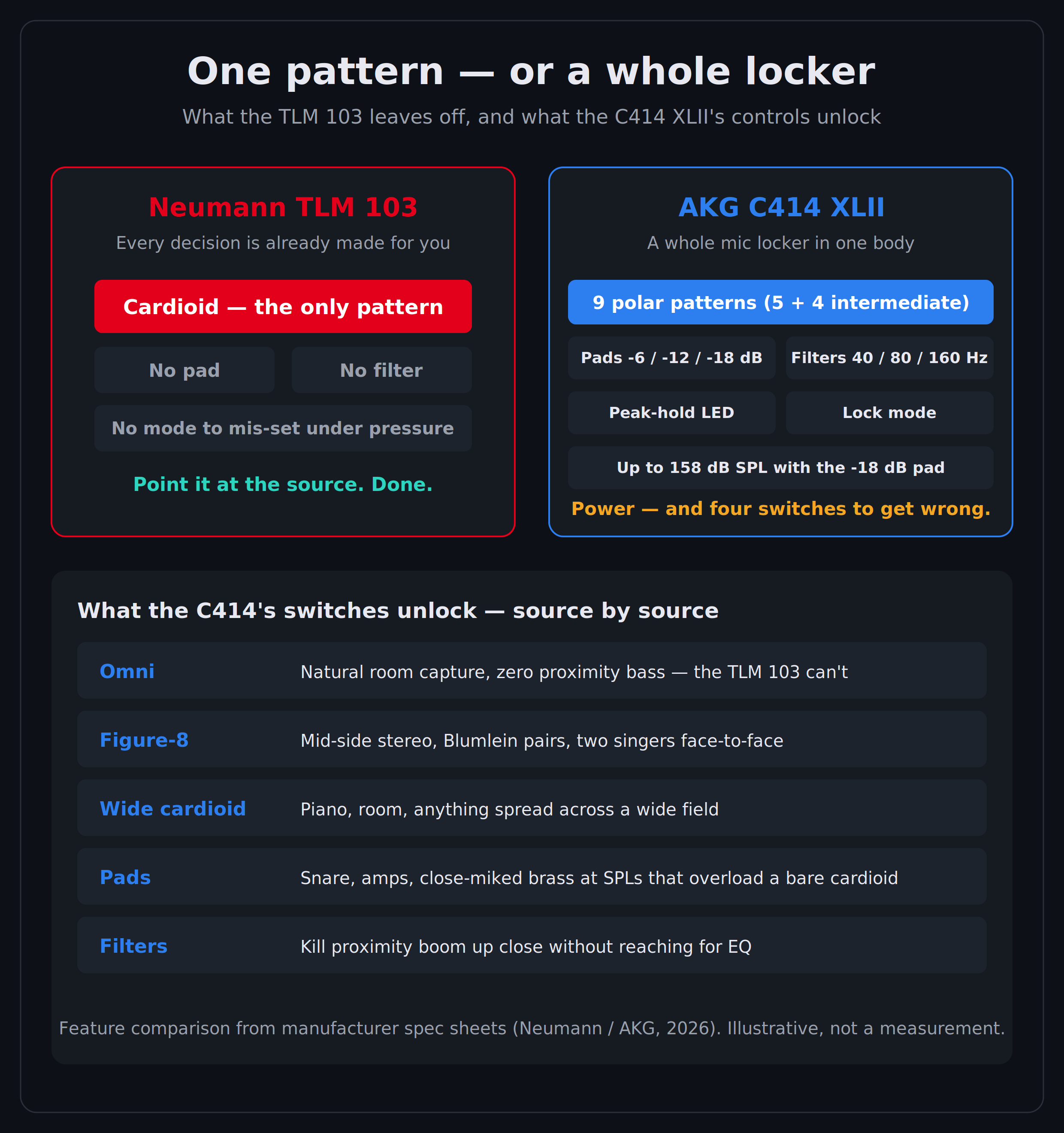
The trade-off is exactly the one the diagram shows. The C414's power comes with surface area for error: a take ruined because the pattern was on omni in an untreated room, or the −18 pad was still engaged from the last snare session. None of those mistakes is possible on a TLM 103, because none of those switches exist. So the real question isn't "which can do more" — the C414 obviously can — it's whether the jobs you do need that range, and whether you'd rather have capability with decisions or simplicity without them. Get honest about your own sessions and the answer usually arrives before you've compared a single frequency response.
Picture the two studios concretely. In the first, a songwriter sits down most evenings, sings into the same mic from the same spot, and wants the take to sound like their records with no fiddling — the TLM 103 is built for that life, and its lack of options is exactly why it never gets in the way. In the second, a producer might track a lead vocal on Monday, a guitar overdub on Tuesday, a friend's drum kit on Wednesday and a string duo on Friday — that studio needs the C414's patterns and pads, and the minutes spent learning its switches pay for themselves across the week. Neither studio is more serious than the other; they just record different things, and the mic should match the calendar you actually keep, not the one you imagine.
Which C414? XLII vs XLS (and Why It Decides This)
Before we go further, a fork most comparisons skip entirely: "the C414" isn't one mic. The two current versions, the XLII and the XLS, share the same body, the same nine patterns, the same pads, filters and accessories, and the same price. The only meaningful difference is the capsule voicing — and it changes which mic you're actually comparing the TLM 103 against.
The C414 XLII is the one with character. AKG voices it with a presence boost and the airy, spatial top end modelled on its legendary C12 from the 1950s, which flatters lead vocals and solo instruments and helps them sit forward in a dense mix. The C414 XLS is engineered the other way: flat, neutral and linear, in the lineage of the long-running C414 B-ULS, built to capture a source exactly as it is. If you want a truthful reference mic, the XLS is the pick. If you want flattering air, the XLII is. Because the TLM 103 is itself a bright, forward, presence-boosted mic, the honest head-to-head is the TLM 103 vs the C414 XLII — two character mics, two flavours of bright. The XLS is a different conversation: the neutral alternative you'd reach for when you specifically don't want either mic's lift. Throughout this article, when we say C414 we mean the XLII, because that's the one cross-shopped against the Neumann — but if neutrality is your goal, note the XLS exists at the same price and quietly changes the verdict. For where the smaller AKG sits relative to the full C414, our C214 vs C414 comparison maps the step down, and the broader range is covered in our AKG C414 review.
In practice, most people cross-shopping the TLM 103 land on the XLII without even registering that the XLS exists, because the XLII is what stores stock and reviewers feature. If you've only ever heard "the C414," you've almost certainly heard the XLII. That's fine — it's the right one to weigh against the Neumann — but it's worth a deliberate listen to both AKG capsules if you can, because pairing a neutral XLS with the bright TLM 103 would hand you a truthful workhorse and a character vocal mic for not much more than the cost of two of either one.
The "Budget U87" Myth, Settled Honestly
The single most repeated line about the TLM 103 is that it's "a budget U87," and it's worth dismantling, because believing it leads people to expect the wrong sound. The lineage is genuine: the TLM 103's K103 capsule is derived from the K87 found in the U87, and Neumann positioned the mic in 1997 as an affordable route to that family at roughly a third of the U87's price. But shared DNA is not the same as a shared voice.
The differences are real and audible. The K103 uses a single live diaphragm with a fixed cardioid pattern, where the U87's capsule is a dual-diaphragm, multi-pattern design — that's why the U87 offers omni and figure-8 and the TLM 103 doesn't. More importantly for the sound, the TLM 103 carries a wider, more lifted presence boost than the U87 and rolls off its low end sooner, so it reads as brighter and more forward, not as a muted, cheaper version of the classic. Engineers who've used both describe the TLM 103 as having its own warm-but-bright "sheen," not the U87's rounder, more mid-focused character. In other words, it's not a U87 with the price filed off; it's a distinct, more modern Neumann voice that happens to share a parent. If you genuinely want to know how it stacks against the original, that's its own fight, and we settle it in Neumann TLM 103 vs U87 and the standalone U87 review. For this comparison, the takeaway is simpler: judge the TLM 103 on the bright, forward sound it actually makes, not on the legend it's marketed near.
Sound & Sources: Vocals, Acoustic, Overheads, VO, Room
Both mics are bright, but they're bright in different ways, and that's the heart of the sonic decision. The TLM 103's lift is a narrow, lifted sheen sitting above its flat-to-5 kHz body — a focused presence that pushes a vocal forward without ever sounding thin. The C414 XLII's top end is broader and keeps opening into air well past the presence region, the quality reviewers reach for words like "open" and "expensive" to describe. Neither curve is a measurement we took; both are sourced from the manufacturers' published responses and drawn schematically below.
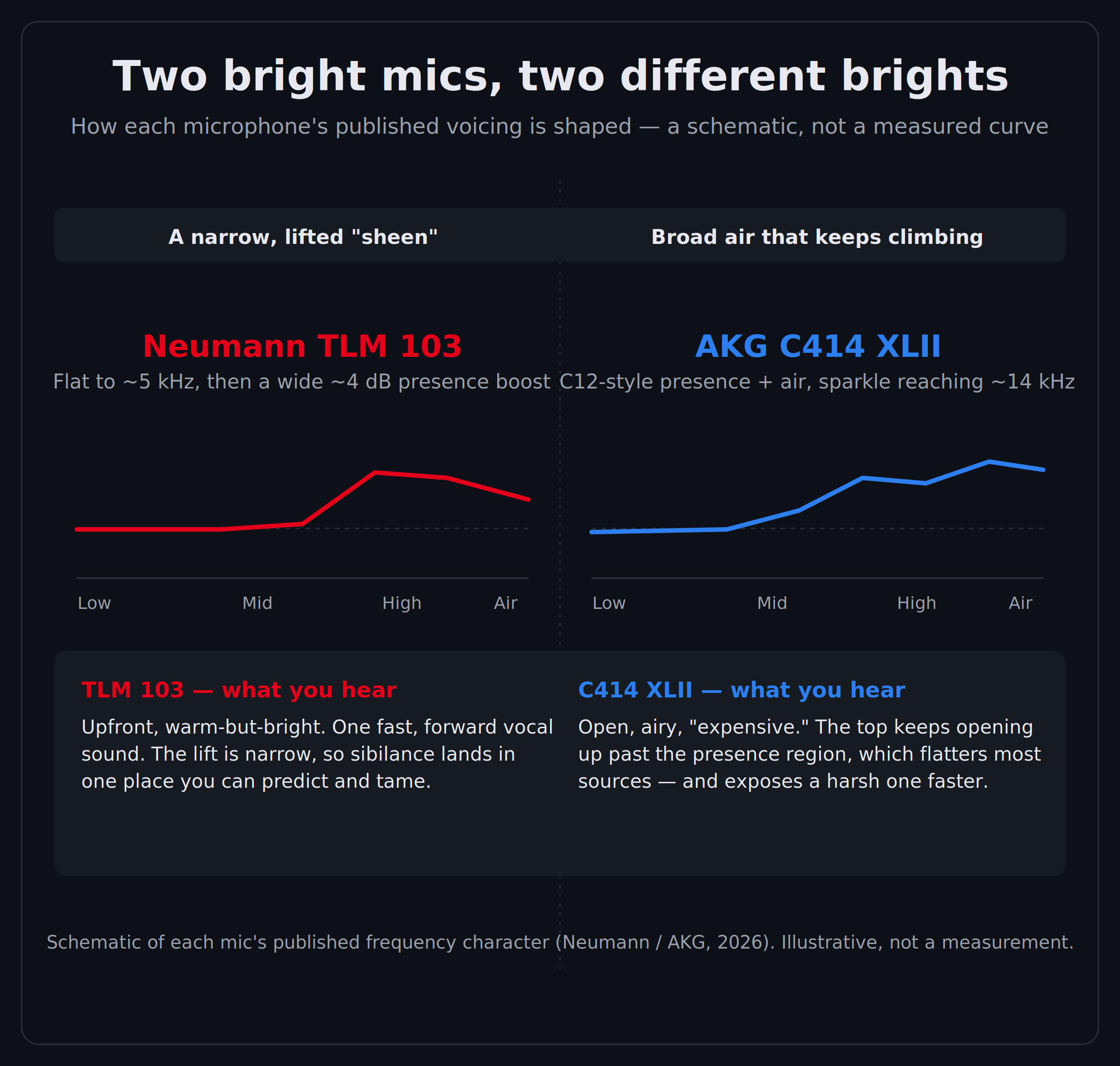
On a single lead vocal, the practical difference is speed versus shaping. The TLM 103 gives you one fast, forward, no-fuss sound: it tends to sit at the front of a mix with little EQ, and because its lift is narrow, sibilance lands in one predictable place you can tame once and forget. The C414 XLII's airier top flatters most voices beautifully and gives you patterns and filters to shape the take in the moment — but on an already-bright or sibilant singer, that extra air is more to manage. For a single recurring voice where consistency matters, we give the TLM 103 the narrow edge (9.1 vs 8.9); for a mic that has to flatter whatever singer walks in, the C414's range makes it the safer pick. Either way, getting the best out of these mics is as much about technique as capsule — our guide to recording vocals at home covers placement and gain-staging for both.
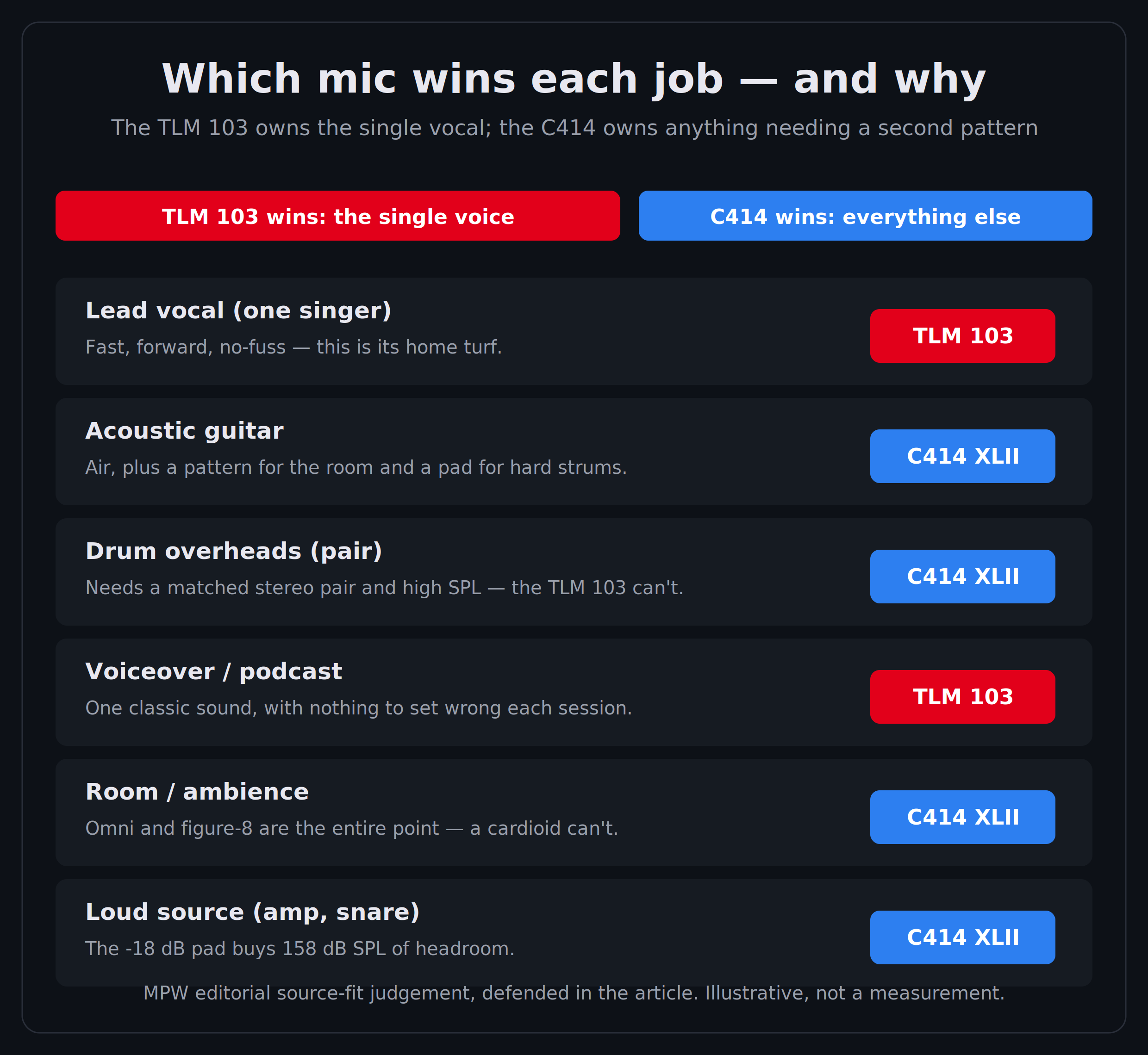
Move past the single voice and the C414 pulls away, which is exactly what its higher versatility score (9.4 vs 7.0) means. On acoustic guitar, the XLII's air brings out string detail and you can switch to wide cardioid for the body of the instrument or drop in a low-cut to control proximity — our acoustic-guitar recording guide walks the placements. The TLM 103 does a fine, warm job on acoustic too, but in one pattern and with no filter. On drum overheads, it's not a contest: overheads usually want a matched stereo pair and high SPL handling, and the C414 — available as a matched pair, with its pads and 158 dB ceiling — is built for it, while a single cardioid TLM 103 simply can't do the stereo job. Voiceover and podcasting swing back to the Neumann: one classic sound, nothing to set wrong session after session, is exactly what a daily-driver VO mic wants. And for room and ambience, the C414's omni and figure-8 patterns are the entire point — capturing a space, a Blumlein pair or a mid-side image are things the TLM 103 has no mode to attempt.
One honest caveat cuts across all of this: neither mic rescues a bad-sounding room. Both are sensitive large-diaphragm condensers that hear everything — the C414 in omni will faithfully capture a boxy bedroom as readily as a great live room, and the TLM 103's forward presence can make early reflections more obvious, not less. If your space is untreated, spend a little on absorption before you agonise over capsules, because the room is doing as much to your recorded sound as the microphone is. With a treated space the choice between these two becomes purely about voice and versatility; without one, both mics will simply tell you the truth about the room, loudly.
When the C414's Switches Actually Earn Their Keep
It's easy to read "nine patterns, three pads, three filters" as marketing and assume you'll leave the mic in cardioid forever — and if you only ever record one voice, you will. But each switch maps to a real job the TLM 103 cannot do at all, and it's worth knowing exactly what you'd be giving up before you decide you don't need them.
The patterns are the big one. Omnidirectional turns the C414 into a natural room mic with no proximity bass build-up — perfect for capturing the sound of a good-sounding space, and impossible on a fixed cardioid. Figure-8 unlocks mid-side recording, Blumlein pairs, and the classic two-singers-on-one-mic setup, where the rear lobe is a feature, not bleed. Wide cardioid splits the difference for a piano lid or a guitar body that's spread across a wide field. The four intermediate stops let you fine-tune exactly how much room creeps into a close source. The TLM 103 has one answer to all of this — cardioid — which is the right answer for a single voice and no answer at all for the rest.
The pads matter the moment a source gets loud. Engaging the −18 dB pad lifts the C414's ceiling to 158 dB SPL, enough to put it an inch from a snare or in front of a cranked guitar cab without the capsule overloading. The TLM 103's 138 dB max is high, but with no pad it has less headroom in hand for the truly punishing close-mic jobs. The low-cut filters (40, 80, 160 Hz) are the quiet hero: they kill proximity-effect boom right at the mic when a singer works in close, so you commit a cleaner low end instead of fixing it later with EQ — again, something the TLM 103 leaves entirely to your distance and your DAW. None of this makes the C414 "better." It makes it capable of more jobs, and the honest question is simply how many of those jobs are yours.
Managing the TLM 103's Presence Boost (the Sibilance Question)
Here's the question almost no comparison answers, even though it's the one TLM 103 owners actually run into: that lovely forward sheen has a flip side. The same ~4 dB presence lift that makes the mic sound immediate and detailed also pushes sibilance and any harshness in a voice forward, and on bright or essy singers the TLM 103 can get spiky if you treat it like a neutral mic. This isn't a flaw — it's the cost of the sound — but you have to know how to manage it, and the good news is the fixes are simple.
Three moves handle almost all of it. First, off-axis placement: angle the mic slightly off the mouth, or have the singer aim just past it, so the hardest sibilants and plosives hit the capsule off the bright on-axis peak. Second, distance: backing off a few inches softens both the proximity bass build-up — the TLM 103 has no low-cut switch to lean on — and the intensity of the presence region, and it gives plosives room to dissipate before the capsule. Third, a real pop filter, which the TLM 103 doesn't include in the box and genuinely needs; pair it with gentle, surgical de-essing in the mix rather than hacking at the whole top end. Get those three right and the presence boost becomes the asset it's meant to be: a vocal that cuts through without you reaching for a high-shelf. The C414 XLII sidesteps part of this by handing you a switchable low-cut and an included pop filter, but it can be the brighter mic of the two up top, so the same disciplines pay off there. The underlying ideas — how a mic's polar pattern shapes off-axis sound, and how its noise floor sets how hard you can push gain — are worth understanding for either choice.
The Spec Table
Everything above, side by side. Note the two rows the cookie-cutter pages tend to get wrong or skip — self-noise, where the C414 XLII's 6 dB-A edges the TLM 103's 7 dB-A, and included accessories, where the gap is wide enough to change the real price.
| Spec | Neumann TLM 103 | AKG C414 XLII |
|---|---|---|
| Type | Large-diaphragm FET condenser, transformerless | Large-diaphragm FET condenser, transformerless |
| Capsule | K103 (derived from the U87's K87) | CK12 (C12 lineage) |
| Polar patterns | Cardioid only (1) | 9 (omni, wide-cardioid, cardioid, hyper, fig-8 + 4 intermediate) |
| Pads | None | −6 / −12 / −18 dB |
| Low-cut filters | None | 40 / 80 / 160 Hz |
| Self-noise | 7 dB-A | 6 dB-A |
| Sensitivity | 23 mV/Pa | 20 mV/Pa |
| Max SPL | 138 dB (135 dB @ 0.5% THD) | 140 dB (up to 158 dB with −18 pad) |
| Frequency character | Flat to ~5 kHz, wide ~4 dB presence boost above | C12-style presence + air, sparkle toward ~14 kHz |
| Weight / length | ~450 g / 132 mm | ~300 g / 160 mm |
| Included accessories | SG 1 swivel mount + wooden box | H85 shock mount + PF80 pop filter + W414 windscreen + case |
| Best for | Single lead vocal, voiceover — one fast classic sound | The whole locker: vocals, acoustic, OH, room, loud sources |
| Street price (USD, 2026) | ~$1,295 (minimal discount) | ~$1,249 (often on sale / bundled) |
Build, Accessories & the Real Cost of Ownership
List prices make these two look like a near-tie at around $1,250–$1,300. The box tells a different story. The TLM 103 ships in a handsome wooden jeweller's box with a rigid SG 1 swivel mount — and that's it. No shock mount, no pop filter, no cable. Neumann will happily sell you its EA 1 or EA 4 elastic suspensions, but they're expensive enough that most owners reach for a quality third-party shock mount and a separate pop filter instead. Factor those in — and given the mic's presence boost, you genuinely want both — and a "$1,295" TLM 103 becomes more like $1,375 by the time it's usable on vocals.
The C414 XLII goes the other way. It streets a touch lower at around $1,249, discounts and bundles far more often, and arrives with the accessories already inside: an H85 shock mount, a PF80 pop filter, a W414 windscreen and an aluminium flight case. There's nothing else to buy before you record. So the honest accounting is that the C414 is usually the cheaper microphone all-in as well as the more capable one — which is why it takes both the build-and-accessories axis (9.3 vs 8.2) and the value axis (9.1 vs 8.4) on the scorecard. That flips the lazy assumption that the Neumann is the budget-conscious pick. It isn't. The TLM 103 holds its price because it sells on sound and name, not on what's in the box.
It's worth weighing longevity too, because both of these are mics you buy once and keep for decades. Neumann and AKG have each made their respective classics for a generation, parts and service are widely available, and both hold their value strongly on the used market — a well-kept TLM 103 or C414 sells for a healthy fraction of new years later, which softens the real cost of either. The C414's included case protects that investment from day one, where a bare TLM 103 in its wooden box benefits from a proper case you'll want to add. Whichever you choose, you're buying a tool that will outlast several interfaces and a couple of DAWs, so weight the decision toward the sound and workflow you'll still want in ten years, not the sticker this week.
This reframes the whole money question. If you're choosing the TLM 103, choose it knowing you're paying a small premium for its specific vocal sound and its no-decisions simplicity — not because it's the value play, because it isn't. If you're choosing the C414 XLII, you're getting the cheaper, better-equipped, more flexible box, and the only thing you're giving up is the TLM 103's particular fast-classic vocal character and the certainty of a mic with nothing to set wrong. Both are honest reasons to spend the money; just spend it for the right one. If either price is more than the project needs, our best condenser microphones under $300 covers the step down, and the wider field is in our best vocal microphones roundup — including where a modern challenger like the Rode NT1 5th Gen undercuts both.
Who Should Buy Which
Buy the Neumann TLM 103 if your work is, overwhelmingly, a single voice in front of a single mic — a singer-songwriter recording their own takes, a voiceover artist, a podcaster, a producer who wants one fast, forward, classic vocal sound and never wants to think about a switch. Its value isn't on the spec sheet; it's in the decisions it removes. You set the gain and the only variable left is the performance. Buy it for the sound and the simplicity, go in knowing you'll add a shock mount and pop filter, and you'll have a mic you can put up half-asleep and trust completely.
Buy the AKG C414 XLII if you want one microphone to cover a studio's worth of jobs: vocals today, acoustic guitar tomorrow, a stereo overhead pair, a room mic, a loud amp, a figure-8 duet. Its nine patterns, three pads and three filters make it the mic you buy once and reach for on almost everything, it's marginally quieter on paper, and it usually costs less all-in with the accessories already in the box. The only price of admission is the handful of switches you now have to set correctly — and if that's a fair trade for never needing a second mic, it's the obvious pick. If you want that flexibility but prefer a flat, neutral voice to the XLII's bright character, the C414 XLS is the same mic with the truthful capsule.
And if your budget genuinely allows for either, don't over-think the overall score. These two mics are built for different studios, not different tiers of the same studio. The C414 XLII is the better tool for the producer who records many sources and wants one mic to rule them; the TLM 103 is the better tool for the producer who records one voice and wants nothing between them and the take. Decide which of those two people you are on the days you actually record — not the days you imagine recording — and the choice stops being close and becomes obvious.
Practical Exercises
The fastest way to feel which mic is yours is to put each decision to a concrete test. Work through these three graded exercises — even just with the demos, the spec sheets and an honest audit of your own sessions — and the choice stops being abstract.
- Over your last ten sessions, count how many used a single source in cardioid versus how many needed a second pattern — a room mic, a stereo pair, a figure-8 duet. If almost everything was one voice up close, the C414's nine patterns are capability you'll pay for and rarely use.
- Now count how often you reached for a pad or a low-cut to tame a loud or boomy source. Each time is a point in the C414 XLII's favour and a job the bare TLM 103 can't do without outboard help.
- Write down which mattered more: the speed of a sound you can't set wrong, or the patterns and switches you'd have used. That honest tally is most of your answer before you compare a single spec.
- Pull up any honest, level-matched shoot-out of the TLM 103 and the C414 XLII on the same voice (plenty exist on the manufacturers' and reviewers' pages). Listen specifically to the top end, not the overall level.
- Note where each mic's brightness sits: the TLM 103's lift is a narrow sheen around its presence region; the C414 XLII keeps opening into air higher up. On a dull voice the C414's air helps; on a sibilant one it's more to manage.
- Decide which problem you'd rather have on your most-recorded singer — too little air, or too much to tame. That single judgement tells you more than any frequency chart.
- For the TLM 103, start at its street price and add the shock mount and pop filter you'll actually need — Neumann's own are expensive, so price a good third-party pair — to get your true all-in floor.
- For the C414 XLII, take its current street price as-is, because the shock mount, pop filter, windscreen and case are already in the box. Then check whether a sale or bundle drops it further.
- Compare the two all-in totals against what each unlocks for your work. Nine times out of ten you'll find the C414 is the cheaper and more capable box — which makes the TLM 103 a deliberate choice for its sound and simplicity, not a saving.