Most reviews of Massive X were written in 2019, in the first flush of the launch, when the only honest verdict anyone could give was “promising, but unfinished.” That was seven years ago. Native Instruments built Massive X to dethrone Serum, shipped it half-formed, updated it slowly, and then watched the wavetable category fill up around it — Serum 2 reinvented itself, Vital arrived and gave most of Serum’s power away for free, and Arturia’s Pigments turned into the do-everything Swiss-army synth. So the only review worth writing in 2026 is not “is Massive X powerful.” It plainly is. The question is the one a producer actually weighs at checkout: with all of that on the table, and a free tier of its own sitting right there, why would you pick this synth today?
Here is the honest version up front. Massive X is, by a real margin, the deepest routing and modulation machine in the mainstream wavetable field — a freely-patched grid where almost anything can modulate almost anything, oscillators can run as inserts, and LFOs can scream at audio rate into the signal path. Nobody who learns it calls it weak. But it is also the synth with the steepest first hour, the slowest update cadence of any flagship in its bracket, and the most awkward relationship with the rest of your studio: it is tied to Native Instruments’ ecosystem, it runs only as a plugin, and the gap between its sound-design ceiling and its everyday convenience is wider than any competitor’s. This review is about that gap, because it is exactly what decides whether Massive X is the right buy for you in 2026 or a brilliant tool you’ll admire and never open.
How we approached this. We re-verified every price, format, version, and feature against Native Instruments’ live product, specification, and pricing pages this session, plus current third-party listings and the official update log — not the 2019 launch coverage, which is where most of the stale “runs standalone” and “regular updates” claims still floating around the web come from. This is a reasoning-and-documentation review, not a first-party benchmark: we did not run a controlled CPU or null test in our own room, so every judgement about how the synth sounds or performs is framed as reasoning from documented behaviour and the consensus of producers who use it daily — never a fabricated measurement. Where a number can move, like the frequent sale price, we tell you to confirm it live. Let’s get into it.
Massive X is the deepest patchable modulation synth in the mainstream wavetable field — two wavetable oscillators with 170+ tables and ten reading modes, two phase-modulation oscillators, audio-rate routing, and a free-form grid that lets nearly anything modulate nearly anything. Pick it if you are a sound designer who lives in routing and movement, who wants raw digital character that Serum and Vital don’t quite have, or who already owns it inside Komplete. Skip it if you want speed and immediacy — Serum 2’s multi-engine workflow and Vital’s free, friendlier interface will get you to a finished patch faster. Try it first for nothing: the free Massive X Player and the full demo let you feel the workflow before you spend a cent. Used as a deep instrument you commit to, it’s outstanding. Bought as a fast preset machine, it will frustrate you.
The Verdict
The most powerful routing-and-modulation engine in mainstream wavetable synthesis — held back in 2026 only by a steep workflow and a glacial update cadence, not by anything it can’t do.
| Sound & raw character | 9.1 | |
| Modulation & routing depth | 9.3 | |
| Oscillator / wavetable engine | 8.8 | |
| Factory content & presets | 8.6 | |
| Workflow & immediacy | 8.0 | |
| Value vs Serum 2 / Vital in 2026 | 7.7 | |
| Who-it’s-for clarity | 8.5 |
That overall is a defended judgement, not an average, and the spread tells the story. Modulation and routing depth (9.3) is where Massive X simply leads its category: the free-form grid, the audio-rate routing, and the ability to drop oscillators into insert slots give it a ceiling no other mainstream wavetable synth reaches. Sound and character (9.1) follow close behind — it has an unapologetically digital, aggressive grain that producers reach for precisely because it doesn’t sound like everything else. The oscillator engine (8.8) and factory content (8.6) are strong and genuinely deep. Workflow (8.0) is the honest soft spot: the synth rewards study and punishes a hurry. And the number that pulls the overall down to 8.4 is the one that matters most at checkout — value versus Serum 2 and Vital in 2026 (7.7). Not because Massive X is overpriced, but because the competition got so good, and one of them is free. Every number above is defended below.
What Massive X Actually Is
First, clear up the single most common confusion: Massive X is not an update to the original Massive. It is a separate, ground-up 2019 successor — a different engine, a different interface, a different sound. The classic Massive (still sold, still beloved, and covered in our original Massive review) is the synth that defined a decade of dubstep and EDM basses. Massive X kept the name and the lineage but threw out the code, which is why owning one tells you almost nothing about the other. If you came here looking for “the new Massive” in the sense of “Massive but better,” recalibrate: this is a more complex, more open, less immediately friendly instrument than its namesake.
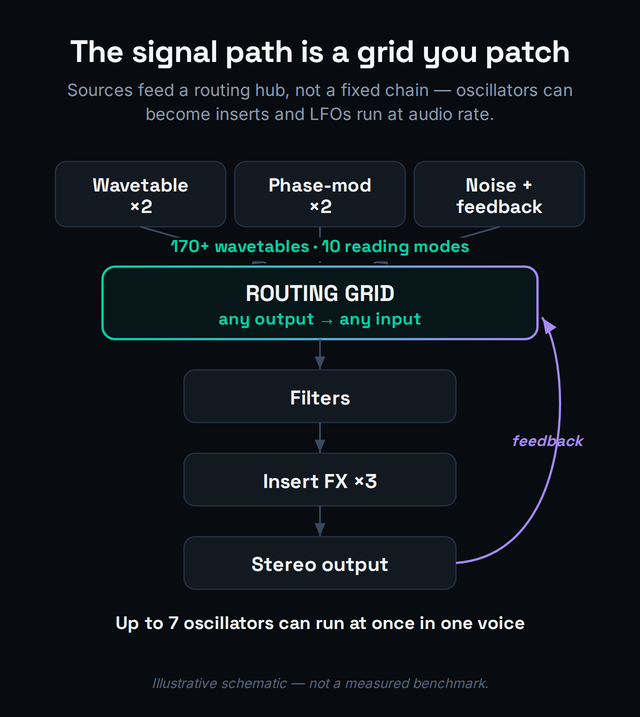
At its core, Massive X is a wavetable synthesizer — it generates sound by scanning through stored single-cycle waveforms, the same fundamental technique that powers Serum, Vital, and Pigments. If wavetable synthesis is new to you, our Bible entry on wavetable synthesis is the clean primer, and the oscillator entry covers the building block underneath it. Where Massive X diverges from its rivals is philosophy. Serum and Vital are built so the obvious path is the fast path; the interface guides you toward a finished sound. Massive X is built so the obvious path is the deep path: it exposes a modular routing layer most synths hide, and it expects you to patch your own signal flow rather than handing you a fixed one. That is the whole personality of the instrument in one sentence — freedom first, convenience second.
One fact correction up front, because the web is full of stale information on it: Massive X does not run standalone. It is a plugin only — VST, VST3, AU, and AAX — so it lives inside a DAW or inside Native Instruments’ own Komplete Kontrol and Maschine hosts, with full NKS integration for hardware browsing. There is no standalone application the way there is for, say, a hardware-modelled synth. For most producers that is a non-issue, since you work in a DAW anyway. But if you specifically wanted a standalone sketchpad synth, this isn’t one, and any 2019-era review telling you otherwise is simply out of date.
The Oscillator & Wavetable Engine
The heart of the synth is a pair of main wavetable oscillators fed by a library of over 170 wavetables, each readable in one of ten different oscillator modes. Those modes are the part that separates Massive X from a stock wavetable engine. Alongside the familiar wave-bending and folding behaviours, NI built genuinely unusual reading modes — the aggressive “Gorilla” family, a hardsync mode, a formant mode, and several others, each with its own sub-modes and additional controls. The practical upshot is that a single wavetable can produce a far wider range of timbres here than it would in a synth that only reads tables one way. You are not just choosing a wave; you are choosing how the oscillator interrogates it.
In practice that matters most when you want one oscillator to do the work of several. Set the first main oscillator to a clean wavetable mode for the body of a sound and the second to one of the harsher modes — a Gorilla variant, say — then modulate the balance between them, and a single held note can travel from smooth to savage without layering a second synth. The phase-modulation oscillators deepen that further: because they modulate the mains rather than sounding on their own, a small amount adds bite and a metallic edge where a sub-oscillator would only add weight. The skill the engine asks of you is knowing which mode to reach for, and that knowledge is the whole difference between Massive X sounding generic and Massive X sounding like nothing else. The modes are the instrument’s vocabulary, not a menu you can safely ignore.
Feeding those two main oscillators are two phase-modulation oscillators, which inject movement and harmonic complexity by phase-modulating the mains — this is where Massive X borrows the spirit of FM synthesis without becoming a dedicated FM synth. Add a flexible noise source with a feedback path, and the raw material before you even reach the filters is already richer than most wavetable synths offer. And here is the detail that sound designers latch onto: oscillators can also be loaded into the insert effect slots, and the LFOs can run at audio rate and be routed straight to the output. Count it all up and you can have, by the commonly cited figure, up to seven oscillators running simultaneously in a single voice. For thick, evolving, downright noisy digital textures, that headroom is the whole appeal.
From the oscillators, sound passes into the filter section — a set of distinctive filters, each with its own sub-modes and character, rather than the usual single multimode filter. This is classic subtractive shaping layered on top of the wavetable source, and it’s capable but not the synth’s headline. If you want to understand exactly which knob does what across this and any other synth, our synthesis parameter reference maps the controls, and the synthesis type selector helps you decide whether a wavetable monster like this is even the right tool for the sound in your head before you buy anything.
One more layer sits underneath all of this: the Voice page, where you decide how Massive X behaves polyphonically before a note ever reaches the filters. You can crossfade between wide unison stacks and true chord voices, and — unusually for a synth — you can modulate those voice parameters like anything else, so the width, detune, and spread of a sound can move and breathe over time rather than sitting fixed. Most synths bury this behind a single detune knob and a voice-count menu; Massive X turns it into another routable, performable part of the patch. It is, in miniature, the entire personality of the instrument: a parameter other synths treat as set-and-forget, this one hands you as something to shape, automate, and play. Powerful, deep, and — the recurring theme — one more thing to learn.
The Modulation Grid: Its Real Strength
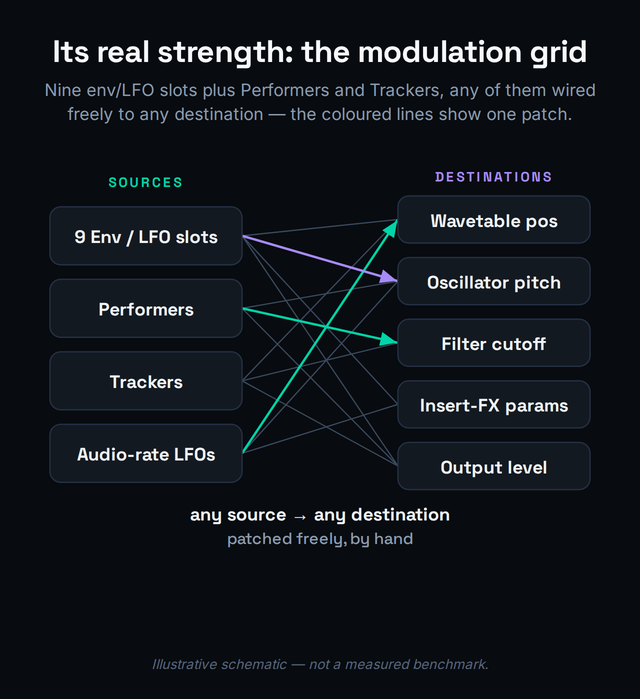
If you remember one thing about Massive X, remember this section, because the modulation system is the actual reason to own it. Every flagship synth has modulation; what Massive X has is a freely-routable grid where you connect any source to any destination with a couple of clicks, and the sources are unusually deep. There are nine slots that hold envelopes and LFOs in any combination, so you are never rationing modulators. On top of that sit two source types that have no real equivalent on most competitors.
The Performers let you draw up to eight bars of modulation by hand — rhythmic, evolving shapes you assign to a control octave and then trigger from the keyboard, turning a held note into a sequenced, moving phrase. The Trackers modulate parameters based on which note you play and how hard you play it: draw a curve and you can, for example, open a filter further as you climb the keyboard, or pile on reverb only when you hit harder. Together with the standard LFOs and envelopes, and the audio-rate routing mentioned above, this is a modulation environment closer to a modular rig than to a typical soft synth. If modulation is the part of synthesis you find most expressive — the movement, the life, the sense that the patch is doing something rather than just sitting there — this is the best implementation of it in the mainstream wavetable bracket, full stop.
A concrete example makes the value obvious. Take one sustained bass note and assign a Performer an eight-bar rhythmic shape that opens and closes the filter; assign a Tracker so the resonance climbs as you move up the keyboard; route an audio-rate LFO into the phase-modulation amount for a metallic shimmer; and modulate wavetable position with a slow envelope so the timbre evolves across the bar. Hold one key and you hear a moving, sequenced, evolving phrase rather than a static drone — and none of it came from a preset, an arpeggiator, or a second plugin. That is the kind of result Massive X makes routine and most synths make laborious. The flip side, again, is that you assembled all four routes yourself: the synth handed you the canvas and the brushes, not the finished painting.
The cost of all this freedom is the obvious one: you have to build the movement, where a more guided synth would have suggested it. That trade — ceiling versus convenience — runs through the entire instrument, and it’s why this synth is so polarising. If you want to go deeper on modulation as a craft across any synth, our guide to layering synths leans on exactly these ideas, and the LFO sync calculator and ADSR visualizer are handy companions while you dial shapes in.
Where It Genuinely Wins
Three things keep Massive X on producers’ drives years after the hype faded, and they cluster around one idea: this is a synth for people who want depth and a specific kind of character, not convenience. First, raw sound. Massive X has an unapologetically digital, sometimes abrasive grain — the Gorilla modes and the audio-rate feedback paths produce aggressive, gnarled tones that Serum and Vital, for all their polish, render a touch cleaner. For modern bass music, hard-edged EDM leads, and experimental sound design, that character is a feature, and it’s the reason a lot of designers reach for it specifically when they want something to sound a little wrong in the right way.
It helps to be specific about what that character actually buys you, because “raw” can read like a euphemism for “harsh.” In modern bass music the value is in the upper harmonics: the reading modes and feedback paths generate dense, ragged overtones that survive heavy distortion and still translate on a club system, where a cleaner synth can sound thin once you process it. In cinematic and experimental work the same trait gives you tones with a built-in sense of unease — metallic, unstable, alive — that you’d otherwise have to manufacture with effects. For clean pop, lush pads, or anything meant to sit politely in a mix, that grain is the wrong tool and you’d reach for Serum or Pigments instead. Character is directional: Massive X is built to be heard, not to disappear.
Second, the routing depth we’ve already covered — the single highest ceiling in its class for building a sound from scratch rather than tweaking a preset toward one. Third, the factory library and presets: Massive X ships with a large, well-designed factory bank, and a deep ecosystem of NI Expansions built specifically for it, so the “I don’t want to patch from zero” path exists and is good — it just isn’t the path the synth is optimised for. If you measure a wavetable synth by how far it can be pushed and how distinct it sounds at the extremes, Massive X scores at the very top. The original Massive earned its place by being instantly usable; Massive X earns its place by being almost endlessly deep.
Where It Lags: Workflow & Cadence
Now the honest qualifier, and it’s a real one. Massive X’s two weaknesses in 2026 are immediacy and momentum, and both are the direct consequence of how NI has treated the synth since launch.
On immediacy: the same openness that gives the synth its ceiling makes the first hour genuinely hard. There is a lot of interface, the routing is not self-explanatory, and the path from “open the plugin” to “finished patch” is longer than on any direct competitor. Serum 2’s redesigned multi-engine workflow and Vital’s clean, approachable layout both get a newcomer to a satisfying sound faster. That isn’t a knock on Massive X’s power; it’s a statement about its learning curve, and for a producer whose priority is staying in flow rather than studying an instrument, the curve is a legitimate reason to choose something else.
The honest mitigation, if you do commit, is to learn the synth in the order it was built rather than the order the interface throws at you. Start on the Play page, which deliberately streamlines the engine into a smaller set of macro-style controls — it exists for exactly the producer who finds the full surface daunting, and it gets you making sounds on day one. Then move into the routing grid one connection at a time, treating each new route as a small experiment rather than a system to master at once. Spend one evening only on the modulation section and another only on the oscillator modes. Producers who bounce off Massive X almost always tried to swallow the whole instrument in a single sitting; the ones who stay learned it in layers. The depth that makes the first hour hard is the same depth that makes the tenth hour rewarding.
On momentum: this is the uncomfortable part. Massive X shipped in 2019 missing features it had promised, and its update cadence has been slow ever since — slow enough that the clearest single data point in this entire review is this: it was not until version 1.7, in early 2026, that Massive X finally exposed all of its parameters to host automation. A flagship synth went roughly six and a half years without full DAW automation of every control, a basic expectation any competitor met on day one. The current version is 1.7.1 (March 2026), and NI’s own specification page still lists Rosetta 2 as a requirement on Apple Silicon. None of this means the synth is abandoned — it remains the flagship synthesizer inside the current Komplete bundle, and v1.7 brought real, welcome improvements — but you should buy it understanding that updates arrive on NI’s timeline, not the rapid one Serum and Vital have trained the market to expect. If a fast-moving roadmap matters to you, factor it in honestly.
Massive X vs Serum 2, Vital & Pigments in 2026
This is the comparison that actually decides the purchase, so let’s be direct about it. We have a dedicated head-to-head in our Serum 2 vs Massive X comparison if you want the full breakdown; here is the short, honest positioning against the three synths most people cross-shop.
| Synth | Best at | The catch | 2026 take |
|---|---|---|---|
| Massive X | Deep routing, audio-rate modulation, raw digital character | Steep workflow; slow updates; NI-ecosystem tie; plugin-only | The sound designer’s pick |
| Serum 2 | Fast, modern multi-engine workflow; huge community; clean output | Paid; a touch cleaner / less raw than Massive X | The all-rounder’s default |
| Vital | Most of Serum’s power, friendly UI, a genuinely free tier | Smaller factory content; less raw character | The value champion |
| Pigments | Most engines under one roof; polished, flexible, modern | Breadth can mean less focus; paid | The Swiss-army pick |
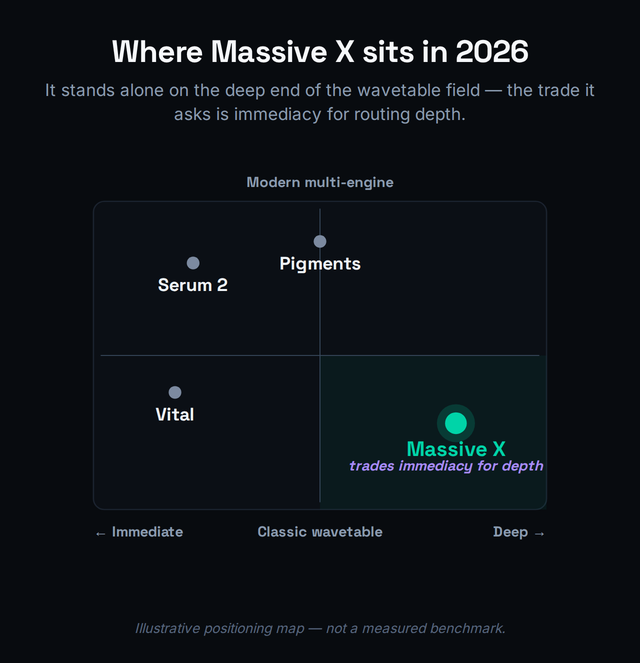
Read the table honestly and the verdict writes itself. If your priority is the deepest patchable modulation and a distinctive raw tone, Massive X wins outright. If your priority is getting to a finished, clean patch fastest, Serum 2 wins. If your priority is power-for-money, Vital is free and embarrassingly capable. And if you want one synth that does a bit of everything, Pigments is the broad pick. Massive X is not the safe default recommendation in 2026 — that’s Serum 2 or Vital for most people — but it is the connoisseur’s choice, and for the right producer that’s not a consolation prize, it’s the entire reason to buy it. For the wider field, our best synth plugins roundup ranks all of these by use case.
One factor the table can’t capture is the ecosystem tie, and it cuts both ways. Massive X lives most comfortably inside Native Instruments’ world — Native Access for installation and updates, NKS for hardware browsing, Komplete Kontrol and Maschine for deep integration. If you already work in that ecosystem, that’s a genuine convenience and a reason to lean in. If you don’t, it’s a small amount of friction the more standalone-feeling competitors avoid: another account, another installer, another updater to keep current. It’s rarely a dealbreaker, but it’s an honest part of the cost of ownership that a pure feature comparison leaves out, and it’s worth weighing if you’ve deliberately kept your studio out of any single vendor’s walled garden.
The Price & How to Actually Get It
Massive X carries a standard price of $199 (199€) on the Native Instruments store. Owners of the original Massive, and other eligible loyalty customers, get crossgrade pricing of around $149 — log in to the store to see whether you qualify before you pay full. And critically, Massive X goes on sale often; it has repeatedly dropped to around $99 at Native Instruments and at affiliate retailers such as Plugin Boutique, so if you’re not in a hurry, the patient move is to wait for one of NI’s regular sale windows rather than pay sticker. Prices move, so confirm the current figure on the live store before buying.
There are two other routes worth knowing. First, Massive X is bundled in Komplete — it’s included in the Standard tier and above of NI’s current Komplete suite, so if you were already considering Komplete for its instruments and effects, Massive X comes along for free inside it; our Komplete review covers what that bundle actually gets you. Second, and most usefully for a buyer on the fence, there is a free version: Massive X Player, part of the free Komplete Start suite. The Player is limited — you don’t get the full advanced routing, the custom oscillator modes, or the complete modulation flexibility — but it is a real, free way to feel the engine and the workflow before deciding, and combined with the full demo it means you never have to buy this synth blind. Use that. The single best thing about Massive X’s pricing is that you can try the actual sound for nothing.
Who Should Pick It in 2026
Massive X is a genuinely easy recommendation for a specific producer and a genuinely poor one for another, so be honest with yourself about which you are. Buy it if you are a sound designer first — if you enjoy building a patch from raw routing, if movement and modulation are the part of synthesis you find most expressive, and if you want a digital character that’s rawer and gnarlier than the clean competition. Buy it if you already own or are buying Komplete, in which case the decision is made for you and you should simply learn it. Buy it if you make modern bass music, experimental electronic, or cinematic sound design where its texture and depth pay off directly.
There’s also a middle case worth naming: the producer who already owns Serum or Vital and is wondering whether Massive X adds anything. The honest answer is that it does, but only along the two axes we’ve stressed — deeper routing and rawer character. If you regularly hit the ceiling of your current synth’s modulation, or you keep wishing your leads and basses had more edge, Massive X is a real complement rather than a duplicate. If you rarely exhaust what you already own, a third wavetable synth is a want, not a need, and the money is better spent filling an actual gap in your setup — a good sampler, a hardware controller, a mastering chain.
Skip it, or at least start with a rival, if speed and immediacy are what you value — if you want to open a synth, browse to a great preset, tweak two macros, and move on. For that producer, Serum 2 or free Vital is the better tool and it isn’t close. Skip it if a fast update roadmap matters to you, given the cadence above. And if you’re completely new to synthesis, start with the fundamentals first — our explainer on what a synthesizer actually is will save you from buying the deepest synth in the field as your first one and bouncing off it. Massive X rewards commitment; it punishes a casual visit.
Try It Yourself (Free Player & Demo)
You never have to buy Massive X to know whether it’s for you. Download the free Massive X Player from Komplete Start, or the full demo, and run these three jobs in order — they move from “do I like the sound” to “can I actually work this way,” which is the question that decides the purchase.
- Install the free Player or demo and load it on a MIDI track in your DAW.
- Browse the factory presets and find three aggressive bass or lead patches; play the same riff through each.
- Note your honest reaction to the raw tone versus a synth you already own. That digital grain is the thing you’re actually buying.
- Start from an init or simple patch and pick a single LFO; route it by hand to wavetable position on the first oscillator.
- Now add a second route from an envelope to the filter, and a Tracker so the filter opens as you play higher.
- Sit with how that felt. If building the movement yourself was satisfying rather than tedious, this synth is for you.
- Load an oscillator into an insert slot and set an LFO to audio rate, routing it into the signal path.
- Draw an eight-bar Performer shape and assign it to the control octave, then trigger it from a held note.
- Bounce the result and drop it into a real mix. Ask the only question that counts: did Massive X give you a sound nothing else in your folder could?
The Verdict
Massive X is the deepest routing-and-modulation engine in mainstream wavetable synthesis, and seven years on, that has not changed — the free-form grid, the audio-rate routing, the Performers and Trackers, and the raw digital character add up to a ceiling no direct competitor reaches. At an 8.4 it earns a clear recommendation for the producer it’s built for: the sound designer who wants depth over convenience and character over polish. The points that keep it from higher are the honest ones — a steep workflow that costs you the first hour, an update cadence slow enough that full host automation arrived only in 2026, and a competitive field so strong in 2026 that the safe default for most people is now Serum 2 or free Vital, not this. Go in wanting the deepest synth in the room and willing to learn it, and Massive X is outstanding. Go in wanting speed, and you’ll write the “too complicated” review yourself. Try the free Player first, and you’ll know within an afternoon which one you are.