A split sheet is the single cheapest piece of paperwork in your career and the one most likely to save it. It is a one-page document that records who wrote what percentage of a song, signed by everyone in the room. That is the whole job. And yet the day a track blows up on streaming is the day a missing split sheet turns three friends into three claimants, freezes the royalties, and pays a lawyer instead of you. This guide is the producer-grade version: what the sheet actually covers, the two columns most people fill in wrong, the exact fields, a worked example you can copy, and how to turn a signed sheet into money you can collect. There is a free template at the end.
This is general information to help you fill out a split sheet and ask better questions — not legal or financial advice. Splits are negotiated, and the percentages here are conventions, not statutory rates. For anything that matters, have a music attorney review it.
A split sheet documents each contributor’s percentage of a song’s composition — the publishing, not the master. Fill one out for every song with more than one writer, the day it’s finished. List each person’s name, role, PRO and IPI number, and their writer’s-share and publisher’s-share percentages (each column totals 100%). Get every signature before the song is released. Then register those exact numbers with your PRO and The MLC so the money actually reaches you.
It Covers Publishing, Not Masters
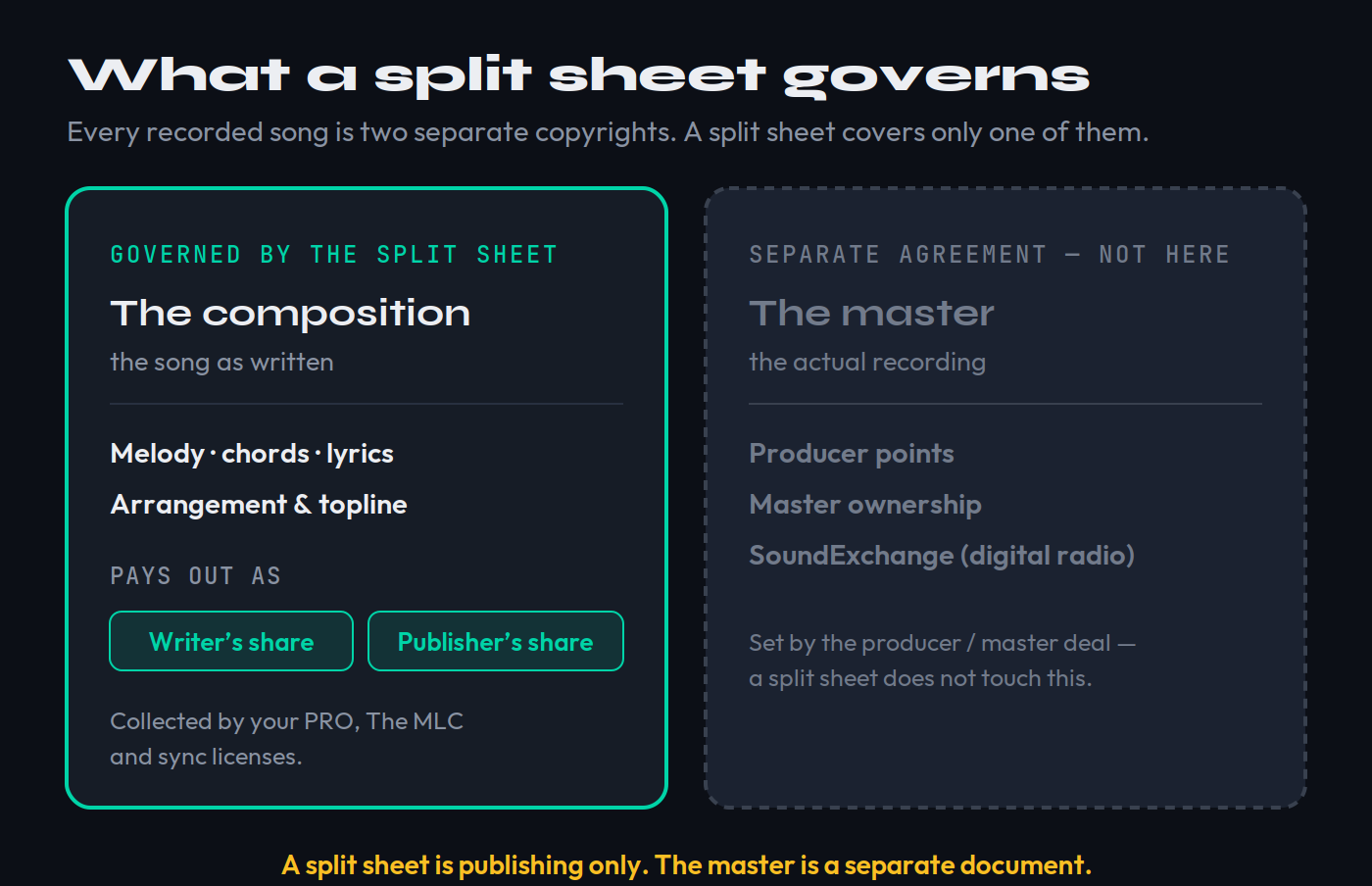
Start here, because almost every split-sheet mistake is really this one mistake wearing a different hat. Every recorded song is two separate pieces of property: the master — the specific recording, the audio file people stream — and the composition, the underlying song itself, the melody and chords and lyrics. They are two different copyrights, owned and paid separately. A split sheet governs only the composition. It says nothing about who owns the recording, nothing about producer points, and nothing about the producer’s fee. If you have read our guide to producer points, this is its other half: points are your cut of the master; the split sheet is the document that protects your cut of the song.
This matters because the two are genuinely independent. A producer who built the beat and the chord progression usually owns part of the composition — they helped write it — but does not automatically own any of the master recording unless a separate agreement says so. A vocalist who recorded over a leased beat might own the master while owning only half the composition. The split sheet is the place you pin down the composition half and nothing else. For the full map of how the two copyrights generate every royalty type, our guide to how music royalties work walks the whole tree; here we stay on the one page the split sheet controls.
One more boundary while we are here: a split sheet is not the same as a work-for-hire agreement. Work-for-hire is the opposite arrangement — a flat fee in exchange for no ongoing share — so a true work-for-hire contributor owns 0% and would not appear on the split sheet as an owner at all. Knowing which one you are signing is the difference between a one-time payment and a stake in the song for its entire copyright life.
The Two Columns: Writer’s Share vs Publisher’s Share
Here is the field that the template farms quietly get wrong, and it is worth real money. Publishing income on a composition divides into two halves: the writer’s share and the publisher’s share. The writer’s share belongs to the people who wrote the song. The publisher’s share belongs to whoever publishes it — and if you are an independent producer with no publishing deal, that publisher is you. Both halves represent real, collectable money, and a proper split sheet has a column for each. Fill in only the writer’s column, register only that, and you have walked away from your own publisher’s share. For the bigger picture of who holds which half and when you need an admin, see music publishing explained.
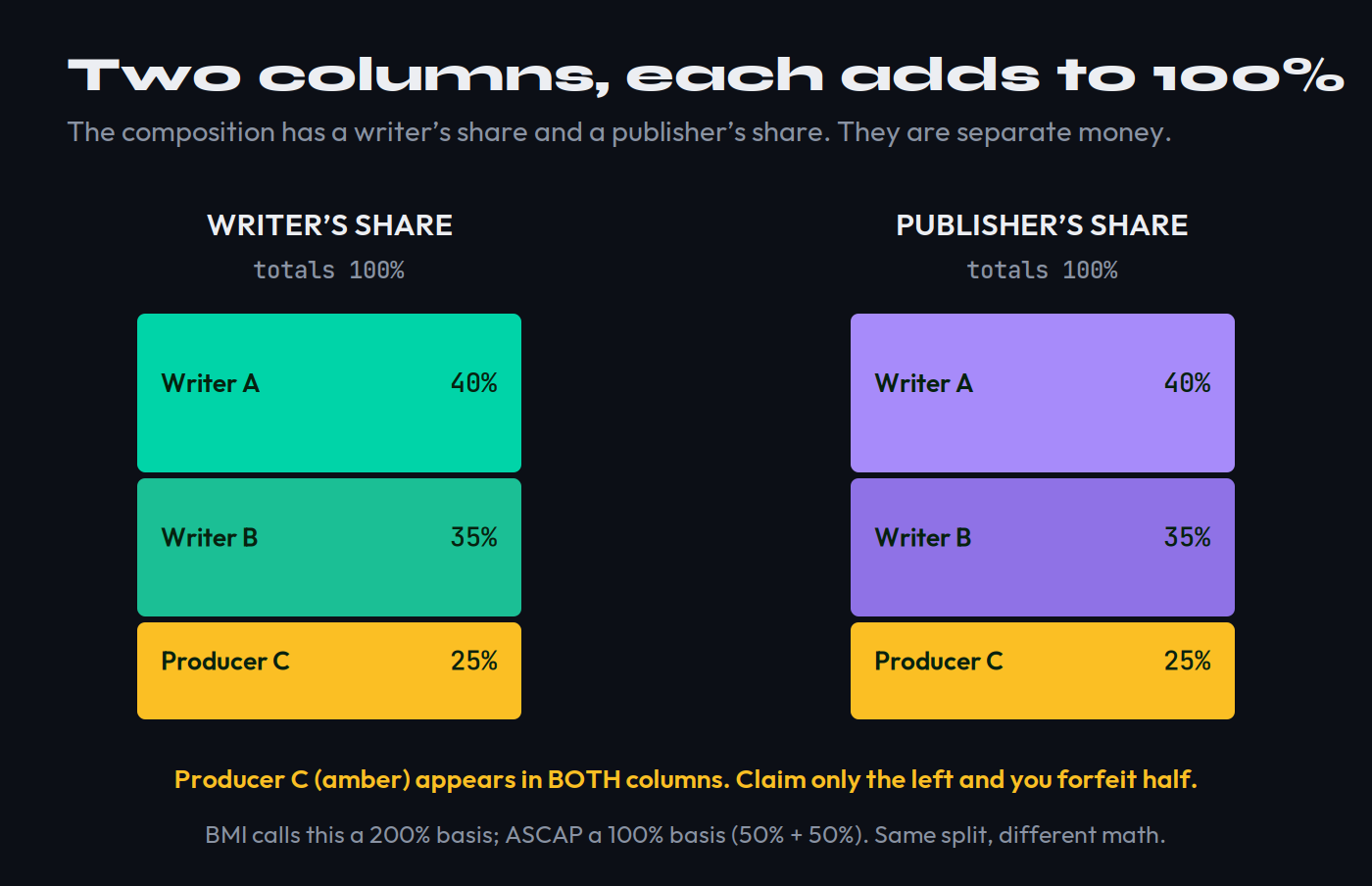
Now the part that confuses everyone, including people who have done this for years: the same split is written two different ways depending on your PRO. BMI captures publishing on a 200% basis — writers add to 100% and publishers add to 100%, for a notional 200% total. ASCAP captures the identical split on a 100% basis — the writer side adds to 50% and the publisher side adds to 50%, for 100% total. It is the same proportion in both systems; only the arithmetic on the form differs. If your co-writer is on ASCAP and you are on BMI, you are describing the exact same ownership in two different number systems, and entering it incorrectly is a classic way to trigger a mismatch. Our ASCAP vs BMI comparison covers which to join; for the split sheet, just agree the proportion in the room and let each writer translate it into their own PRO’s basis at registration.
A new producer registers as a writer with their PRO, sees royalties arrive, and assumes they are collecting everything. They are collecting roughly half. The publisher’s share sits unclaimed until they either register as their own publisher or hand it to an admin. The split sheet is where you write down that you are owed it — so document both columns, every time.
The Default Rule That Quietly Costs You Money
People treat the split sheet as optional — a nice-to-have for cautious people. It is not optional, because of what happens in its absence. Under US copyright law, a song written by two or more people who intend their contributions to merge is a joint work, and the co-authors are co-owners of the whole thing. The crucial detail: absent a written agreement to the contrary, the law presumes the owners share equally, regardless of who actually did what. Two writers means 50/50. Three means a third each. It does not matter that you wrote 90% of it.
Read that again as a producer. If you build the entire track and a friend adds eight bars of a hook, and nothing is written down, the legal default is that your friend can claim an equal share of the publishing — and a court has a real basis to agree. The split sheet is the “agreement to the contrary” that overrides this default with the numbers you actually negotiated. That is its legal job: not to create your ownership, but to document the split you agreed on before the equal-shares default does it for you. A signed sheet is also exactly the clause-level evidence a publisher or label looks for; if you want to see how these terms surface in a real deal, our guide to reading a music contract shows where splits live in the paperwork.
You did almost all the writing; you assume that’s obvious. With no signed sheet, “obvious” isn’t a legal standard — equal shares is. Get the real split on paper the day it’s made, while the contribution is fresh and undisputed.
What Goes on the Sheet, Field by Field
A split sheet can be a single page or a multi-page co-writer agreement, but the working version every producer needs is short. Here is exactly what to capture, in order. Treat it as a checklist you run before anyone leaves the session.
- Song title and date. The final title (and any working titles), plus the date the song was created. The title should match what you will eventually register, so the sheet and the registration line up.
- Every contributor’s legal name and contact. Not stage names — the legal name that will appear on registrations, plus an email or phone. List everyone who had creative input on the writing: songwriters, topliners, a vocalist who wrote the melody, and the producer when the beat or arrangement is part of the song.
- Each person’s role. Writer, producer, topliner, lyricist. Roles make the percentages defensible later and clarify who contributed to the composition versus who only worked on the recording.
- PRO affiliation and IPI/CAE number. For each writer, note whether they are with ASCAP, BMI or SESAC and their IPI (also called CAE) number. If someone doesn’t know theirs, it is searchable in their PRO’s public repertoire database.
- The writer’s-share percentage. What slice of the writing each person owns. These must total 100%. If you genuinely can’t agree, the common default is an even split — but agree it deliberately rather than letting the law decide.
- The publisher’s-share percentage. The second column, also totaling 100%. If a writer is self-published, their writer’s and publisher’s shares both come to them.
- Any samples used. If the song contains a sample, list it, its owner, and the publishing percentage they are owed, so it is documented and can be cleared — our guide to clearing a sample covers what that owner will typically ask for.
- Signatures from everyone. An e-signature is fine and is now standard. Unsigned, the sheet is a memory; signed, it is evidence.
A Real Worked Example: “Midnight Drive”
Abstract percentages are easy to nod along to and hard to actually do, so here is a concrete one. Three people make a song called “Midnight Drive.” Maya writes the topline and all the lyrics. Dev co-writes, contributing the central melody. You produce: the beat, the chord progression, the arrangement the whole song sits on. Everyone agrees the production is genuinely part of the composition — this is a beat-driven track — so all three are writers.
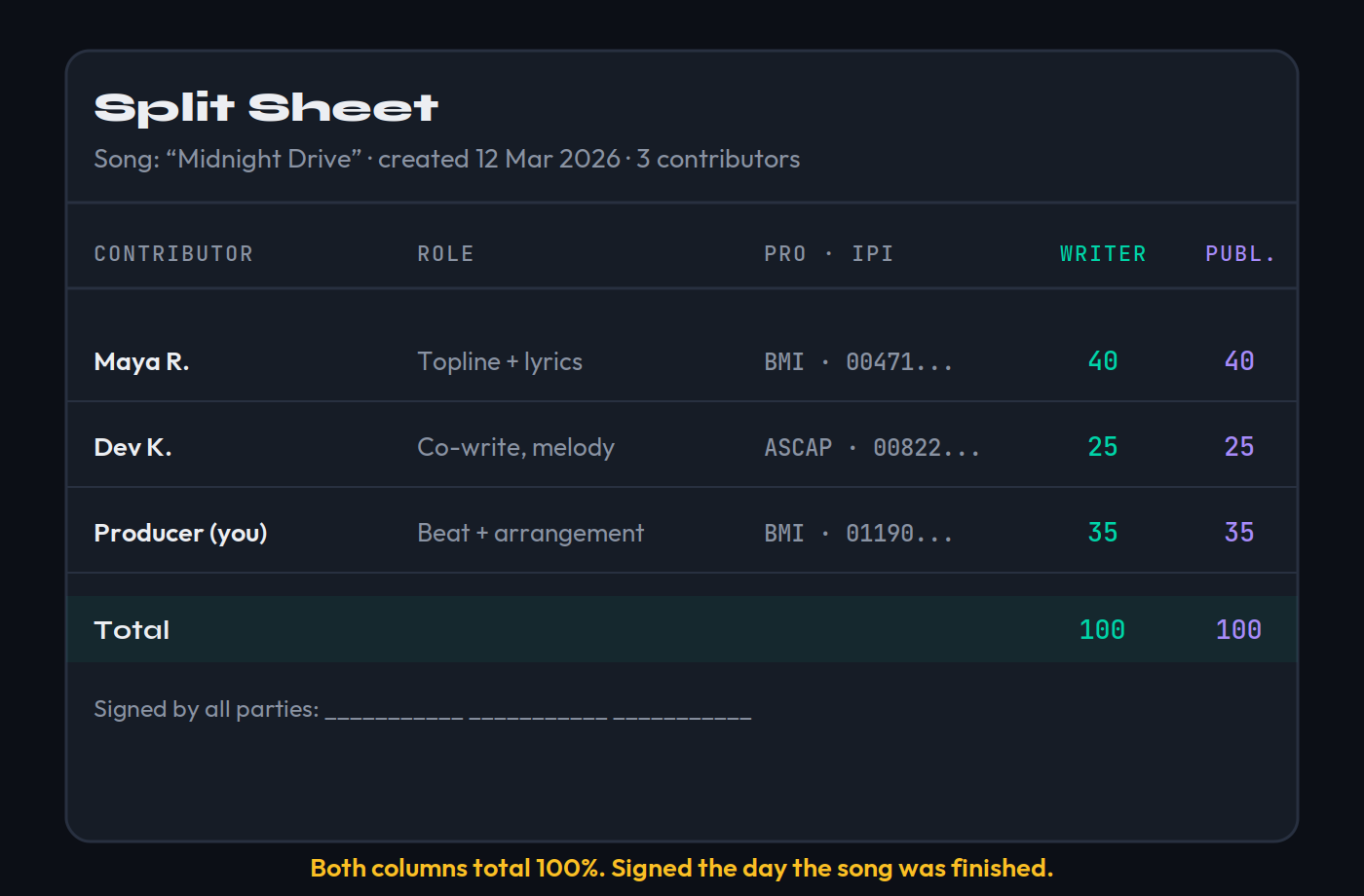
The room agrees: Maya 40%, you 35%, Dev 25% — on both columns, because each of you is your own publisher. The numbers reflect contribution honestly: Maya’s topline and lyrics are the most recognizable part, your production is the backbone, Dev’s melody is real but smaller. Now contrast a second, common scenario to see how roles move the math. Suppose instead you had only engineered — recorded and mixed an already-finished song without writing any of it. Then you contributed to the recording, not the composition; you’d take a fee (and possibly master points), and your writer’s share would be 0% — Maya and Dev would split the 100% between them. Same studio, same people, completely different split, decided entirely by what you actually wrote. When the production is the song, a producer’s composition share commonly lands anywhere from 20% up to about 50%; how hard you can push toward the top of that range is a negotiation, and our guide to negotiating a publishing deal covers the leverage.
From a Signed Sheet to Collected Money
A signed split sheet doesn’t pay you. It is the source document that makes the registrations payable — and the registrations are what actually move money. Here is the chain, because a single US stream pays out through three different organizations and the split sheet feeds two of them.
- Performance royalties — your PRO. Each writer registers the song with ASCAP, BMI or SESAC, entering their agreed writer’s and publisher’s percentages. The PRO collects performance royalties (radio, streaming performance, live, public play) and pays against those splits.
- Mechanical royalties — The MLC. Register the work with The Mechanical Licensing Collective for US digital mechanicals. Registration is free, and the MLC matches songs to streams using your metadata — if your registration doesn’t match what your distributor sent the platforms, the match fails and the money sits unclaimed.
- Master royalties — your distributor. Whoever owns the recording uploads it through a distributor (DistroKid, TuneCore, CD Baby), which collects the master streaming royalty. This is the master side — not governed by the split sheet, but worth knowing it’s a separate stream entirely. Our breakdown of what Spotify pays per stream shows how small each of these slices is, which is exactly why collecting all of them matters.
- Sync — against the same splits. When the song is licensed to film, TV, a game or an ad, the composition fee is split per the publishing percentages on your sheet. The signed sheet is what a music supervisor’s clearance team relies on.
One boundary to keep straight: SoundExchange pays digital-performance royalties on the master (non-interactive services like Pandora and SiriusXM), not the composition — so it sits outside the split sheet, on the recording side. If you want the full revenue picture across both copyrights, our overview of music streaming royalties connects every channel. The headline for the split sheet specifically: it powers the two composition registrations (PRO and MLC), and if you skip either, you collect a fraction of what your songwriting earned.
The Six Mistakes That Cause Disputes
Every frozen-royalty story traces back to one of these. None of them are exotic; they are the same handful, repeated.
The single most expensive mistake. Splits are easy the day the song is made and a war the day it makes money. Sign before anyone leaves the room.
“We said 50/50” is not a document. A label or publisher doing due diligence needs paper, and memories drift conveniently. Always written, always signed.
Filling in only the writer’s share leaves the publisher’s half — real money — uncollected. Two columns, both to 100%.
If the writer percentages add to 95% or 110%, or if two collaborators register conflicting numbers, the PRO or The MLC freezes the payout until it is fixed. Check the totals before anyone signs.
The person who added one memorable line and got left off the sheet is the person who resurfaces with a claim when the song charts. If they contributed to the writing, they go on the sheet — even at a small percentage.
The root error behind most of the others. The split sheet is publishing only. Producer points, master ownership and the producer fee belong in separate agreements — don’t try to settle them here.
Get the MPW Split-Sheet Template
The fastest way to make this a habit is to have a clean template you reuse on every session. We’ve built a producer-grade split sheet that matches everything above — separate writer’s and publisher’s columns, role and PRO/IPI fields, a samples row, a totals check, and signature lines for every party. Open it on a phone the moment a song is done, fill it in, collect signatures, and you have the one document that protects the whole publishing side.
The MPW split-sheet template is free with a subscription to The Producer’s Briefing — use the signup in the sidebar (or below on mobile). It’s built to drop straight into a session and to capture exactly what your PRO and The MLC need at registration. Working with AI-generated music in the mix? Read how to release AI music first — the authorship and ownership questions change what you can put on the sheet.
Put It Into Practice
Reading about splits is not the same as doing them. Run these three and the process becomes muscle memory.
- Open the MPW template (or any free one from ASCAP, BMI, Songtrust or TuneCore) and pick a real song you collaborated on.
- List every contributor, their role, and exactly what each person wrote.
- Fill in both columns so each totals 100%, add the PRO/IPI details, and notice how much easier this is now than it would be after the song earned money.
- Take a beat-driven track with three writers — a producer, a topliner, and a co-writer who added the melody.
- Assign a defensible writer’s split that totals 100%, then justify each number out loud based on contribution (this is the conversation you’ll have for real).
- Now imagine the same song where you only engineered it. Redo the split with your share at 0% and watch how the other two absorb the full 100% — that contrast is the whole point.
- Using a real signed split, register the song with your PRO and enter the writer’s and publisher’s percentages for your share.
- Register the same work with The MLC (it’s free) and confirm the metadata — titles, writer names, IPI numbers — matches what your distributor submitted, so the streams actually match to your registration.
- List which royalty streams each registration now covers, and identify any — the publisher’s share, mechanicals, a sync — you were previously leaving uncollected.
Frequently Asked Questions
A split sheet is a one-page document, signed by everyone who helped write a song, that records what percentage of the composition each person owns. It covers publishing only — the song as written, not the master recording and not the producer fee. It is the evidence behind every registration you make with a PRO, The MLC and a sync licensor, and it determines who gets paid when the song earns. It is not a copyright itself; it is the written agreement that proves the split.
The day the song is finished, in the room, before anyone leaves. You need one for every song with more than one contributor. Splits negotiated while everyone is still happy about the song are easy; splits negotiated after the song makes money, or after a falling-out, are a fight. Open the sheet on a phone, agree the numbers, and get every signature before the file is sent anywhere.
The song title and any alternate titles, the date created, and for each contributor: legal name and contact, their role (writer, producer, topliner), their PRO affiliation (ASCAP, BMI or SESAC) and IPI/CAE number, the percentage of the writer’s share and publisher’s share they own, and their signature. Any samples used should be listed with the owner and their percentage. The writer’s-share percentages must total 100%, and the publisher’s-share percentages must total 100%.
Publishing income on a composition splits into two halves: the writer’s share and the publisher’s share. The writer’s share goes to the people who wrote the song. The publisher’s share goes to whoever publishes it — and if you are unsigned, that is you. A split sheet records both columns, and each totals 100%. BMI expresses this as a 200% basis (100% writers plus 100% publishers); ASCAP expresses the same split as a 100% basis (50% writers plus 50% publishers). Same proportion either way, but you must enter it correctly for your PRO.
It depends on how much of the composition the producer wrote. A producer who only engineered or recorded an already-written song typically gets a fee and zero publishing. A producer who contributed musically — the beat, the chords, the arrangement the song is built on — usually has a writer’s share, commonly 20 to 40%, and up to about 50% in beat-driven genres where the production essentially is the song. An equal split among everyone in the room is a frequent default. These are negotiated conventions, not legal rates.
A split sheet that everyone signs is a written agreement and carries real legal weight — it is the documentation a PRO, publisher or label relies on, and the evidence a court would look to. It is not a copyright registration and does not replace one. Without a signed sheet, US copyright law treats a co-written song as a joint work and presumes the authors share ownership equally, regardless of who actually did what. The split sheet is the written agreement that overrides that equal-shares default with the numbers you actually agreed on.
Two things. First, the legal default takes over: a co-written song is a joint work, and absent a written agreement the law presumes equal shares — so a co-writer who contributed ten percent can claim an equal cut. Second, the money jams. If two writers register conflicting splits, or the percentages add up to more or less than 100%, the PRO or The MLC freezes the royalties until it’s resolved. A signed split sheet prevents both.
The split sheet is the source document; registration is what turns it into money. Each writer enters their agreed percentages with their PRO (ASCAP, BMI or SESAC) for performance royalties, and the song is registered with The MLC for mechanical royalties — MLC registration is free. The master recording is handled separately by your distributor. All parties should register the same numbers; conflicting registrations are the fastest way to freeze a payout.