Buy the Apogee Duet 3 ($599) if you want pristine two-in recording and true portability: it is a bus-powered, breakout-and-travel-case interface with Apogee's converter pedigree and a get-out-of-the-way workflow, and it costs around $400 less. Buy the UA Apollo Twin X ($999 and up) if you want to track in real time through modeled Neve, API and Manley preamps, need more I/O (10×6 with expansion), and intend to live in the UA/LUNA world. Here is the part every older comparison gets wrong: you no longer need an Apollo just to run UAD plug-ins — most of them now run natively on any DAW. So the real 2026 question is not "which one unlocks UAD," it is whether Apollo's Unison realtime tracking is worth the price and the desk space, or whether the Duet's portable simplicity is the better fit. Most singer-songwriters and mobile producers should take the Duet 3. Producers committed to tracking-through-emulated-hardware should take the Apollo. Below is exactly how to tell which one you are.
This article contains affiliate links. If you purchase through our links, we may earn a commission at no extra cost to you. This does not affect our editorial independence — every recommendation here is based on genuine, source-checked assessment.
| Axis | Apogee Duet 3 | UA Apollo Twin X |
|---|---|---|
| Converters & sound | 9.1 | 9.2 |
| Preamps (incl. Unison) | 8.6 | 9.3 |
| I/O & expandability | 7.6 | 9.1 |
| Onboard-DSP value (2026-adjusted) | 7.4 | 9.0 |
| Portability & daily use | 9.4 | 7.2 |
| Ecosystem & software | 7.8 | 9.4 |
| Value | 8.8 | 8.5 |
| Overall | 8.6 | 8.9 |
Scores are MPW editorial judgement, defended section by section below — a decision framework, not a first-party measurement. Specs and prices verified June 23, 2026 against each vendor's current product page and 2026 reviews. Prices are USD; sale, loyalty and bundle pricing move constantly, so confirm at the vendor before you buy.
Updated June 2026 — Apogee Duet 3 vs UA Apollo Twin X
The overall numbers are close on purpose, because an honest reading of these two interfaces does not produce a winner — it produces a fork. The Apollo Twin X takes the higher overall (8.9) because it is the more capable box on most axes: it has the Unison preamps (9.3), the bigger I/O (9.1), the deeper onboard DSP (9.0) and the vast ecosystem (9.4). But look at where the Duet 3 wins: portability (9.4) and value (8.8), plus converters so close (9.1 vs 9.2) the difference is academic. If you will never use ten inputs and you will carry the interface in a bag, those two Duet wins can outweigh everything else the Apollo brings. Ignore the overall, read the axis that matches your life, and the right machine becomes obvious. That is the whole comparison, and every number above is defended below.
Why Every Comparison You've Read Is Out of Date
Here is the problem with almost every "Duet 3 vs Apollo Twin" page you will find: the headline reason it gives you to buy the Apollo stopped being true. For roughly a decade, the argument was airtight and went like this — buy the Apollo because its onboard DSP is the only way to run UAD plug-ins, and UAD plug-ins are the best emulations of classic hardware money can buy. If you wanted a Neve 1073, an LA-2A or a Pultec from Universal Audio, you bought UA hardware. There was no other door. Every ranking comparison from 2021 through 2023 leans on that logic, and it is the single biggest reason buyers talked themselves into the more expensive interface.
That door is now wide open. In 2023, Universal Audio began shipping UAD Native — the same plug-ins, rebuilt to run on your computer's CPU, in any DAW, with no Apollo or UAD-2 hardware attached. They added a subscription called UAD Spark that hands you a large, growing library of those native effects and instruments for a monthly or annual fee, again with no hardware required. UA's own support documentation is blunt about it: the native versions sound identical to the DSP versions, and you can run as many instances as your CPU can handle. So the historic "you must own an Apollo to access UAD" reason to buy the Twin X is, for the bulk of the catalog, simply gone. A page that still leads with it is selling you a 2021 decision in a 2026 market.
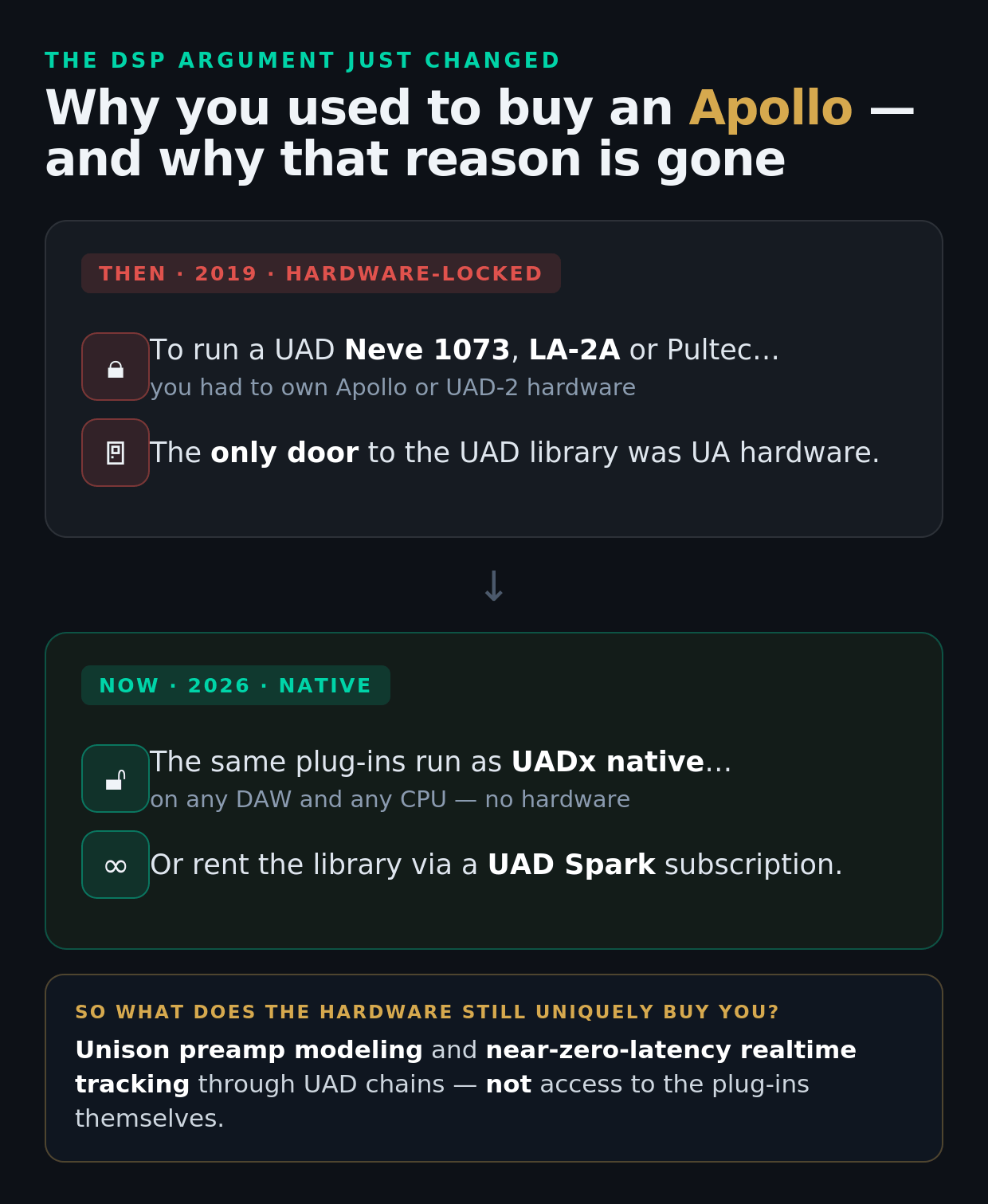
Be careful, though, because the internet now tends to overcorrect in the other direction — "UAD is fully native, so Apollo is pointless." That is also wrong, and getting it exactly right is the whole point of this article. A handful of UAD titles remain DSP-exclusive and still require Apollo or UAD-2 hardware to run, and UA gates some native perpetual licenses to registered Apollo or UAD-2 owners — you can rent those titles through Spark without hardware, but buying them outright to keep forever sometimes still expects a UA device on your account. None of that resurrects the old argument, but it does mean the honest statement is "the access reason is largely obsolete," not "completely." The cookie-cutter pages get this wrong in both directions. The truth sits in the middle, and it reframes the entire decision: if access to the plug-ins is no longer the question, what is the Apollo's DSP still buying you in 2026? That is the only question worth asking, and the next section answers it.
What the Apollo's DSP Still Buys You in 2026
Strip away the obsolete "plug-in access" argument and the Apollo's onboard DSP still does two things a native plug-in on your CPU fundamentally cannot, and they are the reasons the hardware is still worth real money. The first is Unison preamp modeling. When you plug a microphone into an Apollo Twin X and load a Neve, API or Manley preamp model into UAD Console, Unison physically reconfigures the input stage's impedance and gain staging to behave like that preamp's circuit, then prints — or monitors — the sound through the emulation in real time. A native plug-in can only process the signal after your interface's own preamp has already coloured it. Unison is the one place where UA's modeling reaches back to the analog front end, and the Duet 3 has no equivalent: its Advanced Stepped Gain Architecture preamps are excellent and clean, but they are themselves, with no modeling layer.
The second is near-zero-latency tracking through processing. The Apollo's SHARC DSP chips run UAD plug-ins inside the hardware, off your computer's CPU, so a vocalist can monitor through a compressor, an EQ and a reverb with sub-two-millisecond latency regardless of your DAW's buffer size. You can record at a large, stable buffer for mixing and still cut vocals through a full chain with no perceptible delay. Doing the same thing natively means dropping your buffer to a tiny size, which spikes CPU load and risks dropouts the moment your session gets heavy. UA's own framing for 2026 is that DSP interfaces remain the right call precisely for producers who want to track through analog-style chains in real time without putting that load on the computer. The Gen 2 hardware also added a genuinely useful third trick: it can run Sonarworks monitor correction directly on the DSP, so your room-correction profile is applied in the monitoring path with no plug-in and no added latency.
The latency point deserves a concrete number, because "near-zero" gets thrown around loosely. Monitoring through the Apollo's onboard DSP runs at roughly two milliseconds of round-trip latency, low enough that a singer or guitarist perceives no delay against the source in their headphones. To match that natively, you would set your DAW's buffer to something like 32 or 64 samples — and at that buffer, a session already carrying soft synths, samples and a few plug-ins will push many laptops to the edge of dropouts the moment you add a realtime processing chain on the input. The Apollo sidesteps the trade-off by doing the monitoring math in dedicated hardware, leaving your CPU free for the rest of the session. That is the entire practical case for onboard DSP in 2026, and it is worth being clear that it is a tracking case: it matters at the moment of capture, not at mixdown, where native plug-ins at a large buffer are perfectly happy. A producer who never records through processing is paying for a solution to a problem they do not have.
Now weigh that honestly against what most home producers actually do. If you mix in the box and you rarely track live sources — you are working with samples, soft synths and the occasional overdub at a comfortable buffer — almost none of that DSP advantage applies to you, and a UAD Spark subscription on a Duet 3 would give you the same plug-ins for far less outlay. The Apollo's DSP earns its keep specifically when you are capturing performances: tracking vocals, guitars, bass and outboard-style chains, often several at once, where realtime monitoring through emulated hardware changes how the take feels and therefore how it performs. That is the buyer the Apollo is built for. If that is not you, you are paying for an engine you will rarely start.
Converters & Preamps: Apogee Pedigree vs UA
This is the axis where the two are closest, and where reputation does most of the talking. Apogee built its name on conversion: for decades its AD/DA converters and clocking were the reference that high-end studios bought specifically for that clarity, and the Duet 3 inherits that lineage in a portable shell. Its converters and its Advanced Stepped Gain Architecture preamps — an analog circuit that optimises across the gain range for low distortion and wide bandwidth — are genuinely excellent, and reviewers have consistently rated the Duet line's sound well above its price class. If your priority is the cleanest possible two-channel capture with as little colouration as the front end allows, the Duet 3 is exactly the tool the pedigree promises.
Universal Audio, for its part, closed most of the historic gap with the Gen 2 refresh. The current Apollo Twin X uses completely redesigned A/D and D/A conversion that UA rates at roughly 129 dB of dynamic range with ultra-low distortion — on paper the widest dynamic range of any Twin to date, and a meaningful step up from the 127 dB the older units quoted. In practice, both of these interfaces convert at a standard well beyond what the overwhelming majority of home recordings will ever expose. The difference between them on a finished vocal or acoustic guitar, in a typical room, through a typical mic, is far smaller than the difference your room treatment or mic choice makes. We score this near-tied — Apollo a hair ahead on the published numbers, Apogee's converter heritage keeping it within a whisker — because honesty demands it, and because anyone telling you they can reliably hear the gap blind is overstating the case.
It is worth being precise about what "Apogee pedigree" actually refers to, because it is more than marketing. Conversion quality is not only the dynamic-range figure on the spec sheet; it is also about clocking — the timing accuracy of the converter's sample-by-sample operation — and jitter, the tiny timing errors that smear high-frequency detail when clocking is poor. Apogee spent decades building a reputation specifically for low-jitter clocking, and that is a meaningful part of why its converters earned a place in mastering rooms long before the Duet existed. Universal Audio's Gen 2 conversion is genuinely excellent and has closed almost all of the practical distance, so this is not a knockout for either side. But if your work is unusually conversion-sensitive — pristine acoustic capture, classical, mastering-adjacent tasks where the last few percent of clarity matters — Apogee's heritage is a real, if subtle, reason some engineers still reach for it first. For most music production, both converters are far past the point of being the weak link in your chain.
The preamps are where the two diverge, and it is not about quality so much as capability. Both sets of preamps are clean and quiet. But the Apollo's are Unison preamps, which means they can become a modeled Neve, API, Manley or Avalon at the input stage, as covered above. The Duet's ASGA preamps cannot transform; they are a single, very good, transparent flavour. If you want your front end to be a chameleon — different character for vocals, for bass DI, for a re-amped guitar — only the Apollo does that in hardware. If you want one pristine, neutral preamp and you will add character later with plug-ins, the Duet is all you need. Worth a note on a spec wrinkle: Apogee's own launch materials and the original press quote the Duet 3's mic gain as roughly 0–65 dB, while Sweetwater's current product page lists 0–60 dB; either way it is ample for any dynamic or condenser mic you are likely to use, and only a very quiet ribbon into a very low-output chain would ever test the ceiling. To understand why the front-end matters so much, our explainers on the preamp and the Unison preamp go deeper than a spec sheet can.
I/O & Connectivity: 2×4 USB-C vs 10×6 Thunderbolt
On paper this looks lopsided, and in capability it is — but the right way to read it is "how much do you actually need." The Duet 3 is a strict 2-in / 4-out interface over USB-C, and crucially it is bus-powered: one cable to your laptop and you are running, with a second USB-C socket available to feed it extra power from a charger if your machine can't supply enough on its own. Its physical connections live on a redesigned breakout cable — two combi inputs and two balanced outputs — plus a single headphone jack on the unit itself. That is the entire I/O story, and for a singer-songwriter, a podcaster, a producer cutting one or two sources at a time, it is genuinely all that is required. You cannot, however, buy a bigger Duet 3: there is no expansion, no way to add inputs later.
The Apollo Twin X is a 10-in / 6-out interface over Thunderbolt 3, and that headline understates it. Two of those inputs are the Unison mic/line preamps and there is a front-panel Hi-Z instrument input, but the unit also carries up to eight additional channels of digital input over optical ADAT or S/PDIF, so you can bolt on an eight-channel preamp later and track a full drum kit. Thunderbolt also lets you link up to four Apollo interfaces into one larger system as your needs grow. The catch is power: the Apollo is not bus-powered. It ships with — and requires — an external power supply, so it is a desktop fixture, not a grab-and-go. The diagram below maps the two I/O pictures side by side; the gap is real, but only matters to the degree your work actually fills it.
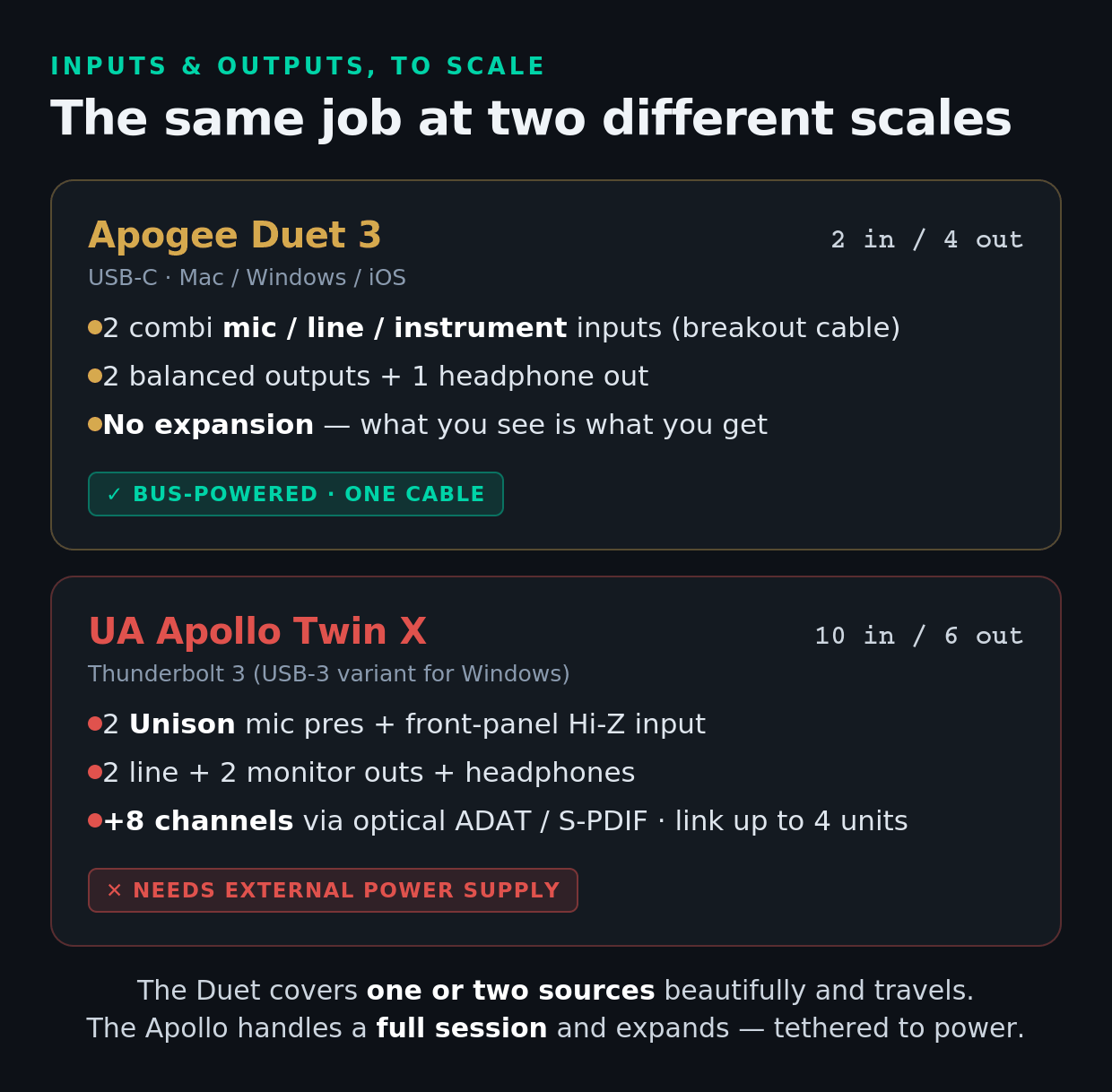
The connectivity detail that trips up the most buyers is the Thunderbolt-versus-USB question, and it has a clean answer in 2026. The standard Apollo Twin X is a Thunderbolt 3 unit that works on both Mac and Windows — but only if your computer has a Thunderbolt port. Because many Windows laptops do not, UA also sells an Apollo Twin X USB, a USB-3 version built specifically for Windows machines without Thunderbolt; it uses the same elite conversion and the same DUO Core DSP, so you give up nothing sonically. The Duet 3 sidesteps the whole issue by being USB-C, which works across Mac, Windows and iOS without a port lottery. If you are on a modern Mac or a Thunderbolt-equipped PC, the Thunderbolt Apollo is the one to get; if you are on a Thunderbolt-less Windows machine and want the Apollo, the USB version is your model; and if cross-platform simplicity including iOS matters, that is a quiet point in the Duet's favour. Our audio interface buying guide walks through connectivity for every tier, and the audio interface primer covers the fundamentals.
Portability & Daily Use
This is the Duet 3's home turf, and it wins decisively. The whole design is built around being carried: a low-profile aluminium-and-glass body, a bus-powered single-cable hookup, a breakout cable that tucks away, and — tellingly — a padded travel case in the box. You can drop it in a backpack with a laptop and a mic and have a professional-grade two-channel rig anywhere, drawing power from the computer alone. For a touring songwriter, a journalist cutting interviews, a producer who works on the move or simply someone with a small desk, that mobility is not a nice-to-have; it is the reason to buy this interface over almost anything else at the price.
The Apollo Twin X is, by contrast, a desktop instrument and makes no apology for it. It is heavier, it is larger, and it needs its external power supply, which means relocating it is a deliberate act involving a wall socket rather than a matter of unplugging one cable. None of that is a flaw — it is the natural consequence of cramming ten inputs, expansion, monitor control, talkback and a bank of DSP into the box — but it does mean the Apollo wants a permanent home on a desk near power. If your studio is a fixed room, this is a non-issue and you will never think about it again. If your "studio" is wherever your laptop happens to be that day, it is a daily friction the Duet 3 simply does not have. Match this axis to how you actually work: the most capable interface in the world is the wrong one if it lives at home on the days you need to record.
The Software & Ecosystem — and the Lock-In
The two interfaces ship into completely different software worlds, and this is where the long-term character of ownership is decided. The Duet 3's software story is deliberately small. You get Apogee's Control 2 app for managing the hardware, and the unit's onboard DSP runs exactly one thing: the Symphony ECS Channel Strip, a tidy EQ-compressor-saturation processor tuned by the legendary mixer Bob Clearmountain. It is good, and tracking through it with zero latency is a real convenience. But it is the only DSP processor the Duet runs, you cannot open the Duet's DSP version inside your DAW the way you can with UA's plug-ins, and if you want the ECS Channel Strip as a native plug-in to use on other tracks, that is a separate purchase — around $49 bundled with the interface, more on its own. Apogee's approach is "here is one excellent channel strip for tracking, now go use your own plug-ins for everything else." It is clean and unpretentious, and for many people it is enough.
The Apollo drops you into one of the deepest ecosystems in audio. There is the full UAD plug-in library — hundreds of meticulously modeled compressors, EQs, tape machines, preamps and reverbs — running both on the onboard DSP for realtime tracking and natively for mixing. There is UAD Console, the realtime mixer that makes Unison and low-latency monitoring work. And there is LUNA, UA's own full recording-and-mixing DAW built specifically around the Apollo workflow, with features like Neve summing and tape emulation baked in, free to Apollo owners. The Twin X comes with a starter bundle of UAD plug-ins and you expand from there. It is a vastly richer software world than the Duet's, and for a producer who wants their interface to be the centre of a hardware-emulation-driven workflow, it is the entire appeal.
LUNA deserves its own honest weighing, because it is the part of the Apollo proposition most likely to be oversold to you. It is a capable, free, genuinely UA-flavoured DAW with built-in Neve summing, Studer tape extensions and tight Apollo integration, and for someone starting fresh who wants that workflow, it is a real perk worth money. But it is also the deepest hook of the lock-in: a project built in LUNA, leaning on its Apollo-specific accelerated monitoring and its native instruments, does not travel cleanly to another DAW, and most working producers already live in Ableton, Logic, Pro Tools or Cubase. So count LUNA as a bonus if its workflow appeals and a non-factor if you are committed to your existing DAW — just do not let "and it comes with a free DAW" inflate the Apollo's value if you will never leave the host you already know. The Duet 3 makes no such offer and asks for no such commitment; it is a converter and a pair of preamps that get out of your way in whatever DAW you already use.
But name the cost the brochures skip: lock-in. Building your sound on UAD plug-ins running on Apollo DSP, and your sessions in LUNA, ties you to the UA ecosystem in a way the Duet 3 never does. The native-UAD shift softened this — you can now keep using your UADx plug-ins on any interface, so leaving is far less punishing than it was in the DSP-only era — but the realtime Unison workflow, the Console-based monitoring and any LUNA-specific sessions are UA-hardware experiences. Choosing the Apollo is choosing to invest in an ecosystem; choosing the Duet 3 is choosing to stay interface-agnostic and bring your own plug-ins. Neither is wrong. But the producer who buys an Apollo, sinks two years and a plug-in collection into the UA world, and then wants to switch will feel a pull the Duet owner never will. Go in with eyes open. For the wider field, our best audio interfaces of 2026 roundup places both of these against the rest of the market.
Price & the Three-Year Cost of Ownership
The sticker gap is the easy part: the Duet 3 sits at $599, a price it has held since launch, while the current Apollo Twin X DUO (Gen 2) lists around $999 and the QUAD around $1,299, though Universal Audio runs frequent sales — at the time of writing Sweetwater has the DUO at $999 with a free Sonarworks monitor-correction add-on thrown in, so confirm the live price before you buy. Call it roughly a $400 difference at the entry point, and more if you step up to the QUAD for extra DSP headroom. That gap alone settles the decision for a lot of budget-conscious buyers, and it should: $400 is a microphone, or a year of plug-in subscriptions, or simply money kept.
But the honest comparison is the three-year cost, because each interface pulls you toward different follow-on spending. With the Duet 3, the realistic add-ons are modest: the native ECS Channel Strip plug-in (around $49 bundled) if you want it on your tracks, perhaps the Duet Dock (about $149) for desktop ergonomics, and — if you want UA-style emulations — a UAD Spark subscription that runs on the Duet just as well as on any interface. With the Apollo, the pull is upward and ongoing: the starter UAD bundle is a taste, and the ecosystem is designed to sell you more plug-ins over time, plus the optional Sonarworks correction and the temptation of expansion hardware. Neither path is wrong, but they have different gravity. The diagram below sketches an illustrative three-year picture for a representative buyer of each; your actual numbers depend entirely on how deep you go.
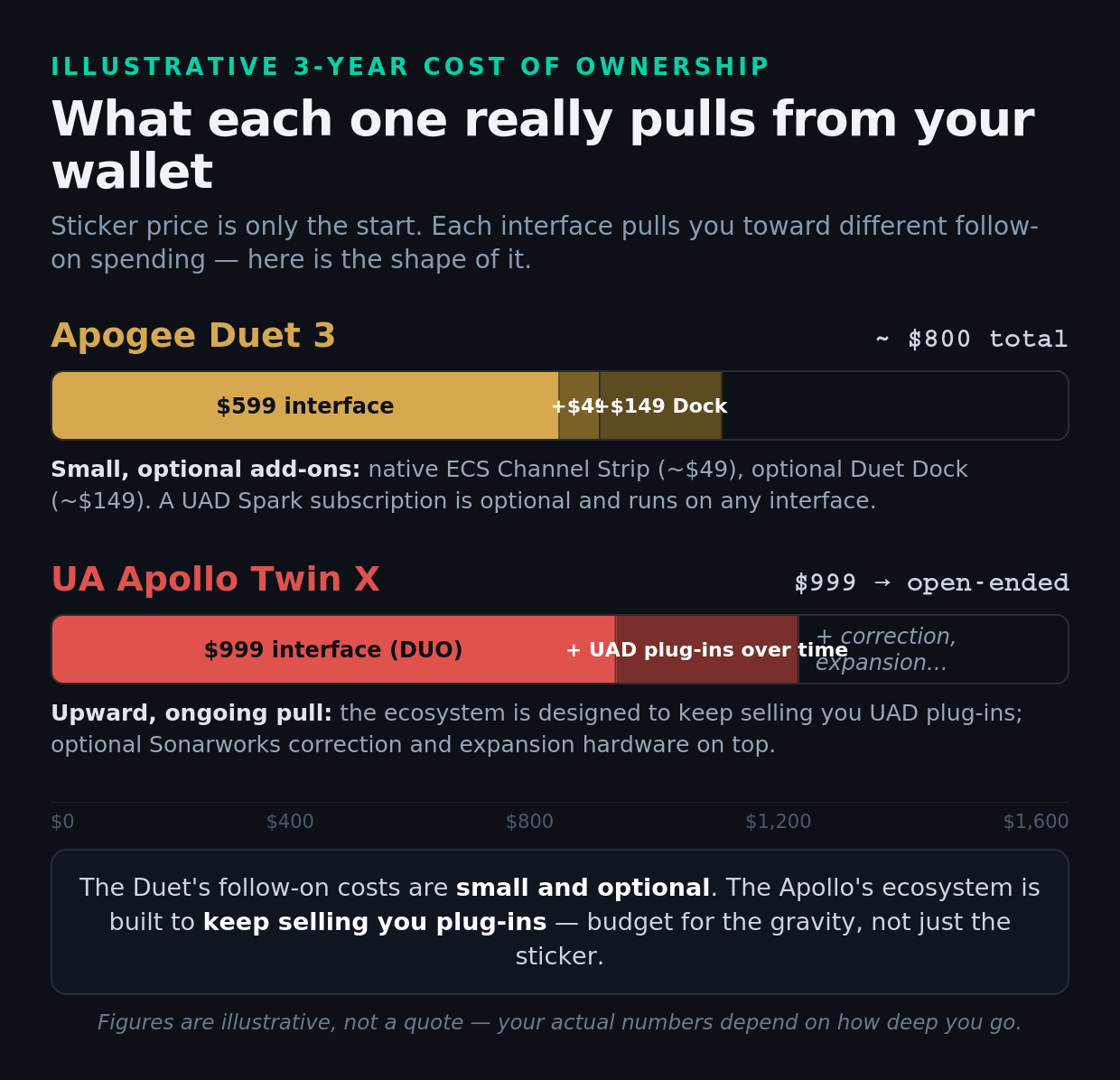
One more honest point on value: the cheapest way into UA-style emulations in 2026 is no longer an Apollo at all — it is a UAD Spark subscription on whatever interface you already own, including a Duet 3. That reframes the money question entirely. You are not paying the Apollo premium to access UA plug-ins anymore; you are paying it for Unison realtime tracking and the bigger I/O. If those two things matter to your work, the premium is justified and the Apollo is a genuine value at $999. If they do not, the Duet 3 plus a Spark subscription gets you most of the sound for hundreds of dollars less, and that is simply the better-value path for a mix-in-the-box producer.
Spec Sheet, Side by Side
| Spec | Apogee Duet 3 | UA Apollo Twin X (Gen 2) |
|---|---|---|
| I/O | 2-in / 4-out | 10-in / 6-out (+ optical ADAT/SPDIF) |
| Connection | USB-C (Mac/Win/iOS) | Thunderbolt 3 (USB-3 variant for Windows) |
| Power | Bus-powered | External PSU (not bus-powered) |
| Preamps | 2× ASGA (clean, no modeling) | 2× Unison (realtime preamp modeling) |
| Converters / dynamic range | Apogee AD/DA pedigree, 24-bit/192kHz | ~129 dB DR, −120 dB THD+N, 24-bit/192kHz |
| Onboard DSP | Runs only the ECS Channel Strip | DUO/QUAD UAD-2 SHARC; full realtime UAD |
| Bundled software | Control 2 + ECS Channel Strip (DSP) | UAD starter bundle + UAD Console |
| Ecosystem / DAW | Bring your own plug-ins | Full UAD library + LUNA DAW |
| Native UAD note | Run UAD Spark natively (any interface) | Native + onboard DSP; some DSP-exclusive titles |
| Portability | Breakout cable + travel case; grab-and-go | Desktop unit; needs power |
| Street price | $599 | $999 (DUO) / $1,299 (QUAD) |
Specs and prices verified June 23, 2026 against the Apogee and Universal Audio product pages, Sweetwater listings and 2026 reviews. Prices are USD; sale, loyalty and bundle pricing vary — confirm at the vendor before purchase. Duet 3 mic-gain range is quoted as 0–65 dB by Apogee and 0–60 dB on Sweetwater's current page.
Who Should Buy Which
Buy the Apogee Duet 3 if you record one or two sources at a time, value portability and a clean, get-out-of-the-way workflow, and want to keep $400 in your pocket. It is the right call for singer-songwriters, podcasters, mobile producers, and anyone who mixes in the box and treats the interface as a pristine converter rather than the centre of a hardware-emulation workflow. Pair it with a UAD Spark subscription and you even get the UA plug-in sound, on a smaller, cheaper, more portable box. The Duet asks nothing of you and travels anywhere — for the buyer it fits, that is exactly the point.
Buy the UA Apollo Twin X if you track live sources regularly and want to monitor and print through modeled Neve, API or Manley preamps in real time, if you need more than two inputs now or expect to, and if you want to commit to the UA/LUNA ecosystem as the home of your sound. It is the right call for producers building records around realtime tracking, for project studios that need to grow, and for anyone for whom Unison and onboard DSP are workflow essentials rather than novelties. Go in knowing you are buying into an ecosystem with real gravity, and that the premium over the Duet now pays for tracking capability and I/O, not for access to plug-ins you can get natively. For the budget end of the same decision, the UA Volt 276 and Volt 1 bring some UA character at a fraction of the price, and the full case for each unit lives in our Apogee Duet 3 review and Apollo Twin review.
And if your budget genuinely allows for either, do not over-think the overall score. These two interfaces are built for different lives, not different tiers of the same life. The Duet 3 is the better tool for the producer who values portability and simplicity above all; the Apollo Twin X is the better tool for the producer who tracks through hardware emulations and wants room to grow. Decide which of those two people you are on the days you actually record — not the days you imagine recording — and the right interface stops being a close call and becomes obvious. The deeper foundations behind every claim here live in our explainers on latency, dynamic range and the signal chain.
Practical Exercises
The fastest way to feel which interface is yours is to put each decision to a concrete test. Work through these three graded exercises — even just with the demos, the spec sheets and your own honest workflow audit — and the choice stops being abstract.
- Over your last ten sessions, count how many times you recorded more than two sources at once. If the answer is rarely or never, the Apollo's 10×6 I/O is capability you will pay for and not use.
- Now count how often you moved your setup — to another room, a friend's place, the road. Each move is a point in the bus-powered, travel-cased Duet 3's favour.
- Write down which mattered more: the inputs you didn't have, or the portability you did. That honest tally is most of your answer before you compare a single spec.
- Start a free UAD Spark trial and install a couple of native UADx plug-ins on whatever interface you currently own. Confirm for yourself that they run, sound right, and need no UA hardware.
- Now record a vocal and try to monitor through one of those plug-ins at your normal buffer size. Note the latency, then drop the buffer until monitoring feels real-time, and watch your CPU meter climb.
- That CPU climb is exactly the problem the Apollo's onboard DSP solves. If you felt it, the Apollo's DSP has real value for you; if monitoring through processing never comes up in your work, it does not.
- For the Duet 3 path, total the $599 interface plus only the add-ons you would realistically buy — the native ECS strip, maybe the Dock, maybe a Spark subscription — and hold it as your floor.
- For the Apollo path, start at $999 (or $1,299 for the QUAD) and honestly project the UAD plug-ins you would accumulate over three years, plus any expansion you'd be tempted into.
- Compare the two totals against the capability each unlocks for your work. The exercise's point is to price the ecosystem gravity, not just the sticker — and to decide whether the Apollo's pull is a feature or a trap for the way you spend.